Showing posts with label John Tomins. Show all posts

Saturday, October 24, 2020

A Visit to SpruceHaven with John and Michelle

      Covid-19 has made changes to the lives of most of us, few of which are welcome, and one of the consequences of the pandemic is the lack of contact with friends. We had  not seen John and Michelle since before the inception of the virus so it was with great pleasure that we were able to meet up for a tour of SpruceHaven in order to show them the modifications to the landscape since their last visit.


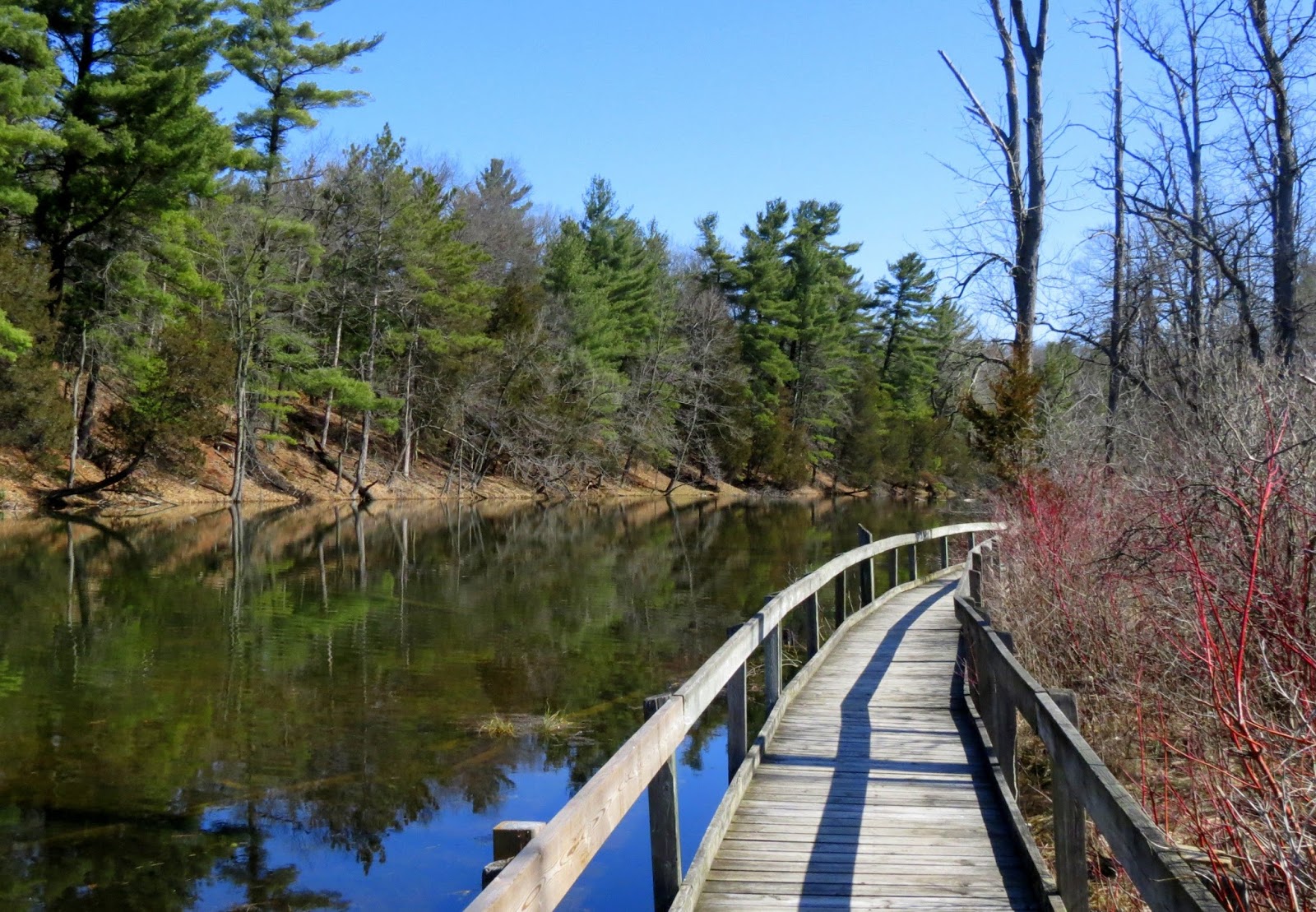
     How pleasant to stroll down one of the many pathways.


     And on into the woodlot where the true glory of fall is showcased at its best.


     The ladder you see at the bottom left of the above picture is used to access the various nest boxes we have installed throughout the woodlot.
     This upscale residence, complete with a complimentary layer of wood shavings, has been home to an Eastern Screech Owl (Megascops asio) for the past two winter.


     Is there any doubt that the owl is inhabiting prime real estate?


     Michelle took this great shot of an Eastern Red-backed Salamander ( Plethodon cinereus), still easily found beneath rotting logs, or under the boards we have placed for them, but soon they will be seeking shelter deep in the soil as the iron grip of winter descends upon their woodland home.


     There are several colour morphs of this familiar lungless salamander, the two most common in our area being the redback shown above;  leadback coming in a close second.
     I am woefully inadequate when it comes to identifying ferns, but there are a few species which present no great difficulty, such as Intermediate Wood Fern (Dryopteris intermedia), one of our more common species in a maple/beech woodland.


     Herb-Robert (Geranium robertianum) has but recently ceased blooming, but the leaves remain an agreeable feature to enjoy on a bright autumn day.


      The grassland we are restoring, appropriately named Sanctuary Field is coming along splendidly.


     If I am not mistaken these berries are Highbush Cranberry (Viburnum opulus), not a true cranberry, but winter forage for a number of species. 


     Giant haybales in the field across the road from SpruceHaven reminded us that fall is a busy time for the  farmer too.


     Hardy little Myrtle Warblers (Setophaga coronata) are always the last of the warblers to leave Ontario in the fall, and many were fattening up in preparation for their departure.


     White-crowned Sparrows (Zonotrichia leucophrys) were no less concerned with bulking up for their journey south.


      Switchgrass (Panicum virgatum) is a deep-rooted, hardy grass that will form the backbone of our prairie ecosystem. It can attain a height of around 250 cm.


     Chipping Sparrows (Spizella passerina) were finding an abundance of food as the grassland delivered its bounty of seeds.


     Michelle was intently focussed on something that had caught her eye.


     Those tussocks of grass all around her look like ideal nesting places for Eastern Meadowlark (Sturnella magna) and we have high hopes that this species will discover the Sanctuary Field next year.
     The seeds of Tickseed (Coreopsis sp.) are highly favoured by American Goldfinches (Spinus tristis) and other seed-eating birds.


     Black-eyed Susan (Rudbeckia hirta) is past its prime but has been a colourful and prolific component of our emerging prairie landscape.


     There is a low-lying area adjacent to the grassland we call The Swale, always wet in spring, that is now being modified into a proper wetland, where we hope to see various species of duck during migration, and perhaps induce Wood Ducks (Aix sponsa) to breed there. Shorebirds may also favour us with their presence once the restoration is completed and provides attractive habitat for them.
     Work had just begun.
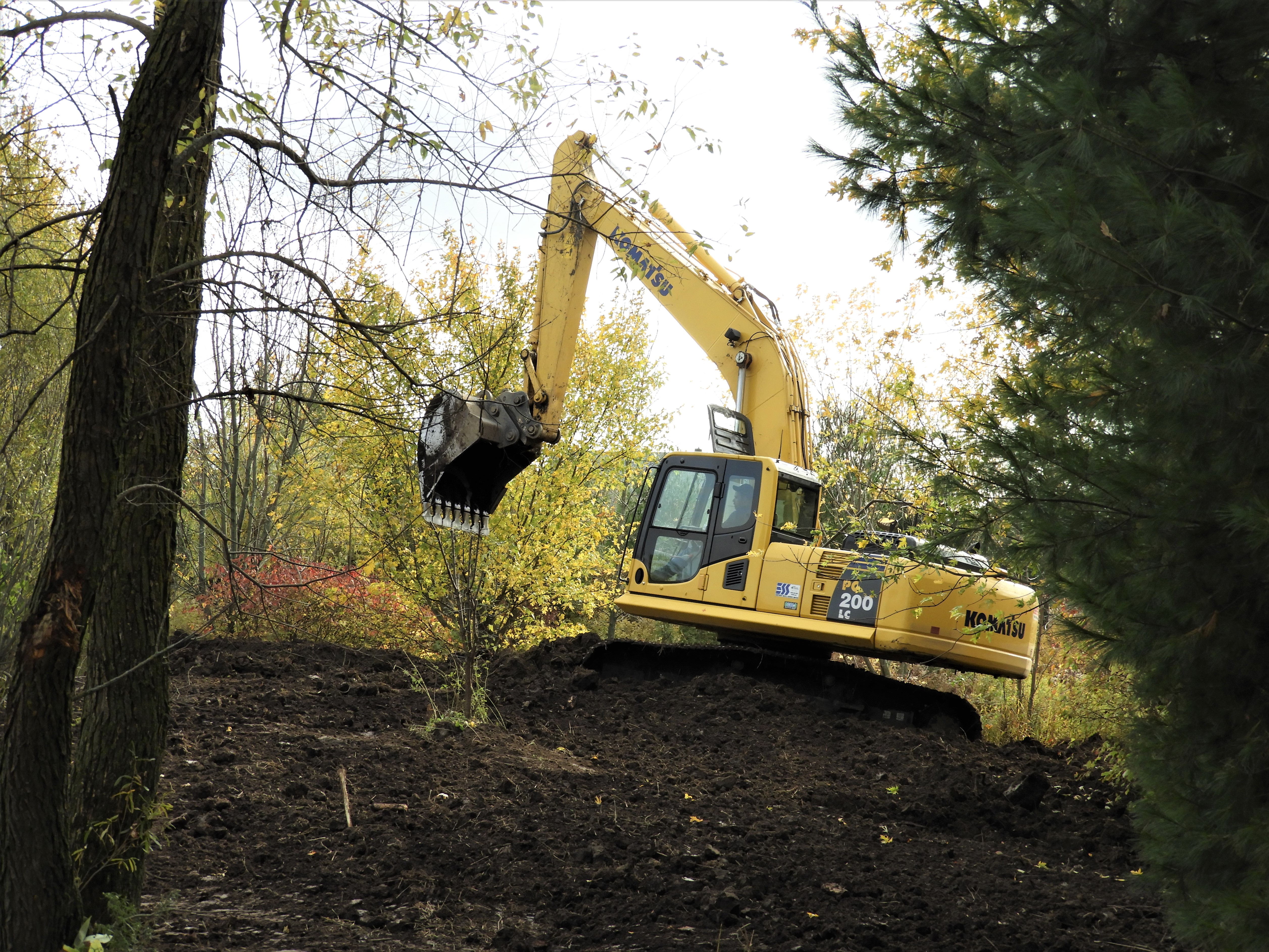


     When I returned two days later, the whole area had been modified and I was excited to contemplate the species we may see there next spring. 


     Run-off from surrounding higher ground should quickly fill this depression, creating a pond rimmed with vegetation.


     The magic of it all causes me to pinch myself every day. 
     It was a pleasure and an honour to be able to share it with Michelle and John.
     I will end this post with something completely unrelated. 
     Recently I led a walk for a group of young children from an alternative school and two of their teachers who wanted to have their students exposed to outdoor education. It proved to be a wonderful adventure for all concerned and at the end of the walk the kids presented me with cards they had made from leaves they had collected and pressed. 


     Of all the things I do, the education of young people is the most significant. For that I need no thanks; to watch them learn is thanks enough. 
     But to see the effort, and the thought, they put into these items was heart-warming indeed.


     Thanks to Katherine and Kayli, two fine, dedicated young women, exceptional teachers, and to a group of children who made my day special.
     It really doesn't get any better than this.


Sunday, April 24, 2016

Pinery Provincial Park, Lambton Shores, ON

      A couple of weeks ago our friends John and Michelle Tomins, fellow members of Waterloo Region Nature, asked us if we would like to join them for a day's outing to Pinery Provincial Park, on the shore of Lake Huron. Happily, we had nothing else on that day and were delighted to go along. 
    Pinery Provincial Park has been a favourite destination for John and Michelle for many years, so we were able to benefit from their intimate knowledge of the area.
     We enjoyed it so much that we returned yesterday with John and Geraldine Sanderson who, you will no doubt recall, were our companions on our recent trip to Cuba.
     This park is surely a gem in the extensive parks network maintained by the Province of Ontario. It features extensive oak savannah, parabolic dunes exhibiting an entire range of beach dune ecology, and Carolinian forest species such as Tuliptree Liriodendron tulipifera and Sassafras Sassafras albidum, trees which reach their northern limit in southern Ontario.


Tulip Tree
     The Ausable River meanders gently through the park and the aptly named Riverside Trail permits a leisurely stroll along its banks where the flora and fauna is both varied and magnificent.


     We were looking out across the river to the opposite bank when two Sandhill Cranes Grus canadensis flew in and landed on the shore. What a delight!


     This Greater Scaup Aythya marila was a bit of a surprise. Generally I associate this species with much larger bodies of water.


     Midland Painted Turtles Chrysemys picta marginata seldom miss an opportunity to bask in the sunshine, an activity so important to a cold-blooded creature in terms of regulating its body temperature.


     Along the trail, right next to the boardwalk, we saw an American Woodcock Scolopax minor feeding and moving around. We were able to observe the bird for several minutes but it was always partly obscured by vegetation and photography was well nigh impossible. The following image is included simply to record its presence. If you look carefully you can see it in the centre of the picture.


     One of the signature species of Pinery Provincial Park is Tufted Titmouse Baeolophus bicolor, a species rarely encountered in southern Ontario, but the park supports a resident breeding population and the bird is easily found.


      John and Michelle were enjoying the stroll around the Riverside Trail; Michelle is intently looking at something.


     Perhaps it is this male Northern Cardinal Cardinalis cardinalis.


     In addition to the numerous trails in the park, each one featuring different habitats and ecological characteristics, it runs along the shore of Lake Huron where there is access to a beach (depending on water levels) and the opportunity to see gulls, terns, cormorants etc. out on the lake.


     It was ironic that when we stopped for lunch, on both visits, we saw our first Hermit Thrushes Catharus guttatus, always the first Catharus thrush to return from the its southern winter quarters.


     There are many bird feeders at the visitor centre (well worth a visit) and this Field Sparrow Spizella pusilla enabled us to take a fairly decent photograph. 


     Eastern Towhee Pipilo erythrophthalmus was equally co-operative beneath the feeders.


     This little American Red Squirrel Tamiasciurus hudsonicus was not about to be outdone as he shimmied up a tree on the way to the bird feeders suspended there.


          A little more ingenious was an American Black Squirrel Sciurus carolinensis that had wedged itself right into a small feeder where it could feed undisturbed, its tail forming a kind of parasol above its head in the tight quarters of its larder.


     White-throated Sparrows Zonotrichia albicollis were frequently seen and heard. This is one of John Sanderson's favourite birds and its song, the voice of Canadian wild places for him, thrilled us all - Sweet Canada, Canada, Canada indeed.


     Another wonderful species, a hardy and early spring migrant, is Eastern Phoebe Sayornis phoebe, always the first of the family known as Tyrant Flycatchers, to return to southern Ontario. Often it arrives to face a final blast of snow before winter gives way to spring, but it hangs on and lives to raise a brood of youngsters when the full flush of insect abundance enables it to do so. It is a confiding little bird, often building its nest in close proximity to human dwellings. Here it is shown on a perch over the river, from which it sallies forth to snag passing insect prey.


     Red Pine Pinus resinosa is familiar to most as the pine of plantations where they grow in orderly rows, harvested on rotation, to be used as utility poles. In the Pinery they grow wild and attain great height. Here is the detail of the bark showing how the tree got its English name. 


     Ontario now has a robust population of Bald Eagles Haliaeetus leucocephalus
and we were pleased to discover a breeding pair at the nest. The picture is taken from a distance; imperative in order not to disturb the birds.


     Both adults can be clearly seen, however, and this adult bird was seen flying overhead.


     In addition we also saw first and second year sub adult birds so the recovery of this species continues apace. In a stroke of bitter irony, this species is the national symbol of the United States, yet over most of the continent for decades a bounty was paid for its destruction and it was totally extirpated in most of the lower forty-eight states, its only stronghold being Alaska. I could never figure how you could hunt your national bird to extinction.
     As you might expect, there are many turtles in the park and there was a good deal of carnage each year as they left the security of the water to find suitable areas to lay their eggs. Cautionary signs (you'd think I could photograph a stationary object and get it centred wouldn't you?) alerted motorists, in the hope that they would reduce speed and watch for these slow moving creatures, perhaps even give them a helping hand to cross the road.


     Now a much better solution has been found. Barriers are constructed to prevent the turtles from getting onto the road.


     Implacably, the turtles trundle along until they come to a safe crossing where they can cross to the other side without danger of being crushed.


     Many of their eggs will still be lost to marauding Raccoons Procyon lotor and Striped Skunks Mephitis mephitis but overall their numbers should increase, and when the turtles were needlessly slaughtered on the road, neither turtle nor predator benefitted. It's amazing how, with a little ingenuity, simple solutions can be found to problems affecting wildlife.
     Miriam took a picture of John, Geraldine and me on our final walk along the Carolinian Trail. I think you can tell that we all had enjoyed a fine day.


Geraldine, John, David

     I bought an annual pass to the provincial parks and I am looking forward to getting good use out of it as we make it our mission to visit many others this year. And you can bet that we will return to Pinery often.

Land Acknowledgement

We acknowledge that the land on which we are situated are the lands traditionally used by the Haudenosaunee, Anishinaabe, and Neutral People. We also acknowledge the enduring presence and deep traditional knowledge, laws, and philosophies of the Indigenous Peoples with whom we share this land today. We are all treaty people with a responsibility to honour all our relations.

Followers