Showing posts with label Geraldine Sanderson. Show all posts

Sunday, July 29, 2018

West Perth Wetland, Mitchell, ON

28 July 2018

     Our good friend John Sanderson recently had hip replacement surgery and is recovering nicely. In order to give his hip a test drive, so to speak, we accompanied him and Geraldine to one of their favourite birding areas. John did well and his mobility has improved immeasurably since before the surgery. He didn't want to push it too much, however, so went back to the car to rest while we carried on with our birding.
     When shorebirds are migrating West Perth Wetland is a magnet for a number of species. Adult peeps (mostly Least (Calidris minutilla) and Semipalmated Sandpipers (Calidris pusilla) were present - and they were too far out to identify other species if there were any - with hatch year birds to follow soon.


      In addition to the birds there was an abundance of Grove Snails (Cepaea nemoralis) and much as we tried to avoid stepping on them it was at times impossible, and whenever we heard a crunch underneath our feet we knew another had met its demise.


     Of ducks we saw many Mallards (Anas platyrynchos) but a lone female Wood Duck (Aix sponsa) joined the parade too.


     Both of these species breed at Mitchell and it will be another couple of months before the migratory ducks from the north begin to arrive.  
     Lesser Yellowlegs (Tringa flavipes) was far and away the most common shorebird, as it generally is at this time of the year. It may be familiar but it is a handsome bird indeed and merits a full measure of our appreciation.


     We probably saw several Savannah Sparrows (Passerculus sandwichensis) but they never stayed put long enough for us to be sure. There is no doubt about this one, however.


     A Caspian Tern (Hydroprogne caspia) and a couple of Ring-billed Gulls (Larus delawarensis) seemed content to loaf around watching the sandpipers frantically gathering food.


     West Perth Wetland can deliver some lovely surprises from time to time (the first time we ever went there a Red Knot (Calidris canutus) in breeding plumage) and today we were treated to the wonderful sight of several splendidly attired Short-billed Dowitchers (Limnodromus griseus) feeding away with their signature stitching motion.


     One might have wished for them to be a little closer, but we had great looks through the scope. It just wasn't as good as it might have been for photographs. Actually had Franc been with us, with his equipment, he would have had some wonderful captures.
     Semipalmated Sandpipers fed a little closer to shore.


     Least Sandpiper too.


     As much of a delight as the dowitchers was a Stilt Sandpiper (Calidris himantopus) still retaining vestiges of its breeding plumage. This is a bird that can be found each year, but not without some diligent searching.


     On the way back to the car a group of Eastern Kingbirds (Tyrannus tyrannus) let us know that they had a successful breeding season.


    When we shared our sightings with John he was delighted at our success. Next time we go to the wetland I have no doubt that he will be able to join us for more of the circuit and he too will have the kind of sensory top up we had.

     And now, if I may, let me address something totally unrelated, a topic that has been much on my mind of late. It is the use (misuse is more appropriate) of single use plastics. The sheer complacency of people now that I have been deliberately taking note is staggering. We seem to be hardly making a dent into this problem and we continue to flood both the earth and the oceans with this nearly indestructible detritus.
     It has to become an individual responsibility to reduce and ultimately eliminate it. 
     I am reminded that many years ago, when companies sent their management people to motivational seminars, I attended such an event in Calgary, AB where Ziz Ziglar was the featured proselytizer. Most of what he evangelized about was utter nonsense it seemed to me, but I do remember one point that left its mark. It was the concept of always measuring the inevitable secondary result of any action you take. He illustrated the point like this. He asked everyone in the audience to raise their hand if they had a piece of the pie served for dessert the previous night. There was a great show of hands. He then asked how many people were ten pounds or more overweight, and there was another great show of hands. He then said, "Well, when you made the choice to have the pie you made the choice to be overweight." One logically follows on the other. And so, when you continue to use single use plastic you are making a conscious decision to pollute the environment.
    So stop doing it. It is probably impossible to achieve 100% success but you can come close to it.  Let me give you one simple illustration of how great strides can be made easily. The other day I went to the store to buy red and green peppers, apples, bananas, green onions,  and a red onion. I took a cloth bag that Miriam made and put everything in that bag. Some shoppers put each item in its own plastic bag - the red pepper in its bag, the green pepper in its bag...and so on. That represents six plastic bags and then they go to the checkout and pay 5 cents for a plastic shopping bag to carry off the six other plastic bags. It boggles the mind. But this behaviour is repeated over and over again. When water in plastic bottles is on sale at the store shoppers leave with cart loads full. I see consumers pick up meat which is already on a styrofoam tray enveloped in plastic wrap, then place it in another plastic bag.
     Instead of buying individual little plastic containers of yogurt why not buy a big tub and use your own containers? Tell restaurants that use plastic straws that you will no longer take your business there if they continue to do so. Find coffee shops that will fill your own cup. 
     I shop at Costco and they are always shoveling food samples at everyone, served in little plastic containers with a plastic utensil provided, all of which are immediately thrown away. I cannot buy produce there. If I want to buy tomatoes, for example, they are prepackaged in a plastic box. Grapes are also in a plastic box, apples are in a plastic box or bag...and so on.
     The airlines have to start to address this problem and as consumers we can be influential. Think of the amount of disposable items used on every plane throughout the world every day. Our politicians need to change their habits. Each time a cabinet meeting is shown on television there is a plastic bottle of water at every chair. Do you all remember Trump's clumsy efforts to drink from a plastic bottle at the podium? Why couldn't that be replaced with pitchers of water and glasses?
     I could go on, but I am sure the point is made. There are countless ways you can stop using single use plastic and if we all do it there will be a very significant reduction. I hope the day will soon come when drinking from a plastic bottle will be as uncouth as spitting in a spittoon. Remember, that was once socially acceptable too.


Saturday, January 14, 2017

Snowy Owls (Harfangs des neiges) and Serviette Rings

13 January 2017

     John and Geraldine's daughter, Leigh, is visiting from Brazil, and wanted nothing so much as to see a Snowy Owl Bubo scandiacus. Miriam and I had great success earlier in finding them, and offered to accompany John, Geraldine and Leigh, to areas north and west of Linwood where we expected they would be. 
     At 09:00 we set off, John driving, to see what we could find.
     The vehicle was filled with convivial chatter, not the least of which was the admonition from Geraldine to John, to drive at "birding speed." Given John's training and experience as an aircraft engine designer, one would have thought at times that supersonic was on his mind! We managed to meander gently, however, seeing various species along the route, ever vigilant for our quarry.
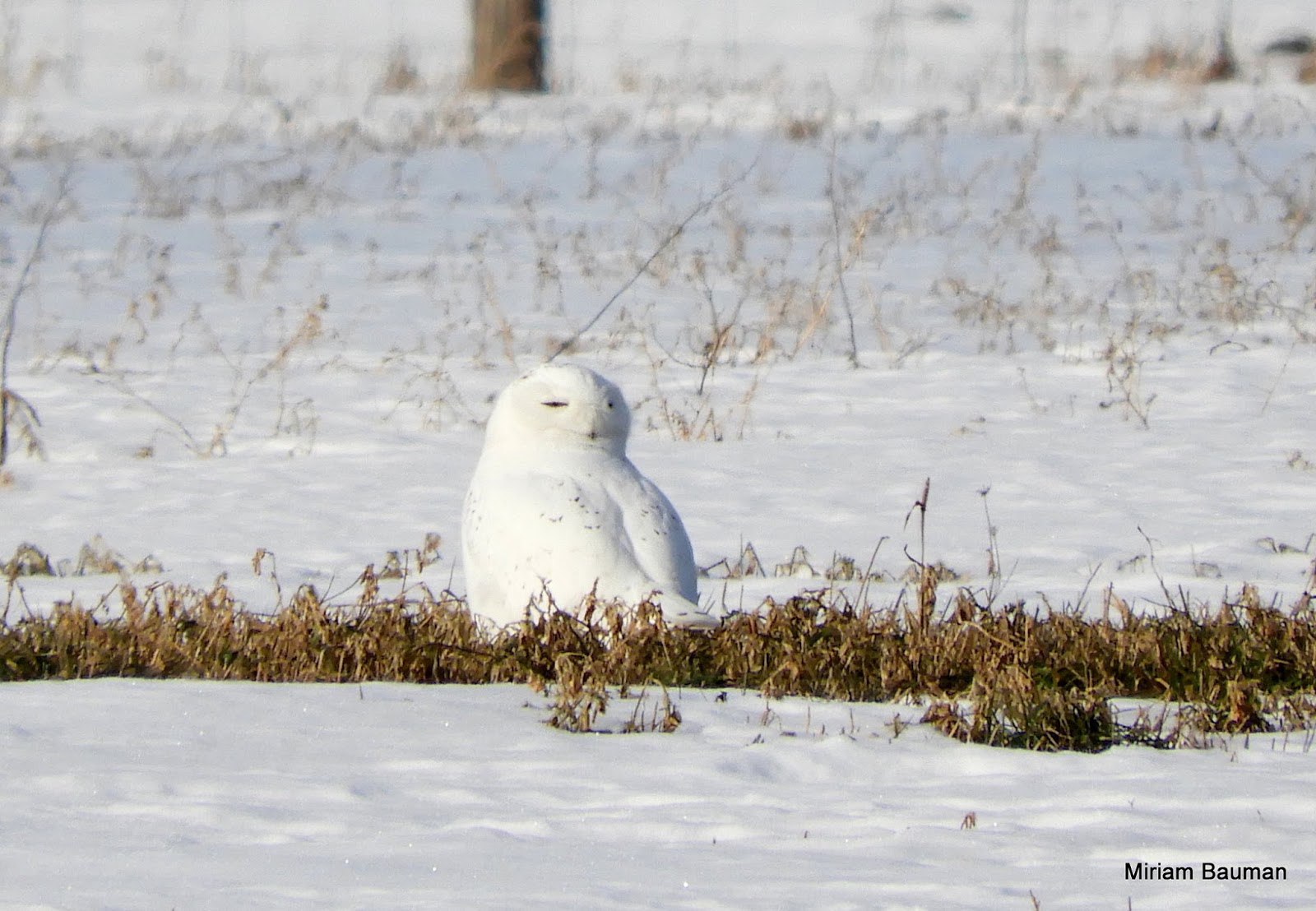
     Miriam spotted the first owl, resting in a field of corn stubble. Initially we thought it was a male, but upon close examination we concluded that it was a female, or perhaps a juvenile.


    This sighting signalled the start of what would be a Snowy Owl bonanza. Before we had finished we had tallied no less than five of them, a record for all of us. For Miriam and me, our previous record of four Snowy Owls in one day fell! Perhaps most pleasing of all was the fact that Leigh spotted her own owl, yelling to her father "STOP" and by this time John had become so compliant he was not driving at warp speed and was able to do so! It's a marvel to share in a view of a Snowy Owl, but to locate one yourself is the icing on the cake.


     Not only did Leigh spot owls like an old pro, she had her mom who was seated at the back of the van pass her the camera and she obtained some very creditable shots, braving the cold as she opened her window to get a clear view.
     Bravo, Leigh!
     Our final two birds were quite distant and the following shot is included just to show them so close together. Obviously any semblance of territoriality is suspended as they seek to make a living in their southern winter quarters.


     Upon arrival back at John and Geraldine's house we were invited in for lunch, (it took us at least five seconds to accept) and went into the home. John immediately poured us a glass of wine and we sat, and sipped, and chatted, while Geraldine prepared a delicious turkey soup and a green salad with dried cranberries. There was bread on the table, crackers, three kinds of cheese - a feast! We then had coffee and a wonderful version of the traditional Italian pannetone modified to accommodate Brazilian taste, with the addition of dulce de leche, a sweet treat with which we were familiar from our travels in Central and South America. "Would you have another slice, David?" said Leigh. "Don't mind if I do," said I!
     
John

Geraldine
     It was while at the table that we got engaged in a discussion about the incredible serviette rings John makes, of which we are privileged to have been the recipient of six. Here are just a few examples.


     The term "spalted" refers to the presence of a fungal infection in the wood, creating dark lines and striations, giving the wood added character. Spalted wood is highly sought after by woodworkers for the added beauty it conveys to a finished creation.


     It is interesting that one can determine the age of the ring by looking at the inscription. In the early days only the type of wood was recorded, but as the years went by Geraldine added the location and date.
     John starts with a 10 cm diameter limb about 30 cm long. Using a band saw he cuts, at a 45° angle, slices (or pancakes) about 2.5 cm thick from the piece of wood. Next, he used a hole saw 5 cm in diameter, and cuts out a holed cylinder from the pancake. Then he uses a 3 cm diameter hole saw and drills out the centre leaving a doughnut. Usually he does six to ten at a time.
     A spindle sander is then used to sand the inside of the ring, and holding the doughnut at various angles he cuts the rounded inside surfaces. A belt sander rounds the outside surface of the ring. When it is visually acceptable he hand finishes the outside of each ring.


     In the early days John used French polish to finish the rings, sanding with fine sandpaper between each coat. Now he uses Minwax fast-drying polyurethane clear gloss and achieves as high a finish as with French polish in less time. After the second coat and hand-sanding between, Geraldine prints the type of wood, its origin and the year of fabrication. After a day of drying a light swipe is applied over the printing, and the ring is put aside to dry. Then, additional coats are added until the final finish is achieved. It takes about two hours to complete a ring, although a precise time is difficult to judge as there is considerable waiting between each stage.


     In my opinion, the finished product is nothing short of a work of art, with each item different from another, with its own character and individual appeal. How lucky we are that John has given us six of them.
     In the picture above, and in those below, you will see a pot that John also made and gave to Miriam. 


     Imagine the work that went into this! These handcrafted products are so much more appealing than factory-made goods, with their mind-numbing similarity. Each product of John's is unique, like no other, even those made from the same section of wood.  Surely the way he is able to capture the grain and flow of the wood in so splendid a fashion speaks volumes to his fine eye for appealing detail.
     Miriam is no less creative with her range of serviettes made from recycled material. Old products find new life and a wonderful burst of creative vision is conferred on a utilitarian product.


     Imagine a summer picnic, al fresco, in a wooded glade, with birds singing, and how it would all be enhanced by these lovely objects.


     All of her recycled line of products can be found here. I take unabashed pride and satisfaction in applauding her creativity and the diversion of material away from the landfill.

Friday, June 17, 2016

A Day at Hullett Marsh, Huron County, ON

     On Monday, 13 June, Miriam and I spent the day at Hullett Marsh along with John and Geraldine Sanderson and Curtiss MacDonald. It was a pleasant day of birding and banter with amenable companions.
     Hullett Marsh is a large area of wetland under the jurisdiction of the Ontario government, and in the fall is well-used by hunters of waterfowl. I wouldn't want to be there at that time with guns popping off all around me; at least the carnage is regulated and supervised. 


     At this time of year, however, Hullett is a great place for birding with varied habitat for many species, including the always impressive Cedar Waxwing Bombycilla cedrorum.


     In addition to a nice variety of bird species dragonflies were abundant and this Black Saddlebags Tramea lacerata even alighted long enough for a picture.


     There was ample evidence of a healthy American Beaver Castor canadensis population and this individual was contentedly munching on aquatic vegetation.


     How this tree manages to remain standing after the beavers didn't quite finish the job is a bit of a mystery!


     There were numerous nest boxes for Wood Ducks Aix sponsa and this female was perched atop one of them.


     The following shots show what a paradise this area is for waterfowl when they are migrating through in the fall, and despite the fact that many fall victim to hunters, the area provides a refuge for others.


     Perhaps the most interesting observation of the day was that of Tree Swallows Tachycineta bicolor nesting in a natural cavity. I have rarely ever seen this; the species is so closely identified with nest boxes now. It certainly was a very pleasing discovery.


        More pictures of this beautiful wetland area:


     On our final stop of the day we were very fortunate to locate Eastern Towhee Pipilo erythrophthalmus, with both male and female vocalizing and displaying in full view.

Eastern Towhee - male

Eastern Towhee - male

Eastern Towhee - female

     On the way home, in what has become a bit of a tradition, Curtiss treated everyone to ice cream - and delicious it was too. What a great way to end an altogether delightful excursion.

Land Acknowledgement

We acknowledge that the land on which we are situated are the lands traditionally used by the Haudenosaunee, Anishinaabe, and Neutral People. We also acknowledge the enduring presence and deep traditional knowledge, laws, and philosophies of the Indigenous Peoples with whom we share this land today. We are all treaty people with a responsibility to honour all our relations.

Followers