Jason, Stephanie, Joel, Tara, Brian, David, Walter
As soon as everyone got to know each other, we set off along the trail, happy to be together on a crisp Ontario morning, anxious to see what we could discover.
It was not long before a male Northern Cardinal (Cardinalis cardinalis) decided to welcome us to his world.
The Mill Race Trail is one of the best places I know where a sighting of White-breasted Nuthatch (Sitta canadensis) is almost a safe bet, and often there are multiple views of this enchanting little bird. Such was the case today.
The other aspect of the trail which birders and non-birders alike, young and old, and in between, find appealing is the fact that Black-capped Chickadees (Poecile atricapillus) have become so accustomed to humans bringing food for them, that the chance to feed from the hand is virtually assured.
I took along seed so that everyone could try it out, and the chickadees were equal opportunity visitors, and without exception everyone experienced the pleasure. None was more thrilled than Walter, who despite his many years and many walks, had never previously had the joy of doing so. In fact the birds seemed to understand this and made up for lost time, alighting on his outstretched hand more than anyone else's. He became The Chickadee Whisperer! We did not manage to capture a bird on his hand but witness the sheer joy on his face as a bird left with its prize of a hulled sunflower seed.
And Brian was sharing the pleasure of the moment too. In fact, it captures the essence of the walk, the time spent together, the enchantment of immersion in nature, and the primal response to intimate association with a wild creature. How could you not be impressed with the resplendent garb of a male Mallard (Anas platyrynchos)?
Downy Woodpecker (Dryobates pubescens) is our smallest woodpecker, and in many respects respects resembles the similar, but larger Hairy Woodpecker (Dryobates villosus).
There are various ways to tell the two birds apart, but for novices it is sometimes difficult.
The surest way to do this when dealing with a male, is that the red crown patch on a Downy Woodpecker is solid, whereas on a Hairy Woodpecker it is broken.
Miriam, to her great credit, upon hearing me explain this marker to the group, captured a picture of a male from the rear, showing the continuous head ornamentation.
Now that's cooperation! Both from the woodpecker and from Miriam! As I mentioned earlier White-breasted Nuthatch is a constant companion too, and Stephanie actually succeeded in having one feed from her hand but the only picture we got was blurred unfortunately.
Brian wasted no opportunity to offer food on his outstretched hand.
We saw a couple of Red-bellied Woodpeckers (Melanerpes carolinus) but none seemed willing to pose close enough for a decent picture.
If you needed to be reminded that fall is a glorious time of year, you had only to look around.
This Japanese Barberry (Family: Berberidaceae) looked exceptionally splendid to me.
Stephanie derived a good deal of enjoyment from feeding the chickadees.
Sheep in an adjacent farmer's field could hardly be classed as wildlife, but were nonetheless pleasant to see for all that.
Perhaps this female Mallard had enjoyed our visit and came to say goodbye.
We had certainly relished our time on the trail. And we'll be back tomorrow to do it all again with a new group of eager naturalists. I can hardly wait!
All bird species noted: Mallard, Belted Kingfisher, Red-bellied Woodpecker, Downy Woodpecker, Blue Jay, American Crow, Black-capped Chickadee, Golden-crowned Kinglet, White-breasted Nuthatch, Common Starling, American Robin, Cedar Waxwing, Dark-eyed Junco, White-crowned Sparrow, Song Sparrow, Red-winged Blackbird, Northern Cardinal. Total: 17.
Monday 26 October 2020
Participants: Lynn Conway, Karen Golets, Beth Hobson, Curtiss MacDonald, Cathi Stewart
Cathi, David, Curtiss, Karen, Lynn, Beth
Even before we entered the trail proper, a male Downy Woodpecker entertained us as it fed on sunflower seed left by some kind human benefactor.
It is a familiar bird, but delightful in every way, permitting close approach, and even taking food from the hand on rare occasions. There is a sense of irony that Miriam recently saw a live shrew in our backyard, and today we saw another one , lured no doubt by the ready availability of bird seed. It would dart out from the hollow centre of this stump and retreat just as quickly.
It was really difficult to get a picture, since it was visible for the briefest of moments and I think there is insufficient detail to even attempt identification.
We left the shrew to its own devices and ambled along a little farther.
A beautiful leaf caught Miriam's attention.
In nature there is beauty all around. Curtiss mentioned how he been being paying attention to the diverse forms of trees recently, remarking to us on the bizarre ways in which some of them grow. As you will have gathered from yesterday's account, to hand feed a chickadee is one of the goals of this walk, and everyone was anxious to give it a try.
Beth seemed to take special delight in doing it, and in truth they were drawn to her hand, forming a steady shuttle waiting for their turn at the table.
For at least one member of the group it was the first time visiting the Mill Race Trail.
As you might imagine, a return visit is in the cards, and Karen too indicated that she intends to escort her grandchildren out there. I know that Lynn walks in this area frequently. There is magic in the air when a chickadee comes to visit!
And there was no less magic when a Golden-crowned Kinglet (Regulus satrapa) paused in its usual frantic flitting among the leaves to permit a picture or two.
For an excellent account of how these tiny waifs survive our harsh and unforgiving winters, I highly recommend Winter World by Bernd Heinrich. Rarely, a particularly confident White-breasted Nuthatch will emulate a chickadee and land on a hand, and Karen was chosen first for this singular honour today.
A chickadee quickly followed to ensure that the nuthatch didn't get all the food!
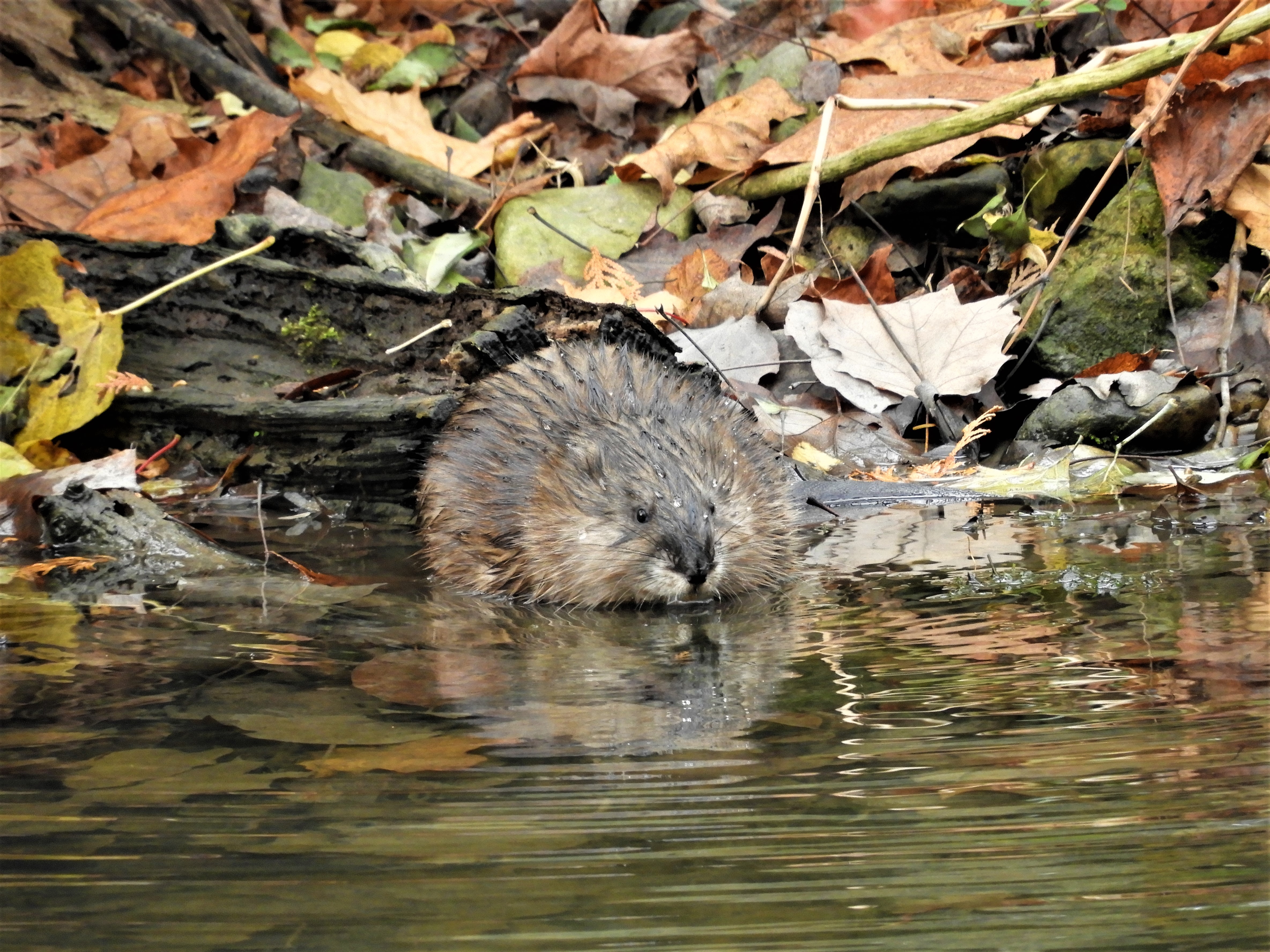
While the walks I lead are principally in quest of birds, we do not neglect any interesting facet of nature, and we were delighted to be able to watch at least three Muskrats (Ondatra zibethicus) going about their preparations for winter, necessitating a few months spent beneath the ice, probably in a cozy beaver lodge in company with American Beavers (Castor canadensis) who readily tolerate these lodgers.
It is a source of comfort to know that these denizens of our waterways are no longer ruthlessly hunted for their pelts.
What is more emblematic of fall than a carpet of leaves?
And may I offer you the scintillating qualities of water droplets - nature's finest jewels without a doubt.
Fungi beggar the casual observer with identification issues; it is to say the least a difficult taxon, but I am confident that this specimen is Hairy Bracket Fungus (Trametes hirsuta), quite common and widespread, fruiting on hardwood logs or stumps.
Cathi indicated a keen interest in knowing more about these fascinating organisms and is seeking to acquire Mushrooms of Ontario and Eastern Canada by George Barron, clearly the best local guide that I know of. The following species remains a mystery, however!
It was located at the base of a hardwood tree and was very large - easily 30cm or more I would say. Dark-eyed Juncos (Junco hyemalis) were found in large numbers industriously searching for food.
Curtiss and Karen had walked ahead, engaged in lively conversation, and discovered that they live in the same building. At times it is indeed a small world.
All bird species noted: Canada Goose, Mallard, Ring-billed Gull, Great Blue Heron, Downy Woodpecker, Blue Jay, American Crow, Black-capped Chickadee, Golden-crowned Kinglet, White-breasted Nuthatch, Common Starling, American Robin, House Sparrow, American Goldfinch, Dark-eyed Junco, White-throated Sparrow, Red-winged Blackbird, Northern Cardinal. Total: 18
Tuesday 27 October 2020
Participants: Betty Cooper. Bill Prociw, Liz Prociw, Mary Ann Vanden Elzen
Liz, Bill, David, Mary Ann, Betty
A friendly Eastern Cottontail (Sylvilagus floridanus) was there to greet us as we entered the trail, to the best of my memory a first-time encounter at this location.
Eastern Chipmunk (Tamias striatus) is far more common, bold and sassy, ever willing to mooch a little food from its human friends.
It is undeniable that it fits any definition of "cute" you care to evoke, and it is a great favourite with all who walk along the Mill Race Trail. A muskrat would probably not elicit the same sentimentality as a chipmunk, but is nonetheless a very pleasing sight for the ardent naturalist.
It was Curtiss yesterday who was keen to draw our attention to trees and their various shapes, sizes and contorted configurations. Today it was Mary Ann who was quick to point them out.
The bank seems to be getting undercut here, and this specimen seems to be in serious danger of being toppled by a strong wind.
Blue Jays (Cyanocitta cristata) were never out of earshot, and rarely out of sight either.
I suspect that the resident population was being joined by a migratory component, which seems to be particularly strong this year.
The old trestle bridge is not used as much as it was in former times when the grist mill in St. Jacobs was operating, but from time to time a train trundles over it.
On this series of walks Red-bellied Woodpecker has been particularly hard to photograph and today that streak was maintained.
American Robins (Turdus migratorius) were very common, feeding on an abundance of berries. In times past every one of them would have been preparing for migration, but in recent years many have remained with us throughout the winter.
And now, let me come to the undisputed star of the show, of this entire series of walks, in fact. My good friend, Betty Cooper, is ninety-three years old, and is still in great shape, and able to undertake a walk of this nature at 6°C, with a round trip length of around 2 km. Furthermore, she is the most interesting and energized conversationalist ever.
What a pleasure it was to have her along. Having checked with her whether she had any objection to having her age revealed on my blog (and receiving her approval), we found a spot for her to sit to pose for a picture.
Mary Ann, ever resourceful, found another great spot, testing it herself first.
Betty moved over for another portrait.
Miriam and I cannot adequately express our feelings of enormous pleasure to have Betty join us. She elevated the walk to a whole other level. And it makes me even more anxious to get this darned pandemic over and done with, so that Betty can once again come and have lunch with us. What a naturalist! What a treasure! What a gem!
All bird species noted: Canada Goose, Mallard, Ring-billed Gull, Red-bellied Woodpecker, Downy Woodpecker, Blue Jay, American Crow, Black-capped Chickadee, Golden-crowned Kinglet, White-breasted Nuthatch, Winter Wren, American Robin, House Sparrow, Dark-eyed Junco, White-crowned Sparrow, Northern Cardinal. Total: 16
Wednesday 28 October 2020
Participants: Carol Anderson, Ross Getsinger, Linda Hartnup, Alan Hills, Victoria Ho, Donna Ivey, Selwyn Tomkun.
Victoria, Selwyn, David, Linda, Alan, Ross, Carol, Donna
It was a glorious sunny day with the temperature getting up to a very pleasant 12 degrees, enjoyable for everyone, though the birds were somewhat sparse.
Nevertheless everyone expressed great enjoyment in an afternoon walk in the company of chickadees - to say nothing of the conviviality of friendships made or cemented, and the sheer joy of human company during the period of COVID restrictions.
Selwyn wasted no time in reaching out his hand, laden with seed.
The rest of the group followed suit in short order.
For some, this was their first "chickadee on the hand" experience. Mallards were seldom far from us, often announcing their presence with their characteristic loud quacks.
This female dazzled us with her beautiful speculum.
Bur Oaks (Quercus macrocarpa) have either shed their leaves or are about to do so as they enter winter dormancy.
Whatever the time of year, Common Dogwood (Cornus florida) is a beautiful addition to any sylvan scene.
It was quiet on the trail, and the birds were either well-hidden or not present, and we made several stops to spend time with the chickadees. Miriam refers to the following as "the Mill Race Pose!"
Numerous Dark-eyed Juncos scrabbled through the leaf litter, turning up seeds and other tasty morsels, delighting everyone with their characteristic white tail flash as they shot up from the ground at the slightest disturbance.
There was not a chickadee on the trail that Ross didn't want to make friends with.
And who could take issue with that?
If I am not mistaken this is the nest of a Paper Wasp (Polistes spp.), but if anyone thinks it is that of a Hornet (Vespula spp.) please let me know.
The Mill Race looked serene bathed in autumn sunlight.
American Robins were seen frequently, both on the ground, and gorging on berries.
I think that Selwyn was emitting a special pheromone today, for not only did he attract many chickadees to his hand, a White-breasted Nuthatch spent serious time with him.
Cedar Waxwings (Bombycilla cedrorum) were feasting on the same berries as the robins, and it looks as though there is an ample crop to see them through the winter.
It was not a walk filled with many bird species but a grand experience nonetheless. It was great to be together, and for Linda and Alan their first outing with Waterloo Region Nature. I hope there will be many more. À la prochaine mes amis!
All bird species noted: Mallard, Ring-billed Gull, Red-bellied Woodpecker, Downy Woodpecker, Blue Jay, American Crow, Black-capped Chickadee, White-breasted Nuthatch, American Robin, Cedar Waxwing, Dark-eyed Junco, White-crowned Sparrow, Northern Cardinal. Total: 13
Thursday 29 October 2020
Participants: Elaine LaRonde, Sandye Moores, Diana Spearn, Min Min Tong
Elaine, Miriam, Sandye, Min Min, Diana
Before setting off on the trail we usually check the Conestogo River from the causeway and were delighted to see a Greater Yellowlegs (Tringa melanoleuca) still present, surely now nearing the end of its fall migration through southern Ontario.
A Belted Kingfisher (Megaceryle alcyon) rattled down the river, but declined to perch anywhere visible, and a Mennonite couple went about their daily business.
We had not been long on the trail when we saw a Mink (Mustela vison) darting along the far bank of the Mill Race, but it was mostly in deep cover, and seldom revealed itself in full view, and then only briefly. Our photograph is not of sterling quality!
As you have already gathered everyone comes prepared to feed the chickadees and our group demonstrated its proficiency in assuming the Mill Race pose!
It did not take long for Elaine to succeed and Min Min recorded the moment.
You will recall the discussion above about the red patch of colour on the heads of male Hairy and Downy Woodpeckers, and having captured the continuous band on the Downy Woodpecker, Miriam was able to illustrate the broken band on a Hairy Woodpecker.
We have paid scant attention to squirrels in these daily accounts, but no walk was without the companionship of Grey Squirrels (Sciurus carolinensis), mainly in their black form found only in the northern part of their range. It is presumed that this colour morph confers some unknown northern adaptation.
Reflection in the water is always interesting, and so close to Halloween, this gnarled and spindly stump seemed to fit the mood.
Wild Teasels (Dipsacus fullonum) have become sentinels in the fields and meadows, and will poke their heads into the wind as the snows of winter descend on us.
They nodded to us as we left to head for home.
All bird species noted: Canada Goose, Mallard, Great Yellowlegs, Mourning Dove, Ring-billed Gull, Belted Kingfisher, Red-bellied Woodpecker, Downy Woodpecker, Hairy Woodpecker, Blue Jay, American Crow, Black-capped Chickadee, Golden-crowned Kinglet, White-breasted Nuthatch, American Robin, Dark-eyed Junco, Northern Cardinal. Total: 17
Mammals seen during the five outings: Shrew sp., Eastern Cottontail, Eastern Chipmunk, Grey Squirrel, American Red Squirrel, Muskrat, Mink, White-tailed Deer
General Comments
The restrictions imposed by the Coronavirus have affected some more than others, but the common complaint voiced by most, concerns the lack of contact with friends and family, surely the most basic and instinctive component of human sociability. These COVID walks, in some small measure, have alleviated some of that stress, providing naturalists with the opportunity to assemble safely with like-minded people to enjoy nature together.
I am very appreciative of all those who have joined me on our outings and I hope we will be doing it again soon. COVID may have us down, but it certainly does not have us out!