Showing posts with label Anne Morgan. Show all posts

Saturday, November 27, 2021

Hillside Park with Waterloo Region Nature

     There are few things I enjoy more in life than leading a bird walk, and when I can do it under the auspices of my favourite naturalists club the pleasure is magnified.
     A group of enthusiastic participants took part in my two latest outings to Hillside Park in Waterloo. In the first contingent the youngest participant was seventeen months old and the oldest a mature eighty-three years. Birding does have its allure!

24 November 2021

Leader: David M. Gascoigne

Members: Miriam Bauman, Lynn Conway, Pauline Copleston, Lisa Den Besten, Beth Hobson, Jen Leat, Graham Macdonald, Marg Macdonald, Karl Malhotra, Geoff Moore, Heather Polan (with Lily), Pauline Richards, Rog Suffling, Kathy Waybrant, Andrew Wesolowski. 

Jen, Kathy, Karl, Lisa, Geoff, Beth, Pauline C, Marg, Rog. Graham, Pauline R, Lynn, Andrew, David

Sunday, August 16, 2020

Marg, Lily and Other Stuff

     In life one has friends and acquaintances, people who pass through with more or less impact, sometimes hardly at all, and then one is fortunate to have to have true, true friends, who can be counted on, who entertain, who delight, to whom one is irresistibly drawn.

     Margaret Lewis-Macdonald is such a person.

     She recently celebrated her eightieth birthday, and such an auspicious event could not be allowed to pass without celebration, even under the dire circumstances imposed by COVID-19. 


     The whole event was organized outside by her stalwart husband, Graham, and went off without a hitch. 

     As you may note, Marg took it all very seriously.

     She had insisted that she wanted no sappy cards and that all greetings should be humorous or naughty! That describes Marg down to a tee!

     As it happened, other friends had birthdays at the same time, so it was a joint celebration for three birthday beauties.

Marg Wendland (80), Marg Macdonald (80), Lynda Buck (75)

     What a pleasure it was to celebrate with these  gorgeous ladies. Good friends, good food, good wine - what more could one ask for?

     Well, you could ask for Lily too!


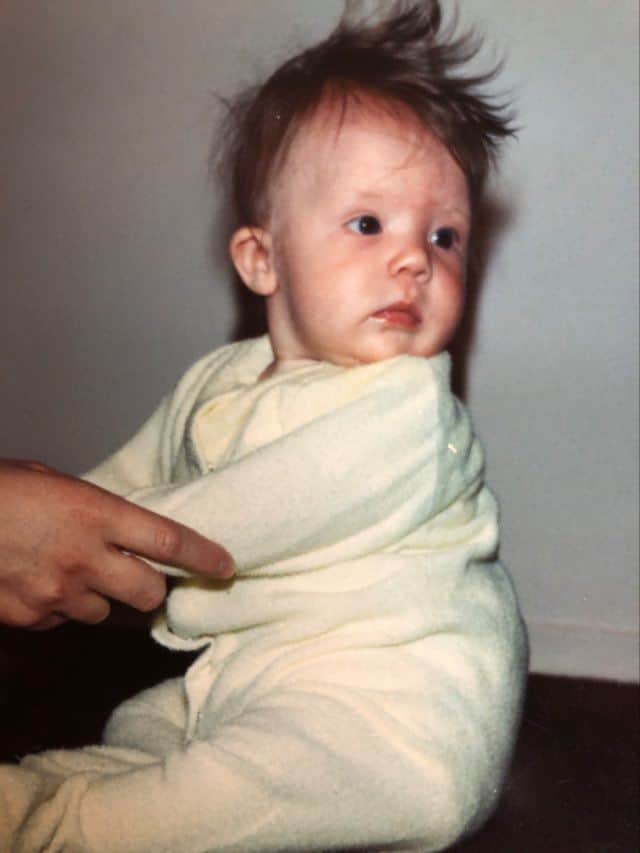
     Before going any further, permit me to show you a couple of pictures of Heather as a baby, and note the stunning resemblance to Lily. It could be the same person! Down to the hair almost!


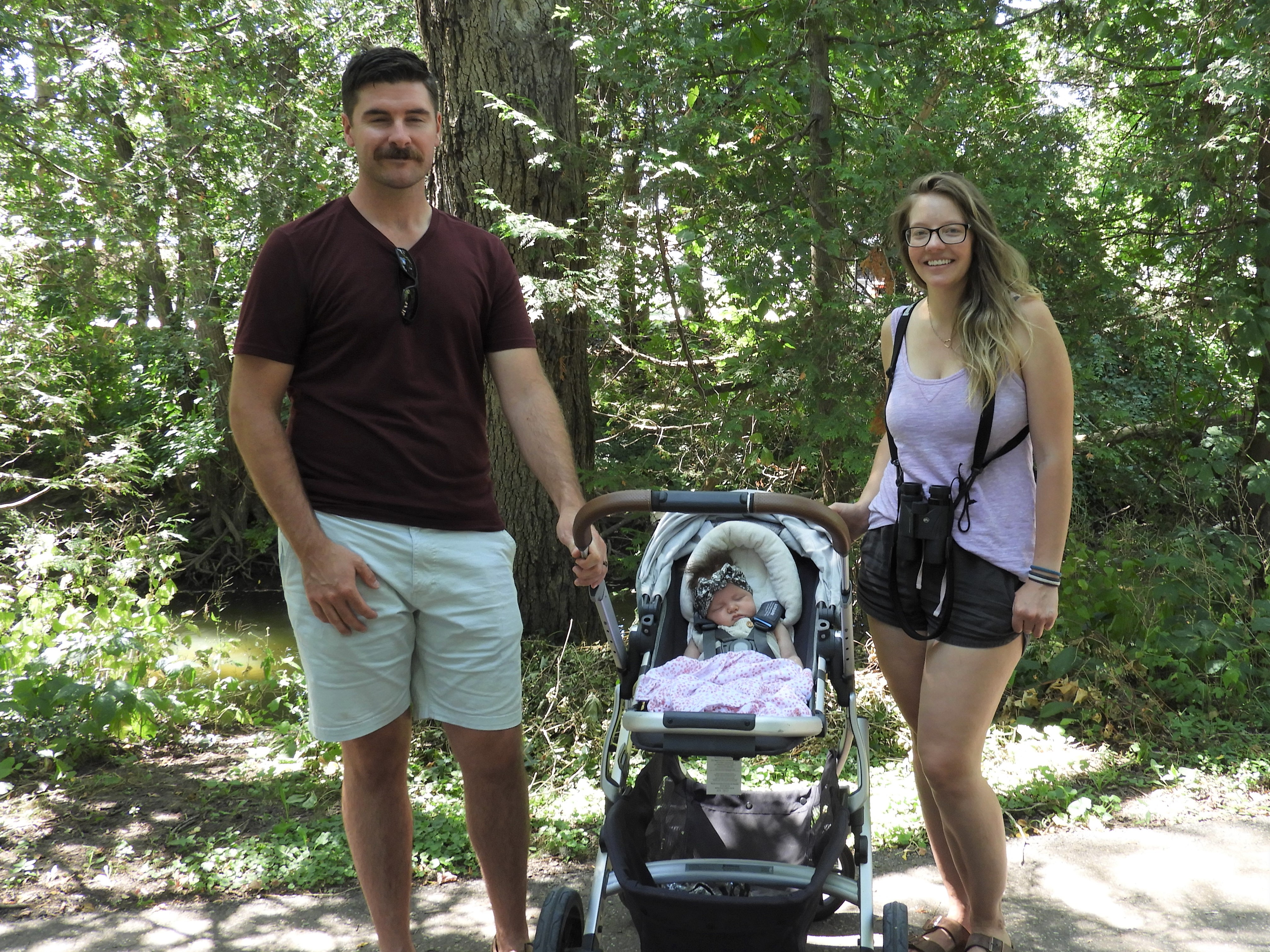
     We were joined on our walk this week by Shane, Lily's daddy, having recently shaved his beard and looking like an erstwhile Tom Selleck! 

     I am utterly convinced that as we continue these nature walks with Lily she will start to absorb the smells, sights and sounds around her, and that her character will be formed in part by these early encounters with nature.

     A girl has to have a sleep now and then.

     So that she can wake up lively and ready to look around.

     And what is life all about if you can't blow bubbles?


     On other fronts, we have a robust population of juvenile Barn Swallows (Hirundo rustica) at SpruceHaven. Many of them are content to perch on a wire and wait for devoted parents to zoom by, stuffing food in their mouths on the way past.

     I mentioned in an earlier post that Northern Flickers (Colaptes auratus) appear to have had a successful breeding season, and this recently independent bird was seen at Forwell Park.


     We pass through a tunnel on our way from Forwell Park to Hillside Park, and it is unfortunate that some of our less enlightened citizens cannot resist defacing the walls with their graffiti. Wouldn't it be wonderful if one of them could, even once, come up with something creative?

      The view above is looking back and I have spared you the pathetic nature of their crude daubing. You will be happy to know, however, that they can spell at least one word correctly, and it has four letters.

     If this American Crow (Corvus brachrynchos) perched high above considered himself superior he was right.

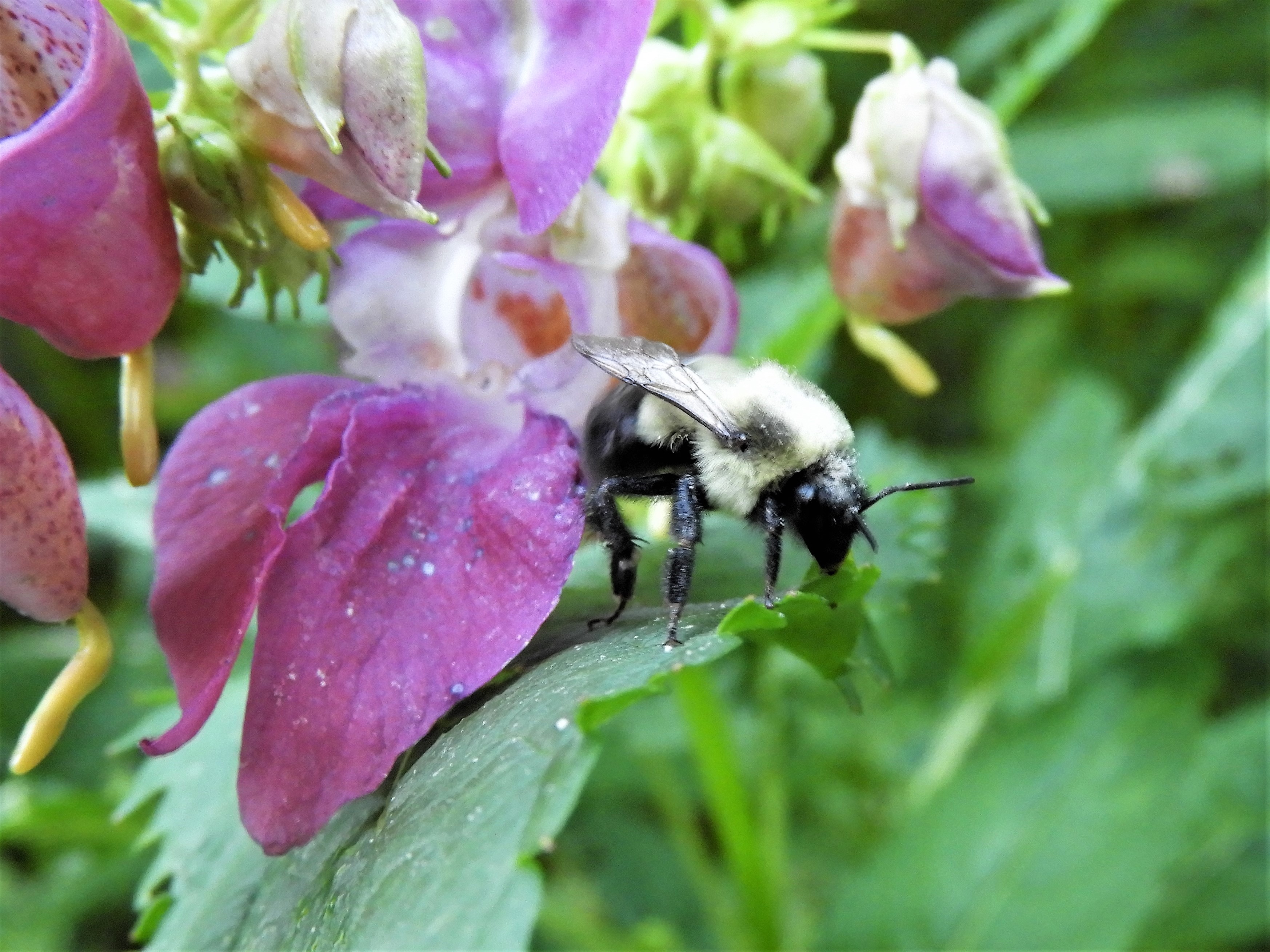
     If I am not mistaken, this insect is a Common Eastern Bumblebee (Bombus impatiens) and it was fascinating to watch as it got right into the corolla of the flower on which it was feeding.

     On a visit to SpruceHaven with the Morgans, Alan took these two wonderful shots.

Green Heron (Butorides virescens)

Clouded Sulphur (Colias philodice) on coneflower

     We had arranged to meet Andrew and Lorraine Wesolowski at RiverSong to tour around and stay for lunch, and just as we arrived a White-tailed Deer (Odocoileus virginianus) ambled slowly across the river.


     It was a wonderful welcome to a beautiful spot.


     Several Midland Painted Turtles (Chrysemys picta marginata) were basking in the warm sun.


     Sometimes you have to make room for a friend.


     Lorraine is an accomplished photographer and managed this superb shot of an Osprey (Pandion haliaeetus) flying along the Conestogo River.


     A Spotted Sandpiper (Actitis macularius) was perched a little out of range for a really good picture, but I think that what Lorraine achieved is delightful.


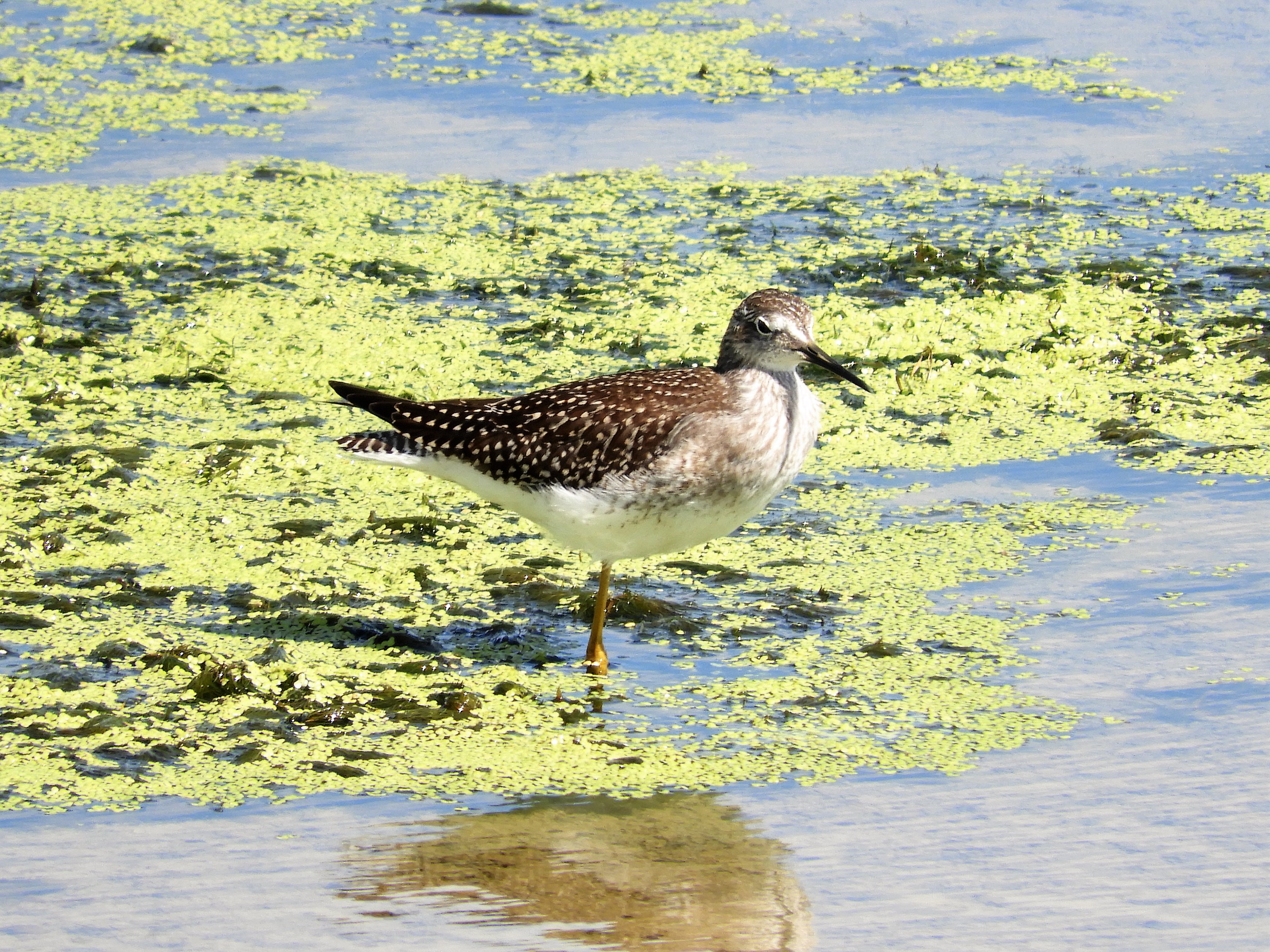
     Miriam and I made our first visit to the sewage ponds at Milverton, where Lesser Yellowlegs (Tringa flavipes) was far and away the most common species.


     For those not  familiar with the esoteric niceties of birding, sewage farms are highly prized habitat for waterfowl, shorebirds, herons, egrets and others, and by default therefore, equally cherished locations for birders. Eau de sewage is a powerful attractant, verging on pheromone for a dedicated birder!
     The highlight of this visit was to locate a Long-billed Dowitcher (Limnodromus scolopaceus), quite rare in these parts.

     Killdeer (Charadrius vociferus) were present, but not in the numbers one would normally expect at this time of the year.

     Many young Red-winged Blackbirds (Agelaius phoeniceus) were enjoying (or not) their first flush of freedom from the nest.

     Eastern Kingbirds (Tyrannus tyrannus) were no less common.

     As you can see, COVID-19 has not really slowed us down one bit!   


Wednesday, July 29, 2020

The Dreaded, Unwelcome Gypsy Moth - It's Here to Stay

     A few days ago we were sitting on the deck at our friends Alan and Anne Morgan's house, gazing at, and admiring Anne's garden which is a phenomenon to behold, sipping wine and talking of all things under the sun.
     At some point our attention was rivetted on a female Gypsy Moth (Lymantria dispar) on an oak tree (Quercus sp) and the conversation quickly changed to this invasive insect, which is present in seemingly apocalyptic numbers this year. I know that memory is selective, but I cannot recall seeing Gypsy Moths in such profusion.
     Having been introduced to North America in 1869 in Boston, it has become a serious pest and is capable of deforesting vast areas of native woodland. Stephen Marshall recounts an incident where he was seated under a tree at a picnic table and was driven away by the pitter-patter of frass (bug poop) falling from the caterpillars on the branches above onto the table and into his coffee!


     Let me try to give you a little more insight into this entirely unwelcome guest.

Hosts: Gypsy Moth caterpillars are especially fond of oak and aspen, but will opportunistically feed on other species as diverse as Hemlock, White Pine and Poison Ivy. The picture below shows females, egg masses, larvae and pupa on a Norway Maple.


Damage: The larvae chew the leaves of their host plants during the spring, and the noise of an army of these creatures can become quite loud. Gypsy Moth is an outbreak species, sometimes persisting for two or three years, during which time trees can be seriously weakened and vulnerable to other pests such as the Two-lined Chestnut Borer (Agrilus bilineatus).

Distribution: Currently found over much of Eastern and Central Canada, the Northern U.S. as far west as Minnesota, and south to the The Carolinas. Isolated infestations have occurred in other regions when eggs have been transferred on plant materials.


Appearance: Larvae are generally mottled grey and have pairs of coloured tubercules. The hairs on the body can be irritating to human skin. Male moths are dark brown with wavy darker markings across the wings. Females are flightless despite having wings that are white with wavy stripes.

Unmated female
Life History and Habits: The eggs overwinter in a mass covered with hairs from the body of the female. Exposure to cold is a requirement for egg development. Eggs usually hatch in April and the young larvae move to the tips of branches where they may be dispersed by the wind (ballooning). Males go through five larval instars, females six, over the course of about six weeks. Feeding occurs at night with the larvae moving to branches and trunks during the day to rest and moult. During serious outbreaks daytime feeding also occurs. 

Caterpillars with chrysalids
     The larvae may settle on plants for pupation but will also wander and settle on rocks, other vegetation, upright surface of buildings or other convenient locations. Adults emerge about two weeks later. The male is a strong flyer but as noted above the female is flightless. 
     After mating, females lay a single egg mass, typically containing 250 eggs. 

Copulation

     The Gypsy Moth is a notoriously variable species and the Siberian Moth (Dendrolimus sibiricus) differs from the European Gypsy Moths in some sinister ways. The females are able to fly and they have a taste for conifers which are the lifeblood of the western forest industry. Not surprisingly the appearance of of the Siberian Moth in British Columbia has caused great consternation and aggressive actions to control or eradicate it.

Photo creditAll of the photographs were taken by Alan Morgan, to whom I owe much gratitude for his permission to use them on my blog.

References

Cranshaw, Whitney and David Shetlar, Garden Insects of North America Second Edition, Princeton University Press ((2018)

Marshall, Stephen A., Insects - Their Natural History and Diversity, Firefly Books (2006)

Milne, Lorus and Margery, National Audubon Guide to Insects and Spiders, Chanticleer Press Inc. (1980)

Stanek, V. J., The Pictorial Encyclopedia of Insects, The Hamlyn Publishing Group Limited (1969)    


Sunday, June 17, 2018

Official Opening of the Green Burial Section at Parkview Cemetery, Waterloo, ON

16 June 2018

     Green burials, in line with the values and principles held by naturalists, are now more frequently available than formerly was the case, in a growing number of communities, and I was delighted when I was asked to be part of the official events on opening day at Parkview Cemetery in Waterloo.
     I was there to talk about Western Ospreys (Pandion haliaetus) since there are two nests clearly visible from the cemetery in nearby Bechtel Park. 


     It seemed to be a natural corollary that people interested in sensible, eco-friendly burial practices would also be curious about these enigmatic birds of prey - and so it turned out to be.
     My good friend, Anne Morgan, was there also to provide the benefit of her expertise on native plants and pollinator insects. This huge nest of a Bald-faced Hornet (Dolichovespula adulterina) was a star attraction.


     A very small part of an insect collection also proved to hold a special fascination, especially for children.


     I should mention at this stage that Miriam had come along with me to act as photographer and I appreciated her help in memorializing the day.
     It is appropriate perhaps to acquaint you with the practice of green burial and all that it entails. If you click on the following images to enlarge them you will be able read the text quite clearly.


         This is the section of the cemetery (in the background) where green burial will be taking place. It will only be disturbed when it is necessary to open the ground; otherwise wildflowers and native plants will populate the landscape.


     Bryce Crouse,  Manager of Cemeteries and Horticulture, welcomed  everyone to the day's events.


     And local councilors, after making their speeches, do what politicians are wont to do, and planted a tree.


          There was an abundance of food and drink, all very tasty, but still unfortunately generating a considerable amount of disposable cups, plates and plastic utensils. 


     At our local club meetings and outings everyone takes their own plates, utensils, a cup, refillable water bottle etc., and perhaps at this kind of "in tune with nature" event participants could be urged to do the same. If only half the people complied that would be a step in the right direction.
    There were several giveaways including pens that are about as enviro-friendly as is possible.


     Packages of wildflower seeds were very popular....


     ......as were native plants.


       The rare Charitable Research Reserve was on hand to conduct nature walks, with a full explanation of how to use the iNature app to identify your sightings.


      I have to say that the ospreys cooperated wonderfully, with the male at one point delivering a large fish to the nest. Everyone who wished to was able to get a great look at these splendid birds.


     In addition, there was an incredibly confiding Red-tailed Hawk (Buteo jamaicensis) on the roof of the chapel and it stayed there for quite a while, seemingly oblivious to the noise and motion going on around it.  Usually you can barely start to raise the camera before the bird takes off.


     I saw a couple of old friends at the event, caught up with people with whom I have worked on other projects, and was able to impart some osprey knowledge to adults and children alike. I also learned a good deal about a burial practice which I hope will become standard in communities across the country.
     My sincere thanks go to Glenna Huff for inviting me and for all her hard work in putting the event together and ensuring its success.

Note added 22 June 2018 - Miriam and I purchased a plot in the green burial section of the cemetery.

Land Acknowledgement

We acknowledge that the land on which we are situated are the lands traditionally used by the Haudenosaunee, Anishinaabe, and Neutral People. We also acknowledge the enduring presence and deep traditional knowledge, laws, and philosophies of the Indigenous Peoples with whom we share this land today. We are all treaty people with a responsibility to honour all our relations.

Followers