Thursday, August 05, 2021

Backyard Highlights and Other Delights (And Lily)

If you listen to birds, every day will have a song in it.
Kyo Maclear

22 July 2021
Our Backyard, Waterloo, ON

     A female Hairy Woodpecker (Dryobates villosus) visited our backyard for a couple of days and seemed to show interest in a nest box that was clearly too small for it, with an entrance hole that would barely permit the bird to squeeze inside.


     She has moved on so I assume that she came to the same conclusion!
     Our backyard wouldn't be the same without a couple of Eastern Chipmunks (Tamias striatus) to entertain us.


     They rank high on the adorability scale and can become very confiding when a little food is offered.
     Male House Finches (Haemorhous mexicanus) are exceedingly handsome birds and these two fed together at the same feeder without so much as a ruffled feather.


     A female came along and supplanted one of the males; perhaps romance was on her mind.


     For several weeks a Northern Cardinal (Cardinalis cardinalis) missing his head feathers has been visiting us. 


     I can't quite figure whether this is a protracted moult or feather mites are at work, although there does seem to be a hint of new feathers emerging. It is not hard to appreciate the dinosaur origins of birds when you see a cardinal in this condition.
     Here is what we are more used to seeing.


     A Chipping Sparrow (Spizella passerina) is a delicate and beautifully plumaged little bird, and we are always happy to see them in our yard.


     Not quite so welcome is a rat (Rattus sp) that visits from time to time.


     Despite our best attempts to trap it we have failed so far, capturing only chipmunks and a Mourning Dove (Zenaida macroura) but we will keep on trying. Its reward will be a long ride into the countryside where it will have the pleasure of starting a new life.
     Mourning Doves seem to be the most placid of all birds and find a quiet place to rest and watch the goings-on of others, quite detached from the hustle and bustle taking place around them.


26 July 2021
Our Backyard, Waterloo, On

     Small moths that come to rest on the walls of the house, or in the porch, usually fly away before we get a chance to photograph them. Not so with these two.

Common Idia Moth (Idia aemula)

Dark-barred Twin-spot Carpet (Xanthorhoe ferrugata)

     Monarchs (Danaus plexippus) have discovered the milkweeds (Asclepias) and this female is ovipositing. 


     We will be sure to keep a keen eye for caterpillars when they emerge.

Questions Posed by Elaine

     A regular reader of my blog, Elaine, has posed a variety of question regarding birds and their breeding biology and lifestyle. I have committed to answer them a few at a time, so here are a few more.

Q. Does the number of eggs laid vary from the first to subsequent clutches?
A. Not always. Some birds, American Robin (Turdus migratorius), for example, routinely lay two clutches,  each containing four eggs. In other species second clutches may contain fewer eggs, especially if the food required by the female for egg formation is in short supply.


Q. Are juvenile birds from the first batch more successful migrating?
A. If the young birds are fit and healthy at the time of departure the migratory outcome is the same. Condition at the time of departure is the key factor.


Q. Do (formerly) juvenile birds return to the location where they were born the following year?
A. Rarely to the exact location, but often to the same area. However, if pair formation occurs away from the breeding site, as with waterfowl, for example, it is unlikely that both partners will have been born in the same area; therefore one of the pair will not return to its natal territory. There is a wide variation across a range of species.

Q. Do "our" birds also nest in their migratory destinations.
A. No. Before departure their reproductive system shuts down and their gonads shrink. Superfluous weight impedes migration. A return to reproductive viability does not happen again until the following spring, when a whole series of factors combine to stimulate and reactivate the endocrine system.

30 July 2021
Health Valley Trail, St. Jacobs, ON
     

     American Herring Gull (Larus smithsonianus) is far less common than Ring-billed Gull (Larus delawarensis) at this time of the year, but for some reason this section of the Conestogo River seems favoured by the few that spend the summer here.


     Conditions seem to have been just right for Eastern Black Walnut (Juglans nigra) and the fruit crop is impressive.


     It is often located in close proximity to a river or stream, and I have seen it over the past few days along both the Grand and Conestogo Rivers.


     Miriam and I arrived a little earlier than Heather and Lily, and Lily waved a cheery hello.


     A stately Great Blue Heron (Ardea herodias) moved along the river stealthily in search of prey, pausing now and then.


     A young bird still has much to learn and might benefit from keeping a keen eye on a skilled adult.


     Lily was intent on taking it all in.


     Many hungry mouths at an American Cliff Swallow (Petrochelidon pyrrhonota) colony were keeping parents busy delivering food to their young.


Chicory (Cichorium intybus) was blooming everywhere.


     A Furrow Bee (Halictus sp.), well dusted with pollen, evidently found it attractive.


     Several young Cedar Waxwings (Bombycilla cedrorum) were honing their flycatching skills.


     A couple of American Robins just seemed to be enjoying each other's company.


     Upright Hedge-parsley (Torilis japonica) is an attractive plant, thriving even in depleted soils.


      The sign on this bench left us a little puzzled, and the addition of a vase of roses only added to the mystery.


     The pond damsel below is in the genus Argia. Only two species are found in the province, both in similar habitat, and not entirely unalike in appearance. I am pretty sure, however, that this is a Powdered Dancer (Argia moesta).


     Both species are prone to alight on bare ground like this, and are surprisingly quick when approached.
     Common Fibre Vase (Thelephora terrestris), also know as Earth Fan, is an interesting fungus.


     Turkey Tail (Trametes versicolor) is another common bracket fungus of our area.


      Neither Miriam nor I can could instantly identify this pretty pink flower, but Heather, hearkening back to her time spent as a field biologist, knew instantly that it is Deptford Pink (Dianthus armeria).


     At the end of our walk we decided to go for an ice cream. Heather thought she would get away with giving a lick or two to Lily. Fat chance!


     Lily grabbed onto that cone and wasn't relinquishing hold for anybody!


     Amazingly she started at the top and worked her way down and hardly even made a mess.


     Next time it will have to be one extra, Heather! 

Tuesday, August 03, 2021

Book Review - The Natural History of Edward Lear - Princeton University Press


     While I profess no great knowledge of fine art, I have been for as long as I can remember a fan of Edward Lear. I have for years held the opinion that he may lay a valid claim to being the finest bird illustrator of all time. This book tends to confirm that viewpoint.

     When Lear first embarked on painting wildlife, the results were instantly stunning. In a time when others were producing images that were flat and lifeless, Lear's remarkable portraits were lifelike, animated and virtually leapt or flew from the paper. His paintings of parrots are classics to this day. As Peck points out, it must be remembered that few people at that time had actually seen these exotic creatures, so Lear's pictures must have seemed even more dramatic to an audience thirsty for views of the wildlife of the farthest reaches of the Empire. Lear, as much as possible, worked with live subjects, enabling him to inject their idiosyncratic qualities into his paintings.

     Lear was engaged by John Gould, one of the foremost ornithologists of the day, and the pre-eminent publisher of high quality ornithological works. Gould, a shrewd businessman, was quick to recognize Lear's superior talent and made him a salaried employee. Their relationship was fractious at times, and Lear often felt aggrieved at the treatment he received. He seemed conflicted, however, being simultaneously angry with Gould, and resentful of the manner in which he was treated, yet craving more attention. Isabella Tree, in her wonderful book The Bird Man - The Extraordinary Story of John Gould, provides a great accounting of their relationship.
    Lear, in fact, painted wildlife for relatively few years, making the transition to landscape art, where his talent caught the attention of Queen Victoria who selected him as her teacher. 

     After Lear left the cold and damp weather of England and moved to Italy, where he lived for the rest of his life, his landscape paintings dominated his work. He travelled extensively, often to remote locations, generally walking, and exposed scenes of exotic life hitherto unknown to most. Interestingly, many of his works were tethered to reality, by the inclusion of people and their animals, no doubt a reflection of his early experience as a painter of wildlife.

     In addition to becoming a landscape artist, Lear was also creating a staggering output of nonsense verse and nonsense drawings, a genre from which he derived great pleasure. David Attenborough, in his splendid foreword to the book, (not without a delicious sense of irony, I might add), reminds us that the first owl to lodge in his memory was one that went to sea in a beautiful pea-green boat.
     Please indulge me while I cite the first verse of this well-loved poem:

The Owl and the Pussy-cat went to sea
In a beautiful pea-green boat.
They took some honey, and plenty of money,
Wrapped up in a five-pound note.
The Owl looked up to the stars above,
And sang to a small guitar,
"O lovely Pussy! O Pussy my love,
What a beautiful Pussy you are,
You are
You are
What a beautiful Pussy you are!"

     It is hard for me to imagine anything much more perfect than this, and the drawings that accompanied it are no less enticing.
     Interestingly, Lear had no qualms about an owl and a cat falling love and going off together, and I cannot help but wonder what a positive force he might have been today when controversy surrounding same-sex marriage and other controversial relationships continue to rage.

     All in all, this is a wonderful book, filled with fabulous colour plates, enabling us to get to know one of the enigmatic figures of the nineteenth century. Robert McCracken Peck deserves a great deal of credit for bringing it to us.

The Natural History of Edward Lear - Princeton University Press
Author: Robert McCracken Peck
Paperback 
US$29.95, £25.00 - ISBN: 9780691217239
Published: 13 April 2021
240 pages - 215 colour illustrations
7 x 10 inches (17.5 x 25 cm)

Saturday, July 31, 2021

Laurel Creek, again - and more - and Lily

 21 July 2021

Laurel Creek Conservation Area, Waterloo, ON

     
     We are taking full advantage of the annual pass we bought to permit entry to all the conservation areas administered by the Grand River Conservation Area, and at the same time indulging our passion for nature. To no one's surprise, especially not mine, Miriam is proving to be a proficient and persistent macro photographer.
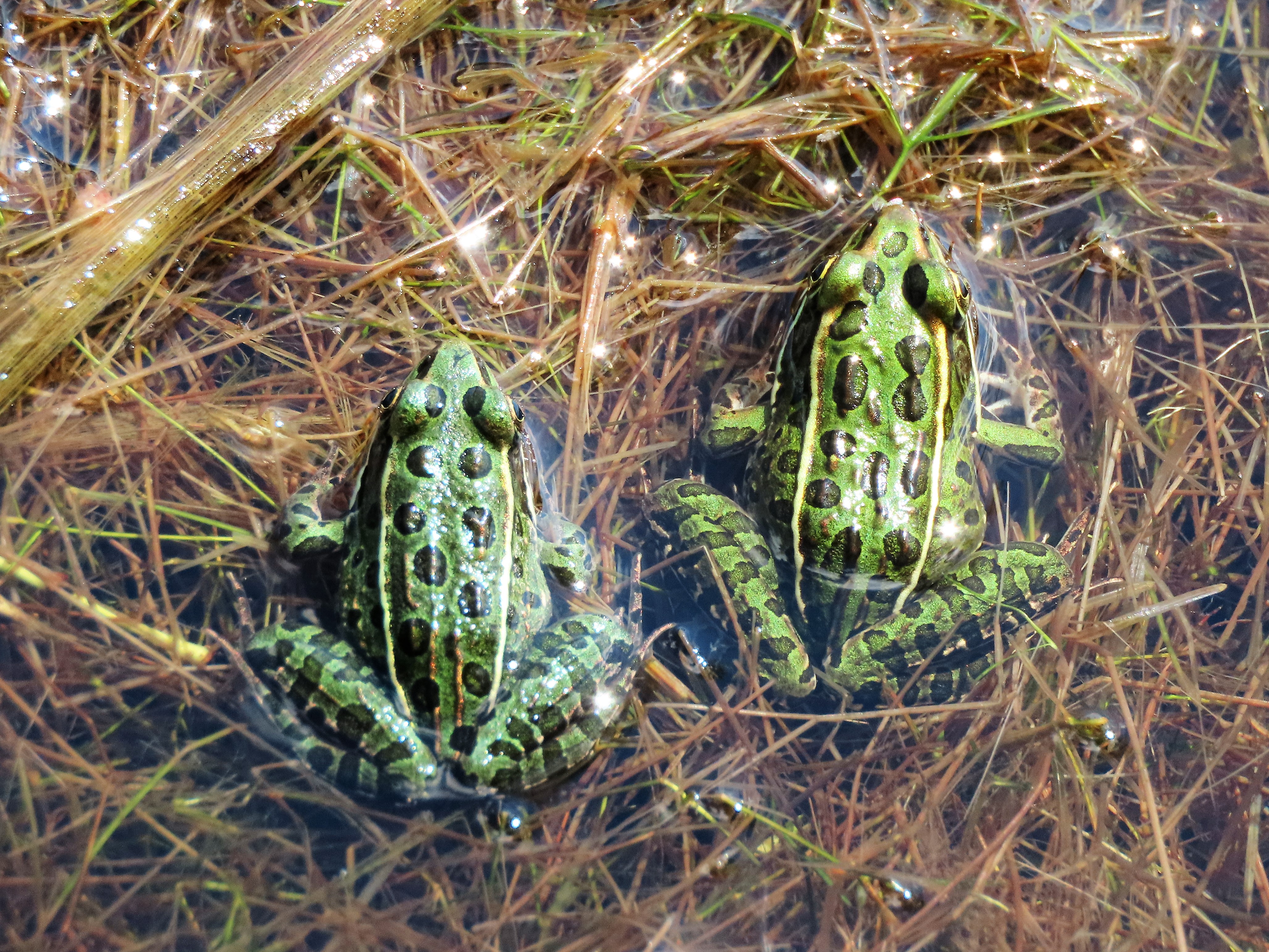
     As indicated when telling of our last foray into Laurel Creek C.A., Northern Leopard Frogs (Lithobates pipiens) give every indication of a very successful year.


     I am using not even the slightest hyperbole when I say that they were everywhere we walked, hopping out of our way as we moved, frequently heading for the nearest patch of water.


     At a given moment there were hundreds in view.


     So often, of late, there has been a litany of despair associated with wildlife populations, so it is encouraging to be able to report success of this magnitude.


     There follows a picture of a Slender Spreadwing (Lestes rectangularis), albeit not of exceptional quality.


     Field Bindweed (Convolvulus arvensis) does not move and is somewhat easier to photograph!


     Paper Wasps (Polistes spp.) are the insects we love to hate, yet they generally do not threaten us unless their nest is under siege.
     Dark Paper Wasp (Polistes fuscatus) is a distinctly marked species, and Miriam approached this individual at close range to get her pictures.


     Neither Miriam nor the wasp felt at risk from the other, and both went about their business undisturbed. 


     Common Red Soldier Beetles (Rhagonycha fulva) were not shy about showing the world what they do best!


     Unlike the paper wasp above, this Widow Yellowjacket (Vespula vidua) is more aggressive and at times stings without apparent provocation.


     Miriam was a little more circumspect in her approach to it.
     Canada Geese (Branta canadensis) are not stingy when it comes to providing fertilizer for all who wish to collect it, often on the soles of your shoes unfortunately!


     Viewed from below they are a handsome vanguard.


     Some species of dragonfly never seem to land, but Widow Skimmer (Libellula luctuosa) has no such reluctance.


     This Acadian Hairstreak (Satyrium acadica) was equally cooperative. 


     Monarchs (Danaus plexippus) have been seen more frequently of late. This one is perhaps dusted with pollen.


     A Song Sparrow (Melospiza melodia) found a convenient perch on a memorial bench.....


     .....from where it trilled its lovely song.


     American Goldfinch (Spinus tristis) is a very handsome bird.


     This species is a late breeder, but the onset of nesting is about to begin.


     Here is a Carrot Seed Moth (Sitochroa palealis) viewed from every angle.


     Clouded Sulphur (Colias philodice) is abundant.


     Butterflies are an important component of the diet of Eastern Kingbird (Tyrannus tyrannus).


Questions posed by Elaine

     A regular reader of my blog, Elaine, has posed a variety of question regarding birds and their biology and lifestyle and I will start to answer them, two or three at a time in this and subsequent posts.

Q. Do some birds only have one brood per year?
A. Most species at our latitude are single-brooded, especially neotropical migrants like wood warblers, thrushes, flycatchers, hummingbirds etc who are present here for three to four months on average, and do not have sufficient time to raise a second brood. Large birds such as raptors with long incubation periods and prolonged nestling care have only one brood.


Q. Which factors influence how many broods birds have per year?
A. Food availability is generally the most significant factor. In times of abundance more second broods are initiated, but not by the entire population of a species. In a well-studied Barn Swallow (Hirundo rustica) colony, for example, around thirty pairs had successful first nests, a dozen or so laid second clutches. Second broods have higher failure rates across a range of species.


Q. If a bird's nest, eggs or babies are destroyed, what's the impact on their nesting behaviour.
A. If the event occurs early most species will renest. However, if it is late in the cycle, just before nestlings are about to fledge for example, no attempt will be made to renest and the year's breeding attempt will be lost.

22 July 2021
Hillside Park, Waterloo, ON with Heather and Lily

     Ebony Jewelwing (Calopteryx maculata) may be found from April through October, but July and August are the peak flight months here in southwestern Ontario.

Ebony Jewelwing ♂

     They were abundant at Hillside Park.

Ebony Jewelwing ♀


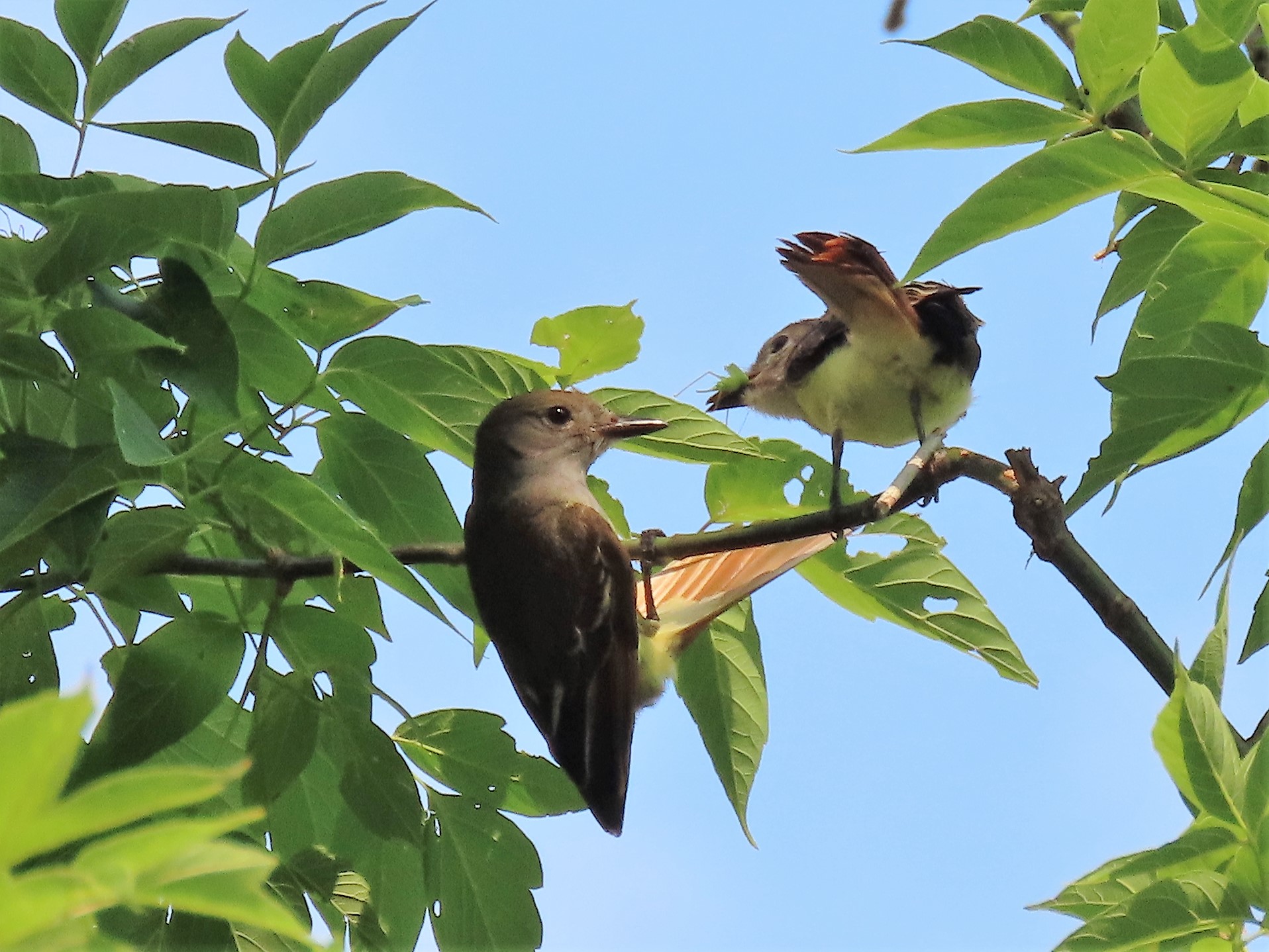
     We have always had great success finding Great Crested Flycatcher (Myiarchus crinitus) at this location and today we came upon evidence of a successful breeding season.


     We were happy to notice this recently fledged Eastern Phoebe (Sayornis phoebe) too.


     Clouded Sulphur (Colias philodice) was the most common butterfly encountered.


     Lily was of course the star of the show, and here she is being very good in her stroller as her mom looks off at something that caught her eye.


     Lily is not always happy to be in the confines of her stroller any more, but today for the most part she was a model of good behaviour.


     A hearty breakfast helped to keep her occupied.


     Green Immigrant Leaf Weevil (Polydrusus formosus) is another invasive pest in the army of species that has arrived here in shipments of fruit or by other means.


     It feeds on the leaves and blossoms of many woodland trees, but is also a threat to fruit trees and orchards.
     Himalayan Balsam (Impatiens glandulifera) as its very name implies is also invasive, and is an aggressive colonizer, supplanting native species.


     It produces copious nectar and is well serviced by bees.
     All too soon it was time to bid goodbye to Heather and Lily.


     Securely strapped into her car seat, Lily smiled goodbye to us. 


     See you next week!

26 July 2021
SpruceHaven, St. Agatha, ON

     Sanctuary Field is well on its way to becoming the grassland we are all hoping for.


     In places Black-eyed Susan (Rudbeckia hirta) is forming a carpet of gold.


     The pond in front of the house is abuzz with activity and I was happy to spot this female Eastern Pondhawk (Erythemis simplicicollis) resting on the broad leaf of a water lily.


     Better be careful not to become a snack for a watchful Green Frog (Lithobates clamitans).


     Some are partly hidden, just lying in wait for unsuspecting prey.


     The Staghorn Sumach (Rhus typhina) are beginning to send us a message that summer is running away on us and fall is not so far ahead. 


     Their ostentatious and extravagant fruit clusters will soon pale by comparison with their fiery autumn foliage.
      Something to look forward to.

Thursday, July 29, 2021

Sharks of the World - Princeton University Press


     There may be no word in the English language that is more likely to invoke wonder or fear, or a combination of the two, than "shark". Much of the reaction to sharks, verging at times on hysteria, has been fuelled by the film "Jaws", and subsequent spinoffs, and sensationalized and lurid accounts of monsters that not only are the stuff of nightmares, but flirt with truth and skirt the very edges of reality.
     This is the book to set you straight!
     The text points out: "Many tens of millions of  people use the sea for work or recreation, but there are only about 100 shark bite incidents reported globally each year................Although the risk of serious injury from sharks is incredibly small, and the fear produced may seem to be completely out of proportion to this risk.......not least because the likelihood of them occurring at all is so slim."
      Logic be damned, however! 
      You are considerably more susceptible to injury or death driving to the beach, than you are from sharks when you arrive there and go for a swim; but no one thinks twice about getting into a car.
     I have the impression, and the hope, that this book will help to alleviate the fear of sharks and put the emphasis on wonder. 
     The first ninety-three pages are dedicated to an examination of how sharks came about in the evolution of fishes, followed by an examination of their biology. Twenty pages are devoted to "Sharks and People" and a key to the orders and families of living sharks.
     There follows a detailed examination of all the known species of sharks found throughout the world.
     These accounts are replete with colour photographs and illustrations, line drawings, charts, diagrams, and maps. The status (IUCN Red List) is provided for each species and it is disheartening to see the number of species that are are threatened, or in some cases in serious danger of imminent extinction. The savage, unsustainable practice of capturing sharks only for their fins, must be stopped. This very activity is a clear indication that as humans we have not advanced as far as we might give ourselves credit for. Morality apart, it is sheer madness to exploit a resource until it no longer exists.
     A first rate glossary follows the species accounts, with four other appendices titled "Oceans and Seas", "Field Observations", "Fin Identification", and "Tooth Identification".
     An intensive bibliography provides links to further reading.
     I remember vividly seeing my first sharks, basking in warm tropical waters. They were probably Tiger Sharks, although at the time I did not have the skill to identify them. They seemed to be the very antithesis of dangerous, mindless killers; they appeared quite gentle in fact.  We had no desire to interfere with them in any way, neither for profit nor out of fear, not as food nor to hang a shark tooth on a thong around our neck. 
     It is my fervent hope that we will cease our reckless, destructive assaults on these vital inhabitants of intact and healthy oceans.  In the process maybe we can stop loading the seas with plastics and other pollutants too.
     We owe it to ourselves to take action, but more especially, it is a legacy of clean oceans with robust populations of all its creatures that we should wish to bequeath to those who come after us.
     This book will help you to support shark conservation and steer a clear path away from the unsustainable, ecosystem-damaging and morally bankrupt practices that continue right up to this day.
     Make sure you let your elected officials know how you feel.

Sharks of the World - Princeton University Press
Authors: David A. Ebert, Marc Dando and Sarah Fowler
Hardcover
US$49.95 - £40.00  -  ISBN 9780691205991
Published - USA 20 July 2021
                 UK 22 June 2021
608 pages - 2,000+ coloured illustrations, photographs, maps and charts
8.5 x 9 in. (21.25 x 22.5 cm)
     

Land Acknowledgement

We acknowledge that the land on which we are situated are the lands traditionally used by the Haudenosaunee, Anishinaabe, and Neutral People. We also acknowledge the enduring presence and deep traditional knowledge, laws, and philosophies of the Indigenous Peoples with whom we share this land today. We are all treaty people with a responsibility to honour all our relations.

Followers