Showing posts with label Sugar Maple. Show all posts

Sunday, February 25, 2018

Snowy Owl (Harfang des neiges)

25 February 2018

     I was advised yesterday evening by our good friend, Anne Morgan, that she and her husband Alan, along with Virgil and Beth Martin had been hunting for Snowy Owls (Bubo scandiacus) and had met with resounding success. Even though we had a busy day ahead of us Miriam and I decided that we could spare a couple of hours to search for these northern birds who will soon be leaving our area. It was sunny and the temperature was 8°C, unusually warm for this time of year. 
     We had not gone far when we saw several Red-tailed Hawks (Buteo jamaicensis) gambolling in the sky, ostensibly involved in courtship flights. The spectacle they put on is quite amazing, twisting and turning, tumbling like circus acrobats. We were able to photograph this individual before it left its perch to join in the fun.


     The Region of Waterloo is the epicentre of Mennonite residency in Ontario, and being Sunday morning, the meeting houses were full. The horses, all lined up at the hitching rails waiting for their owners to return, presented quite a sight, as did the conveyances, each with a "Slow Moving Vehicle" sign emblazoned on the back.


     The fact that it has been so mild of late (and is predicted to continue warmer than usual) means that the sap has started to flow in the Sugar Maples (Acer saccharum), much earlier than is normal, and many trees bore telltale sap-collecting pails. Plastic has pretty much taken over now, but the old metal pails still in use not many years ago were certainly better suited to a rural landscape, and seemed a natural part of the annual cycle.


     In fact, many large operations no longer use pails at all and have a network of plastic pipes connecting the trees to a central collection area.
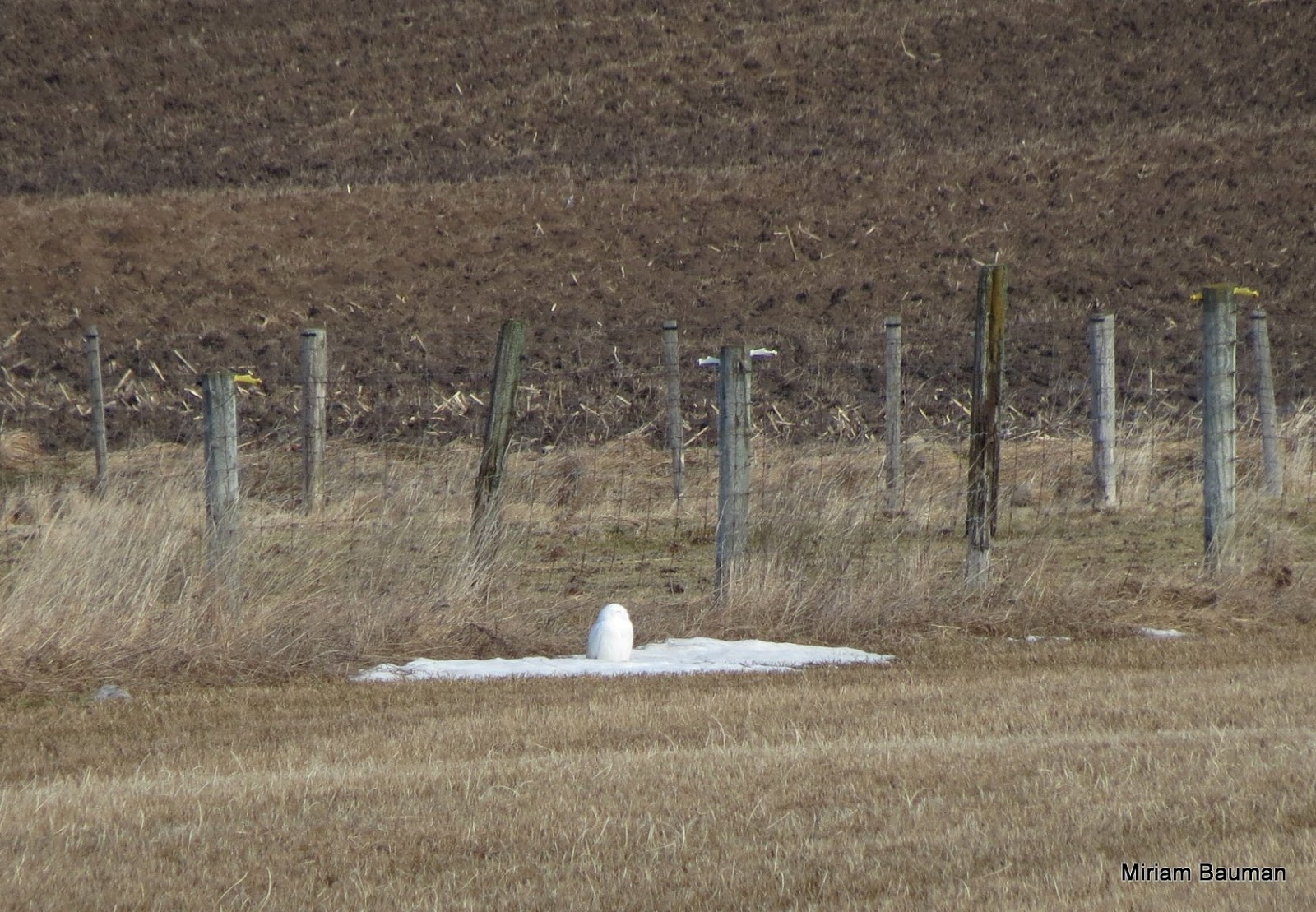
     Our first Snowy Owl was a male, quite far off and sitting on the last patch of snow in the field.

     We drove along keeping a keen eye peeled for others and finally our efforts were handsomely rewarded. A female was located hunkered down behind a stump, sheltering from the wind. And it was very close to the road. By using the car as a blind, and basically letting the car roll very slowly, with intermittent stops,  we were able to get a series of photographs.


     This truly is a magnificent creature and it matters not how many times I have seen one, a sense of awe and reverence takes over. It is akin to being in the presence of greatness.


     Tomorrow looks fairly open with only a few discretionary chores to take care of, so I think we might embark on a search again. After all the Snowies will soon be leaving us and we will have to wait another nine months or so until we see them return. We wish them good hunting on the tundra, with plentiful prey. May they raise large families to send south to fill our hearts with joy next winter.

Addendum to this post 26 February 2018: We went out again today and discovered another seven Snowy Owls. Remarkable!

Also - Only in America: https://www.youtube.com/watch?v=fB7MwvqCtlk

Friday, November 17, 2017

American Red Squirrel (Écureuil roux)

     The American Red Squirrel (Tamiasciurus hudsonicus) is a delightful little creature, full of charm and personality.


     This individual was feeding on the last few keys left on the Sugar Maple (Acer saccharum) in our backyard, and was scampering from one part of the tree to another, sometimes moving at lightening speed.


    This species does not enter into true hibernation and may often be seen in the winter, in temperatures as low as minus 25°, on a sunny day. It is strictly diurnal and is most active during the most comfortable hours of the day, morning and afternoon in summer and midday in winter.
     Although it garners seeds for storage underground this individual seemed content to make a meal of what was left on the tree.


     American Red Squirrels share their habitat with larger Grey Squirrels (Sciurus carolinensis) but are quite fearless and readily rout them if they dare to trespass. Red Squirrels are so often seen chasing Grey Squirrels it gave way to the myth that the Red Squirrel castrates its larger cousin!
     Squirrels are a nuisance for anyone feeding birds, but this little charmer is far less of a problem that Grey or Black Squirrels. It is never seen to be as voracious and seldom cleans out a feeder.
     I have always enjoyed this description of American Red Squirrel by the American zoologist, Clinton Merriam.

The Chickaree combines qualities so wholly at variance, so unique, so incomprehensible, and so characteristic withal, that one scarcely knows in what light to regard him. His inquisitiveness, audacity, inordinate assurance, and exasperating insolence, together with his insatiable love of mischief and shameless disregard of all the ordinary customs and civilities of life, would lead one to suppose that he was little entitled to respect; and yet his intelligence, his untiring perseverance, and genuine industry, the cunning cleverness displayed in many of his actions and the irresistible humour with which he does everything command for him a certain degree of admiration. He is arrogant, impetuous, and conceited to an extreme degree, his confidence in his own superior capabilities not infrequently costing him his life. In fact, these contradictions in character and idiosyncrasies in disposition render him a psychological problem of no easy solution.

         I think that most of us would echo its sentiments!

Tuesday, October 14, 2014

The Maple Leaf Forever

Canada's National Flag

     Several years ago we planted a Sugar Maple Acer saccharum in our back yard and it has progressed from a spindly sapling to a magnificent medium sized tree. This is what we see from our bedroom window.


     If anyone has ever wondered about the origin of the leaf on our national flag, this is it. 


     Although I am not given to overly patriotic feelings I am always stirred a little when I see the flag. Its simple image portrays an alliance with nature, and both our flag and our national anthem are free from jingoism and calls to arms, or statements that our country is superior to others. It is a peaceful symbol of a peaceful nation and one that evokes a great deal of resonance with its citizens.
     The flag will be fifty years old in February 2015 and it is quite remarkable the degree of opposition to it when it was first proposed by one of Canada's greatest sons, Lester Bowles Pearson, winner (very fittingly) of the Nobel Prize for Peace. Now, it is most ardently embraced by the very factions who fought so hard to prevent its adoption. It really has become a much loved symbol to all who live here, native born and immigrant alike. And long may it continue to be so.

Land Acknowledgement

We acknowledge that the land on which we are situated are the lands traditionally used by the Haudenosaunee, Anishinaabe, and Neutral People. We also acknowledge the enduring presence and deep traditional knowledge, laws, and philosophies of the Indigenous Peoples with whom we share this land today. We are all treaty people with a responsibility to honour all our relations.

Followers