Showing posts with label Spring. Show all posts

Thursday, May 07, 2026

More Random Spring Sightings

24 April, 2026
Benjamin Park, Waterloo, ON 

     Often overlooked, Blue Cohosh (Caulophyllum thalictroides) is a sure sign of early spring, and a flower I look forward to.


     It seems that as soon as I locate Blue Cohosh, Mayapple (Podophyllum peltatum) is not far behind.


     Lichens are not easy to identify, but they are always exciting to see. I believe those shown below are Rosette Lichens (genus Physcia).


     Violets (genus Viola) are said to inspire love and affection.


     Sometimes the affection blooms longer than the flowers!
     This trunk bears the signature of several cavity-nesting species of birds. 


     A couple of years ago a pair of Red-breasted Nuthatches (Sitta canadensis) set up home there, but I suspect the inner sections have degraded and are no longer suitable.
     An American Robin (Turdus migratorius) is as familiar as it is beloved.


     Common Grackle (Quiscalus quiscula) is more beautiful than is generally acknowleged.


     Like the American comedian, Rodney Dangerfield, it gets no respect!

TRIVIA

     I was recently asked by a bright young fellow about the scientific designations vulgare or vulgaris and officinale or officinalis, both seen quite frequently.

Vulgare or vulgaris is the Latin word for "common" or "widespread." It is frequently used as a specific epithet and does not indicate in any way that the organism is vulgar!

Officinalis or officinale, a botanical Latin term, is generally used as a specific epithet to identify plants with medicinal properties.

     I knew those four years of high school Latin would come in handy one day!


Monday, May 04, 2026

Random Spring Sightings

 18 April, 2026
SpruceHaven, St. Agatha, ON

     Eastern Red-backed Salamander (Plethodon cinereus) is far-and-away the most common salamander in our region and can usually be found by lifting a log or two in the vicinity of a vernal pond, or even a moist forest floor.


     As the genus Plethodon implies it is lungless and should not be handled since it breathes through its skin. Handling can interfere with breathing and cause  surface mucus to dry out permitting the entry of harmful bacteria.


     Eastern Red-backed Salamanders can be found in most deciduous woodlands, but may also inhabit coniferous forests. They feed on insects, spiders and other terrestrial invertebrates and, in turn, become food for birds, small mammals and snakes.

22 April, 2026
Benjamin Park, Waterloo, ON

     A Purple Finch (Haemorhous purpureus) is not a bird I see frequently, so it was very agreeable to be greeted by this male as soon as I set foot on the trail.


     I eagerly await the emergence of Trilliums (genus Trillium) and Benjamin Park is an area where they occur in profusion. 
     White Trillium or Large-flowered Trillium (Trillium grandiflorum) is the most abundant species, but it is difficult to know until the flower is revealed.


     There is no doubt that the following plant is Purple Trillium (Trillium erectum).


     White Trillium has been the provincial flower of Ontario since 1937.
     Lungwort (Pulmonaria canadensis) appears early and fills the woodlands with surreal beauty.


     The first wood warbler I see is nearly always Myrtle Warbler (Setophaga coronata).


     Unlike most warblers which are obligate insectivores, Myrtle Warblers are able to switch to a diet of fruit and berries when insects are not available during periodic cold snaps.
     Red-winged Blackbirds (Agelaius phoeniceus) have a loud, distinctive song familiar to all.


     It evokes a feeling of profound joy to greet early Mourning Cloaks (Nymphalis antiopa).


     There is more, but we'll save that until the next time.

Tuesday, April 08, 2025

Additions to the Family - and no Tariffs to Worry About

 01 April, 2025

     Spring has been a decidedly hit and miss proposition this year, but the first of April was delightful and we went for a walk.
     In the eternal way of the affairs of nature, procreation was on the minds of many.
     A pair of Canada Geese (Branta canadensis) had chosen the top of a Muskrat (Ondatra zibethicus) house as the site for their nest.


     Doubtless a wise choice, the nest is elevated, located in the water away from land predators, and Muskrats are fierce animals and never shy away from a fight, so they probably fill the role of additional defender.


     The male goose, ready to chase away intruders, patrolled the pond in silent warning to all who might contemplate interference with the nest, to back off, or risk attack. An enraged Canada Goose is a formidable force!

     Ospreys (Pandion haliaetus) have raised a family atop the light standards in the parking lot at RIM Park in Waterloo for many years. 

     It was good to see them back for another season.
     A second pair of Canada Geese had sealed their bond once again, and were focussing all their efforts on producing the next generation.


     Broadleaf Cattails (Typha latifolia) were surging up through inundated wetlands.


     Last year's nest of Baltimore Oriole (Icterus galbula) reminded us that they too will be returning a few weeks from now.


     The Grand River, swollen by constant rain, was flowing rapidly.


     A male Common Merganser (Mergus merganser) seemed to relish being effortlessly swept along.


     Eastern Towhee (Pipilo erythropthalmus) is not an uncommon bird, but it can be devilishly hard to find. 


     This is the best picture we could get of an evasive male.
     On the way home we spotted a female American Kestrel (Falco sparverius) on a snag and turned the car around to get a picture.


     Amazingly, she didn't immediately fly off, as is usually the case.


     She knew what was about to happen.


     Mission accomplished!


     Her look of contentment surely indicates that kestrel eggs will soon be laid and busy parents will have their work cut out for them to find food for a growing brood.


     There will be more love in the air, of course, but last night we had snow and fierce winds, and as I compose this post it is minus seven degrees.
      The Melody d'Amour may have to wait a while yet!


Sunday, March 23, 2025

More Hints of Spring

14 March 2025

     As the snow receded at home Snowdrops (family Amarycillidae) were visible and brought us great joy. We couldn't resist bringing a few into the house, where they remained vibrant for a surprisingly long time.


     We didn't plant these flowers so how they got there is a bit of a mystery, but we are glad that they did.


     They are exquisite, don't you think?

Hillside Park


     A female Downy Woodpecker (Dryobates pubescens) hitched up a tree; earlier she had been jousting with another female, so hormones are firing them up.


     A pair of Mallards (Anas platyrynchos) were hanging out together.


     Soon the female will construct a nest, lay eggs and begin incubation.


     At that point she will cease to receive attention or cooperation from the male and will go on to raise her brood independently.
     Some humans are even like that!
     White-throated Sparrow (Zonotrichia albicollis) may now be heard singing its distinctive song, generally represented anthropomorphically as "Sweet Canada, Canada, Canada" - and that seems especially endearing at present.


     Black-capped Chickadee (Poecile atricapillus) is ubiquitous and much loved, and the males are now serenading females with their seductive "feebeee" invitation to cohabit for the season.


     A Red-tailed Hawk (Buteo jamaicensis) sailed overhead, momentarily harassed by crows. Raptors too are pairing off in anticipation of the breeding season ahead.


17 March, 2025
RIM Park, Waterloo, ON


     American Robins (Turdus migratorius) are now abundant, migrants having joined resident birds.


     There was flooding on the path and the creeks were swollen, so our walk there was curtailed somewhat.


     One might be forgiven for thinking that this Rock Dove (Columba livia) was a weather vane.


     As always, the yellow exclamation point of a Coltsfoot (Tussilago farfara) was one of the first to herald spring's arrival.


     The infructescences of Staghorn Sumac (Rhus typhina) have nothing to do with spring, but are always delightful.


     An American Crow (Corvus brachyrynchos) digging in the soft ground was doubtless rewarded with many juicy grubs.


19 March, 2025
Benjamin Park, Waterloo, ON

     Flies (order Diptera) are already out. 


     Downy Woodpeckers appeared hyper-active and this female flitted from tree to tree, sometimes barely pausing for a moment.


     Upside down works too!


     I don't have a count on the number of American Crows I saw, but there were readily thirty. 


     A few seemed to be engaged in courtship behaviour, but mostly they hung out together in small groups.


     Black birds are not the easiest to photograph, and I didn't have Miriam with me to weave her magic.


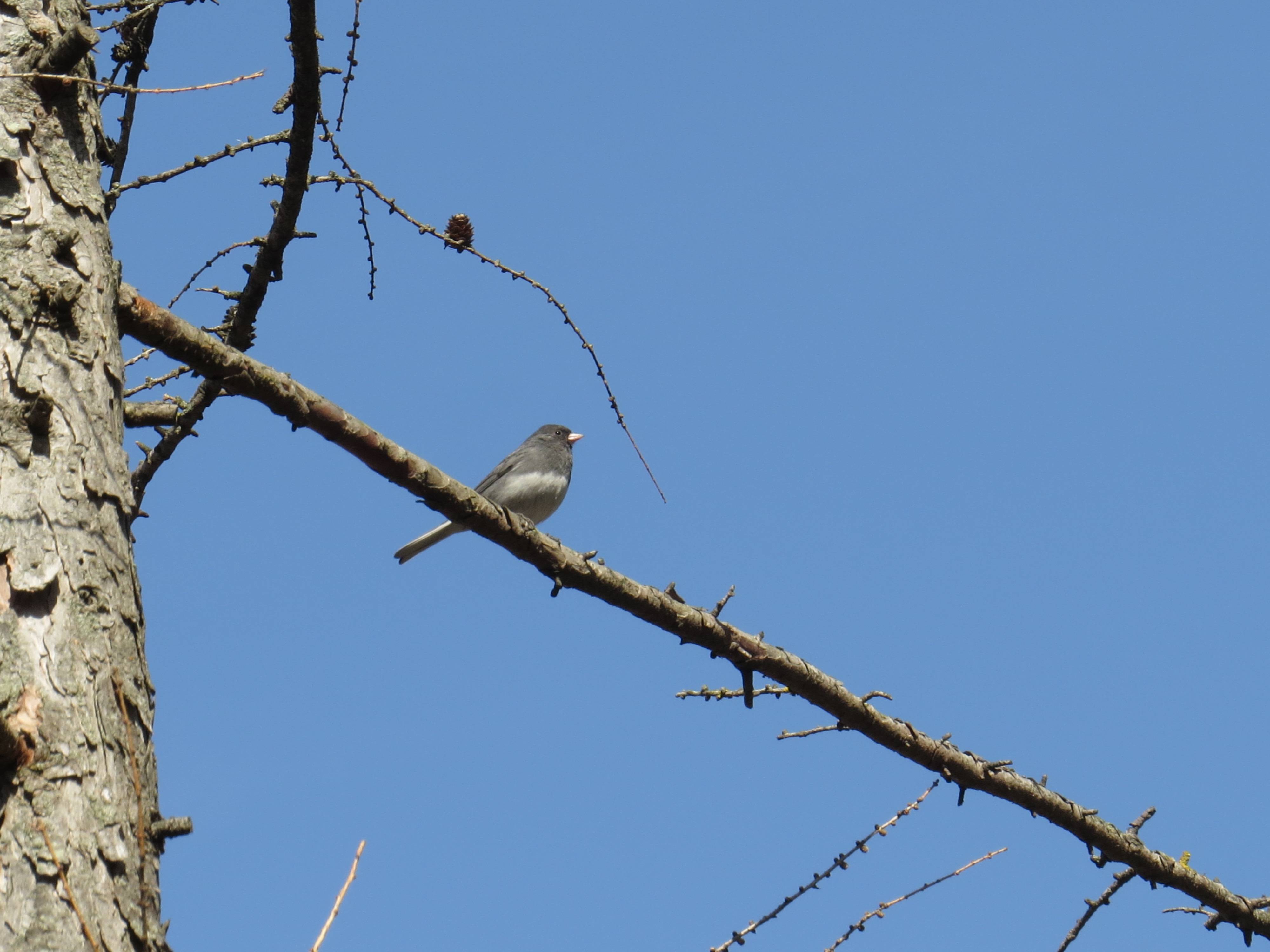
     Dark-eyed Junco (Junco hyemalis) were exceptionally active; usually seen on the ground, today they favoured perches on trees and shrubs.


     It's hard not to conclude that Eastern Grey Squirrels (Sciurus carolinensis) were not simply enjoying one of the first warm days of spring.


     At times they seemed like children playing tag.
     I pointed  this male Downy Woodpecker in the direction of the females, but I don't think he followed my advice. 


     Perhaps he had another beauty in his sights.

Spring is here! Enjoy!


Land Acknowledgement

We acknowledge that the land on which we are situated are the lands traditionally used by the Haudenosaunee, Anishinaabe, and Neutral People. We also acknowledge the enduring presence and deep traditional knowledge, laws, and philosophies of the Indigenous Peoples with whom we share this land today. We are all treaty people with a responsibility to honour all our relations.

Followers