Showing posts with label Red Wattlebird. Show all posts

Saturday, February 13, 2021

Random Memories of Australia - Part 6

      There are still interesting and colourful birds from Australia for a couple more reminiscences, and for which I have decent photographs, so here are a few  species to delight you. As always they are in no particular sequence and one bird holds no more (or no less) appeal for me than another. They are all wonderful!

Galah (Eolophus roseicapilla)

     It might depend on whom you talked to whether Galahs would receive universal approval, due to their ability to do serious damage in a garden or orchard, but for me, unabashed, over-the-top bird lover that I am, every single encounter was unalloyed pleasure. 


     How could you not be thrilled at a chance to share your day with this beauty?
     Galah is widespread over much of Australia, sometimes occurring in quite large flocks.


     Like many frugivorous birds it has benefitted from the smorgasbord humans have laid before it, but by raiding fruit trees and consuming seeds and grain, it has not always endeared itself to us.
     Galahs in a group always appear to project a level of exuberance that smacks of the sheer delectation of life. I enjoyed the following observation by noted Australian ornithologist, Ian Rowley.

"Galahs give the impression of enjoying their lives to a much greater extent than most other animals. They appear to get real pleasure from the perfection of their flying, swerving in and out of the trees with a consummate skill quite superfluous to the mundane need of commuting. Swinging trapeze fashion from telephone lines, sliding down the guy wires of aerials and indulging in near-ecstatic display during the 'rain dance', are all unproductive but appear such fun."


     Who could resist the allure of this friendly, intelligent bird? Certainly you may count me among its most ardent admirers.

Musk Duck (Biziura lobata)

     It would be reasonable to conclude that most people, when contemplating waterfowl around the world, would conjure up images of beauty. From the familiar Mallard (Anas platyrynchos) to the Wood Duck (Aix sponsa); from the dazzling plumage of a Mandarin Duck (Aix galericulata) to the sleek elegance of a Northern Pintail (Anas acuta), all would evoke grace and attractiveness. 
     And then there is the Musk Duck.....


     It could safely lay claim to being the most bizarre duck in the world. The male has a black lobe under the base of the lower mandible and stiff tail that often rests on the water. It is a stocky, powerfully built duck, and is not especially good-natured.
    The female is substantially smaller than the male and needs to be constantly aware of attack.

Musk Duck ♀

      Males are aggressive towards other species and do not hesitate to launch an assault on any bird that strays too close or seems to displease it in one fashion or another. 
     It is found in terrestrial wetlands and coastal waters, primarily in southeastern and southwestern Australia, including Tasmania


     In captivity it is hostile to humans and reacts wihtout provocation. On my first visit to Australia in 1998, Peter Fullager accompanied me to Tidbinbilla, where a male Musk Duck there was known as Ripper, having attacked a research biologist and ripped his jeans!
     Australia is renowned for the splendid and unique diversity of its wildlife; Musk Duck certainly makes the list!

Australasian Grebe (Tachybaptus novaehollandiae)

     Australasian Grebe is a beautifully-marked little grebe, sooty grey overall with a black face and yellow eye and gape patch.

 
     It is widespread in Australia but found most commonly in the southeast.


     Like all grebes it is wedded to water, but exploits a variety of wetlands from small stock dams, river backwaters, and open spaces in swamps and marshes, to large open lakes.
     The male is slightly larger than the female.


     Prey, based on nine stomach analyses (1,226 identified prey) revealed Hemiptera (557), aquatic beetles (59) and their larvae (222), snails (76), and small fish (180).  
     Australasian Grebes appear to be unique in their regular consumption of snails.

White-faced Heron (Egretta novaehollandiae)

     This is the most common and widespread heron in Australia and we saw it frequently.


     Although usually found stalking prey in shallow water, it is an opportunistic hunter and does not eschew dry land where terrestrial invertebrates and small mammals may be captured. White-faced Herons are solitary feeders, and in wetlands where several individuals may be present, adequate spacing is maintained. 


     The white face is a distinguishing feature and imports a very handsome quality to the bird.
     In any wetland we frequented in the three states we visited we could rely on seeing White-faced Heron.


     And it was always a pleasure.

Red Wattlebird (Anthochaera carunculata)

     In the last selection of Australian birds I featured Little Wattlebird (Anthochaera chrysoptera) and we will now take a look at one of its sister species, Red Wattlebird.


      The red wattles from which it derives its name are clearly visible. The wattles become longer and more intense in colour as the bird ages.
      Red Wattlebird is bigger than Little Wattlebird and exploits similar habitats for food and nesting sites.


     Its yellow belly is prominent, both perched and in flight, and quickly differentiates it from the silvery-streaked underparts of Little Wattlebird.
     

     Red Wattlebird is acrobatic around sources of nectar and captures insects in mid air. It hops on the ground rather than walking.
     The diversity of Australian Honeyeaters is remarkable and wattlebirds are like no others.

Crested Pigeon (Ocyphaps lophotes)

     Crested Pigeon, a handsome species, is of relatively recent origin in southeastern Australia which is where we encountered it.


     Andrew Patrick, in his excellent Birds of Sydney reports as follows: 

"Two birds in a North Rocks garden in 1980 were thought very noteworthy at the time. Crested Pigeons are now one of the most common birds seen in parks, gardens and bushland all across Sydney". 

     In fact, it was one of the first birds we saw on the afternoon of our arrival in Sydney, at the Royal Botanic Garden, where the above picture was taken.
     For those of us in North America accustomed to urban pigeons and other comparatively drab birds, pigeons and doves found in Australia verge on psychedelic!


     We grew accustomed to Crested Pigeon, but never blasé about it. It was always a distinct pleasure to see this familiar bird.


     There are no less than fifteen Mourning Doves (Zenaida macroura) feeding on cracked corn in my snowy backyard right now. Oh to turn one of them into a Crested Pigeon!

     I hope that you continue to enjoy these posts on Australian birds. I think I still have enough passable pictures for a couple more. I am ecstatic to be re-living the experience in this way.      


Monday, February 01, 2021

Random Memories of Australia - Part 4

     I am happy to share with you another episode of the fabulous birds from "down under". How utterly wonderful they all are.
     As always, they are presented in no set order - but all are guaranteed to thrill!

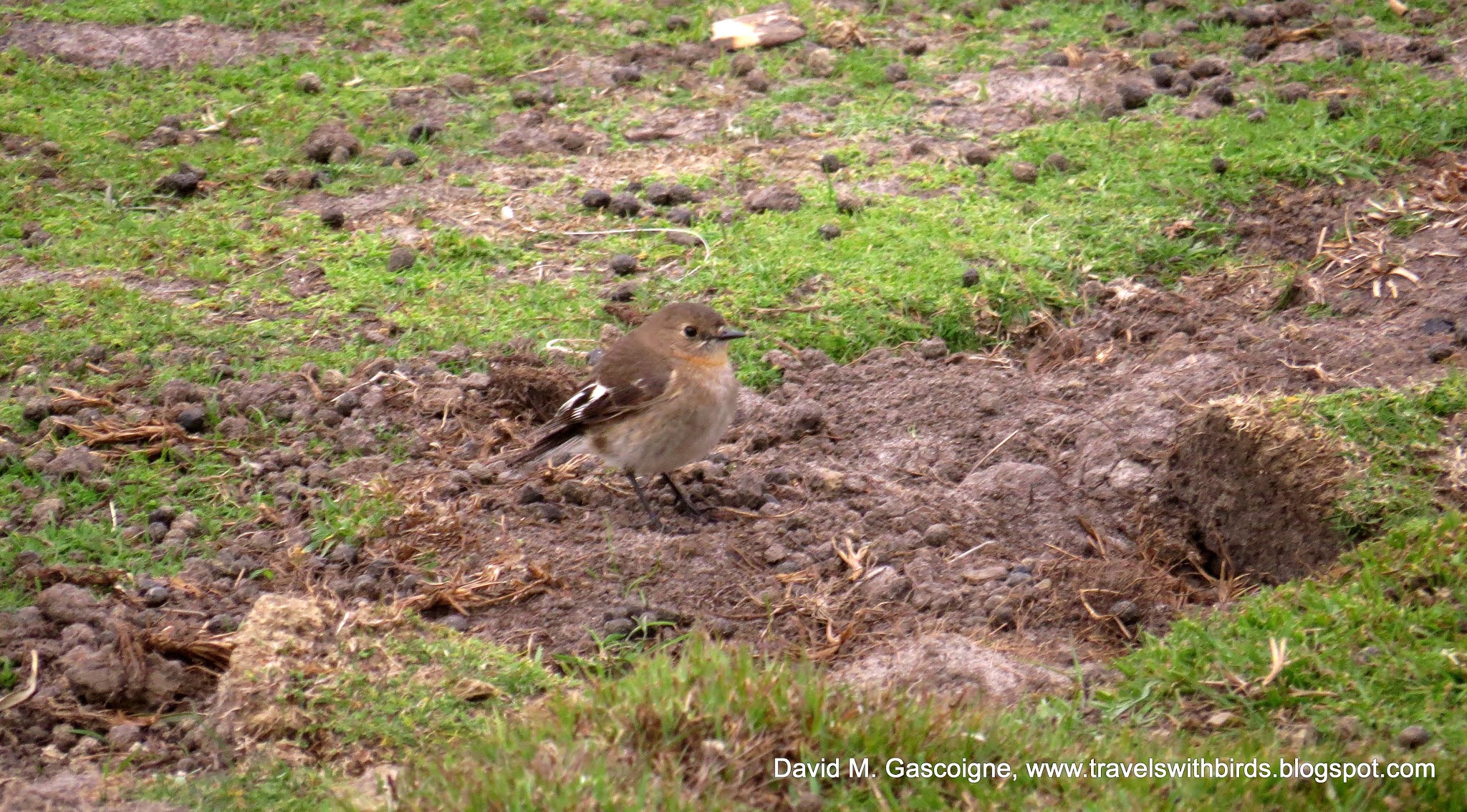
Flame Robin (Petroica phoenicea)

     This dazzling little bird was one of the first birds to greet us when we arrived at Inala, a bright male standing upright on the grass. Its erect stance reminded me somewhat of a pipit.


          It was quite common at Inala and we saw it frequently. It was habituated to humans and was generally not far from our cottage or from other buildings when we observed it.


     It fed on the ground and appeared to be having great success capturing insects by pouncing on them.


     The female is not as brightly coloured as the male, as is generally the case with passerines, but she is very attractive in her own subtle way.


     We were delighted to share their company.

Satin Bowerbird (Ptilonorhynchus violaceus)

      On a continent renowned for its avian wonders, few are more emblematic of the uniqueness of Australia than bowerbirds, where the male builds a display (a bower) for the sole purpose of attracting a female. The only purpose of the bower is to induce her to mate with him.
     Moreover, different species of bowerbird construct bowers of different styles, with a clear choice of ornamentation.
     We were very fortunate to meet up with Satin Bowerbird on several occasions; the male of the species is exceptionally handsome.


     The bower is characteristically formed of two curving walls of sticks with the approach to it decorated with blue items of every description, from flower petals to plastic spoons and other human detritus. The colour is the determining factor.


     There is a sense of order and symmetry to the blue runway, not readily apparent to the human eye perhaps, but of great significance to the male, for if a piece is moved, he immediately moves it back to its original position.
     Rival males are not above stealing items for their own display, so bowers are jealously guarded.


     We can only wonder whether this female succumbed to his blandishments.


     I suspect that he might have been hard to resist!

Little Pied Cormorant (Microcarbo melanoleucos)

     I have a great deal of fondness for cormorants, birds that have been subjected to irrational and cruel persecution by humans throughout history. Unfortunately widespread mistreatment continues to this day, science be damned, facts be damned, and it is a blot on society that we continue to condone such chronic injustice.
     Little Pied Cormorant is appropriately named, with some individuals being barely larger than American Crow (Corvus brachrynchos).


It is found in sheltered coastal waters as well as inland wetlands. It displays a marked preference to nest close to Australian Darter (Anhinga novaehollandiae) and the two species are seen together in the image below.


     We saw Little Pied Cormorant often, and I was elated on every occasion.


     One of my prized possession is a picture of Little Pied Cormorant by the accomplished Canadian artist, and cormorant advocate, Barry Kent McKay, originally featured in The Double-crested Cormorant by Linda R. Wires, a book that should be read by everyone, bird lover and "regular" citizen alike.

Pink-eared Duck (Malacorhynchus membranaceus)

     There are strange and wonderful waterfowl in Australia, few more bizarre than Pink-eared Duck.


    Bizarre, yes, but attractive, absolutely.
     This is a small duck with an oddly shaped bill and zebra-striped flanks, and a black mask to set off its already rakish appearance. The pink "ear" is small and often difficult to see.


     It is colonial and sometimes breeds in huge concentrations, nesting over water in any suitable vegetation, or in a tree hollow.
     Pink-eared Duck is widespread throughout inland wetlands of mainland Australia but we encountered it only twice, both times in Victoria.


     It is an enigmatic species and one not soon forgotten.

Red Wattlebird (Anthochaera carunculata)

     Red Wattlebird is a large honeyeater, quite common in suitable habitat, that does not shy away from human landscapes such as gardens, parks, golf courses and vineyards, in addition to being present in its ancestral habitat of eucalypt forests and woodlands.


     We came across this species frequently in New South Wales and Victoria, as well as its congener Little Wattlebird (Anthochaera chrysoptera), and in Tasmania Yellow Wattlebird (Anthochaera chrysoptera), a species endemic to the island.


     Like most honeyeaters its principal diet is nectar but this species willingly avails itself of sugar water feeders in the manner of hummingbirds on this side of the world.
     Red Wattlebird is a strong flyer, readily capturing flying insects. It shows white tips to wings and tail in flight.

Eastern Rosella (Platycercus eximius)

     I don't recall whether I danced a jig the first time I saw Eastern Rosella; if not, I surely expressed delight in myriad other different ways!
     It is spectacular!


     It is found throughout southeastern Australia, including Tasmania, and we saw it in the three states we visited.
     For me, if there is such a thing as a quintessential Australian parrot, in the land of parrots I might add, this is it.


     I am quite sure that my jaw dropped with every  encounter.
     We encountered Eastern Rosella most frequently in rural areas and on the outskirts of major cities, often perched on fences or overhead wires. On several occasions we saw small flocks foraging on the ground.


     Pairs seem to maintain a loosely defined territory outside the breeding season. Eastern Rosellas mate for life and are socially monogamous, but probably not sexually monogamous. 


     As recent research has discovered the nests of many, if not most, bird species contained eggs sired by more than one male.
     Such is life in the fast lane! Just ask a well known politician and former TV reality star that might spring to mind!
     I already am starting to muse about which species I will show you next. They will be interesting; that's a promise!   
      

Land Acknowledgement

We acknowledge that the land on which we are situated are the lands traditionally used by the Haudenosaunee, Anishinaabe, and Neutral People. We also acknowledge the enduring presence and deep traditional knowledge, laws, and philosophies of the Indigenous Peoples with whom we share this land today. We are all treaty people with a responsibility to honour all our relations.

Followers