I am happy to share with you another episode of the fabulous birds from "down under". How utterly wonderful they all are.
As always, they are presented in no set order - but all are guaranteed to thrill!
Flame Robin (Petroica phoenicea)
This dazzling little bird was one of the first birds to greet us when we arrived at Inala, a bright male standing upright on the grass. Its erect stance reminded me somewhat of a pipit.

It was quite common at Inala and we saw it frequently. It was habituated to humans and was generally not far from our cottage or from other buildings when we observed it.

It fed on the ground and appeared to be having great success capturing insects by pouncing on them.

The female is not as brightly coloured as the male, as is generally the case with passerines, but she is very attractive in her own subtle way.
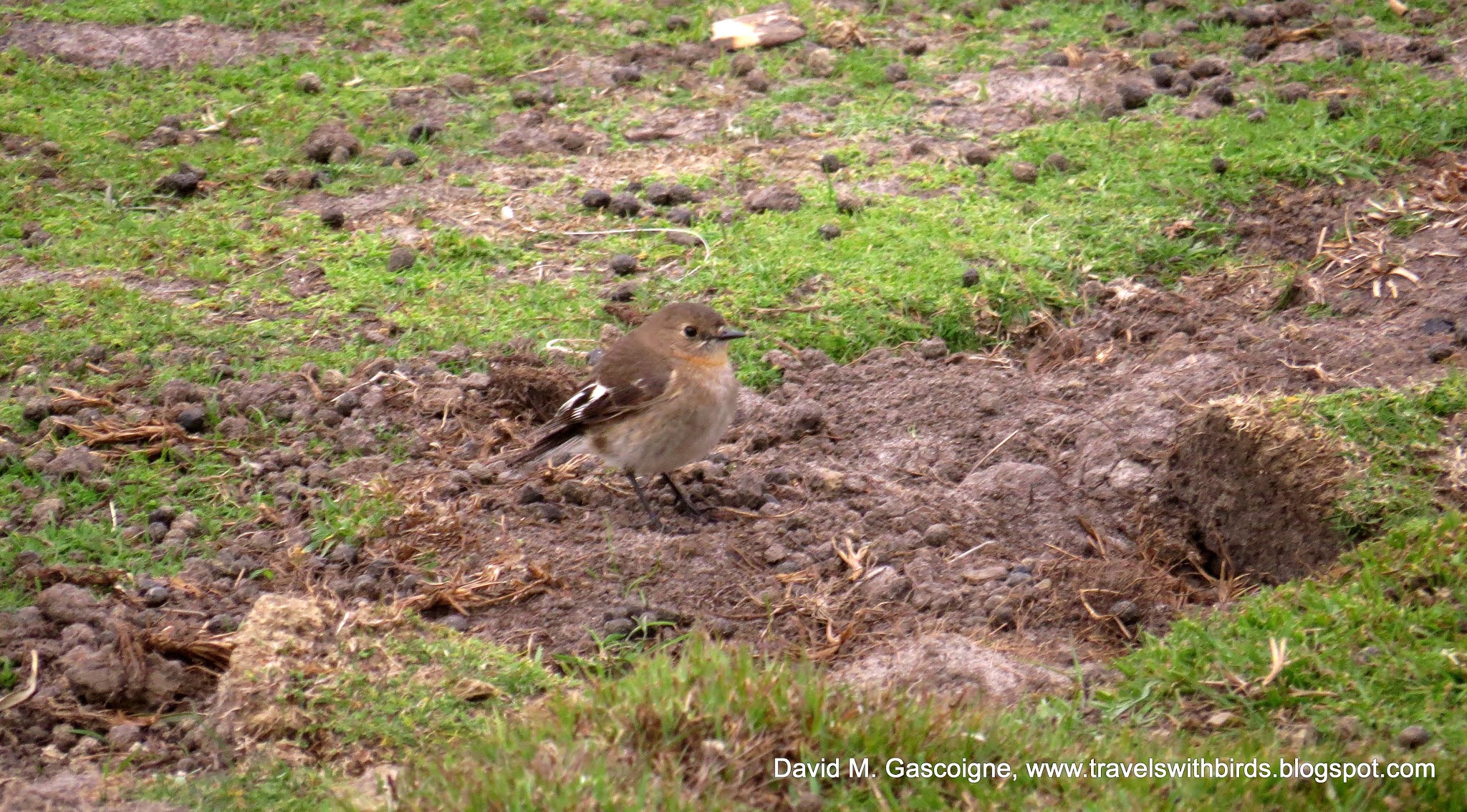
We were delighted to share their company.
Satin Bowerbird (Ptilonorhynchus violaceus)
On a continent renowned for its avian wonders, few are more emblematic of the uniqueness of Australia than bowerbirds, where the male builds a display (a bower) for the sole purpose of attracting a female. The only purpose of the bower is to induce her to mate with him.
Moreover, different species of bowerbird construct bowers of different styles, with a clear choice of ornamentation.
We were very fortunate to meet up with Satin Bowerbird on several occasions; the male of the species is exceptionally handsome.

The bower is characteristically formed of two curving walls of sticks with the approach to it decorated with blue items of every description, from flower petals to plastic spoons and other human detritus. The colour is the determining factor.

There is a sense of order and symmetry to the blue runway, not readily apparent to the human eye perhaps, but of great significance to the male, for if a piece is moved, he immediately moves it back to its original position.
Rival males are not above stealing items for their own display, so bowers are jealously guarded.

We can only wonder whether this female succumbed to his blandishments.

I suspect that he might have been hard to resist!
Little Pied Cormorant (Microcarbo melanoleucos)
I have a great deal of fondness for cormorants, birds that have been subjected to irrational and cruel persecution by humans throughout history. Unfortunately widespread mistreatment continues to this day, science be damned, facts be damned, and it is a blot on society that we continue to condone such chronic injustice.
Little Pied Cormorant is appropriately named, with some individuals being barely larger than American Crow (Corvus brachrynchos).

It is found in sheltered coastal waters as well as inland wetlands. It displays a marked preference to nest close to Australian Darter (Anhinga novaehollandiae) and the two species are seen together in the image below.

We saw Little Pied Cormorant often, and I was elated on every occasion.

One of my prized possession is a picture of Little Pied Cormorant by the accomplished Canadian artist, and cormorant advocate, Barry Kent McKay, originally featured in The Double-crested Cormorant by Linda R. Wires, a book that should be read by everyone, bird lover and "regular" citizen alike.
Pink-eared Duck (Malacorhynchus membranaceus)
There are strange and wonderful waterfowl in Australia, few more bizarre than Pink-eared Duck.

Bizarre, yes, but attractive, absolutely.
This is a small duck with an oddly shaped bill and zebra-striped flanks, and a black mask to set off its already rakish appearance. The pink "ear" is small and often difficult to see.

It is colonial and sometimes breeds in huge concentrations, nesting over water in any suitable vegetation, or in a tree hollow.
Pink-eared Duck is widespread throughout inland wetlands of mainland Australia but we encountered it only twice, both times in Victoria.

It is an enigmatic species and one not soon forgotten.
Red Wattlebird (Anthochaera carunculata)
Red Wattlebird is a large honeyeater, quite common in suitable habitat, that does not shy away from human landscapes such as gardens, parks, golf courses and vineyards, in addition to being present in its ancestral habitat of eucalypt forests and woodlands.

We came across this species frequently in New South Wales and Victoria, as well as its congener Little Wattlebird (Anthochaera chrysoptera), and in Tasmania Yellow Wattlebird (Anthochaera chrysoptera), a species endemic to the island.

Like most honeyeaters its principal diet is nectar but this species willingly avails itself of sugar water feeders in the manner of hummingbirds on this side of the world.
Red Wattlebird is a strong flyer, readily capturing flying insects. It shows white tips to wings and tail in flight.
Eastern Rosella (Platycercus eximius)
I don't recall whether I danced a jig the first time I saw Eastern Rosella; if not, I surely expressed delight in myriad other different ways!
It is spectacular!

It is found throughout southeastern Australia, including Tasmania, and we saw it in the three states we visited.
For me, if there is such a thing as a quintessential Australian parrot, in the land of parrots I might add, this is it.

I am quite sure that my jaw dropped with every encounter.
We encountered Eastern Rosella most frequently in rural areas and on the outskirts of major cities, often perched on fences or overhead wires. On several occasions we saw small flocks foraging on the ground.

Pairs seem to maintain a loosely defined territory outside the breeding season. Eastern Rosellas mate for life and are socially monogamous, but probably not sexually monogamous.

As recent research has discovered the nests of many, if not most, bird species contained eggs sired by more than one male.
Such is life in the fast lane! Just ask a well known politician and former TV reality star that might spring to mind!
I already am starting to muse about which species I will show you next. They will be interesting; that's a promise!