Showing posts with label Purple Finch. Show all posts

Tuesday, June 21, 2022

Our Backyard at Random

23 April, 2022

     American Goldfinch (Spinus tristis) is the most common species to visit our yard, and may be expected in all seasons.
     The drab plumage of winter is yielding to breeding finery.


     Here a couple of goldfinches are joined by a very handsome male House Finch (Haemorhous mexicanus).


     For some reason, Mourning Doves (Zenaida macroura) seem fond of perching on the side of the bird bath, drinking from time to time, but seldom bathing.


03 May, 2022

     Northern Cardinal (Cardinalis cardinalis) is a very common species, and the song of the male trilling ardently from high atop a tree is an uplifting springtime melody. But even singers have to eat!


     Eating seems to be a permanent occupation for Eastern Cottontails (Sylvilagus floridanus) and they are quite capable of invoking Miriam's wrath as they merrily chew away at every green shoot that pops above the ground, studiously ignoring the weeds, but laying waste to the coneflowers.


     A Purple Finch (Haemorhous purpureus) is an infrequent visitor; we were delighted to welcome this resplendent male.


     White-throated Sparrow (Zonotrichia albicollis) is common spring and fall.


     Familiarity never breeds contempt for American Goldfinches. A group of them is appropriately called a charm.


     This Common Grackle (Quiscalus quiscula) seemed to be engaged in a shouting match.


     In some years Pine Siskins (Spinus pinus) are abundant, in other years totally absent. The spring of 2022 brought flocks to Waterloo Region and some visited our feeders.


     A male House Finch is a handsome fellow, but not quite as splendid as his congener, the Purple Finch seen above.


     Eastern Chipmunks (Tamias striatus) find everything they need in our backyard, including friendly humans.


     And what would a backyard in southern Ontario be without a Blue Jay (Cyanocitta cristata) or two?


04 May, 2022

     Chipping Sparrow (Spizella passerina) does not patronize our garden anywhere near as often as in years past so it was a great pleasure to welcome this individual.


28 May, 2022

     A pair of Black-capped Chickadees (Poecile atricapillus) had been checking out the nest box and seemed to have decided on it, only to lose interest and move on. Finally, however, they have built a snug nest, and seem set to raise a family.


     We thought at one point their plans were going to be thwarted by a Downy Woodpecker (Dryobates pubescens) and you can see where the male woodpecker had worked at enlarging the hole.
     Raccoons (Procyon lotor) have prospered in urban situations and it was no surprise to see this individual ambling along the fence, totally unperturbed by humans.


29 May, 2022

     An American Robin (Turdus migratorius) is a very familiar visitor. 
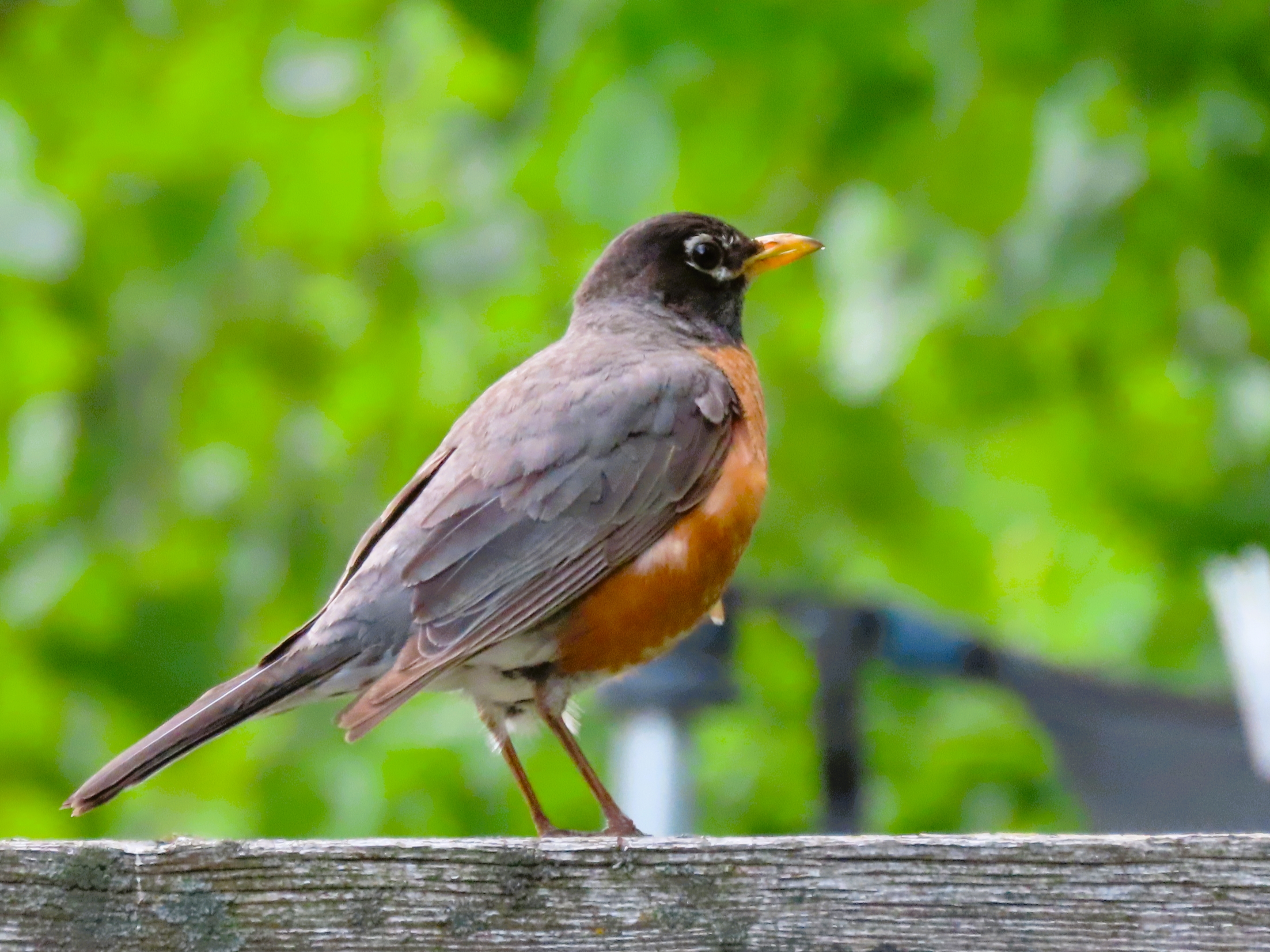

     A few years ago a pair raised young in a nest at the side of the house, and we keep hoping for a repeat performance.
     We had not realized that the chickadee nest already had young, but here is an adult carrying a juicy caterpillar into the nest box to feed hungry chicks.


     A constant shuttle was maintained by both parents.


     These little birds are kept busy. Miriam and I tallied the number of food deliveries made in two half-hour periods as follows: 09h:16 - 09h:46 - 16 visits, and 16h:30 - 17h:00 - 12 visits.
     During that period the adults have to locate prey, capture it and return to the nest box, all the while getting food for themselves to maintain their energy levels.
     On two occasions we watched the chickadees fiercely drive a goldfinch from the feeders, brooking no competition for food I presume, since there was no threat to the young. I kept the feeders filled with sunflower hearts so the adults would have ready access to sustenance.
     What goes in must come out and here is an adult leaving with a faecal sac.


     Not only do they have to feed the kids they have to clean up after them too. Sounds a bit like humans, doesn't it?

30 May, 2022

     Who doesn't enjoy having a chipmunk in the garden?


     A Common Grackle is a very attractive species, especially when viewed in sunlight to highlight the iridescence of its plumage to best advantage.
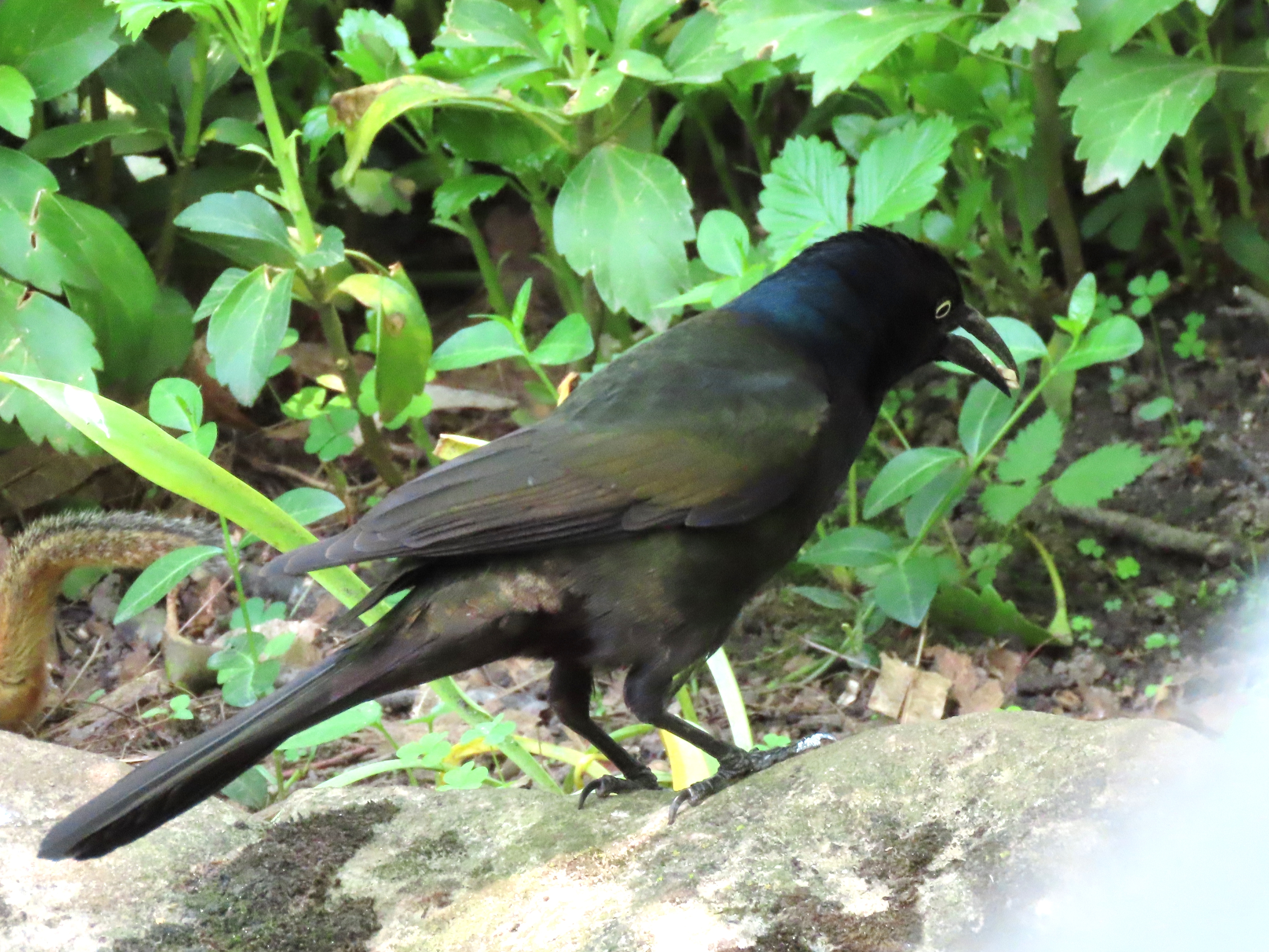

     This Black Squirrel (Sciurus carolinensis) was unusual (and very distinctive) in having a red tail.


31 May, 2022

     An Eastern Tiger Swallowtail (Papilio glaucus) is one of our most impressive butterflies.


18 June, 2022

     Many species have fed their young in our backyard, but for the first time we had a Blue Jay (Cyanocitta cristata) feeding a single juvenile.

Adult

Juvenile

      It is remarkable what can be observed in a regular suburban backyard.      

Wednesday, March 28, 2018

Weekend in Algonquin Provincial Park 24- 25 March 2018


     Last year we decided to take a late winter break in Algonquin Provincial Park and enjoyed it so much we decided to make it an annual event.
     Thus, for the second time, most of the members of The Tuesday Rambles with David group, namely Franc and Carol, Jim and Francine, Judy, and Miriam and I prepared for a couple of days of birding in the near north. This year we were joined by my daughter, Caroline, and son-in-law, Andrew, who journeyed from Ottawa and met us in the park.
     Last year we arranged with Spring Lake Resort in Dwight, ON to open up four rooms for us ahead of their normal opening date of 1 May, and this year they kindly obliged us with five rooms. It is an ideal spot for us to stay, about sixteen kilometres from the west gate of the park. Irene Pobojewski, our congenial host, permitted us last year and again this year, to swing by in the morning to plug in a crock pot of chili which was Francine's contribution to the dinner we would all enjoy together in one of the rooms that evening.
     Having taken care of this chore, we headed for the Spruce Bog Trail where Caroline and Andrew awaited us in the parking area. It was cold, minus 11.5°C, with a bit of a wind, but in the shelter of the dense stand of spruce the effect of the wind was mitigated. This is the best spot in the park for Spruce Grouse (Falcipennis canadensis), a species that will sometimes walk right up to you, but at other times can be frustratingly difficult to find. We had no luck today.


Carol, Caroline, Francine, Miriam, Judy, Jim
     Blue Jays (Cyanocitta cristata) were both numerous and noisy and they were quite happy to feast on the bird seed we left for them.


     As we moved across the exposed area of the bog, a classic northern peat bog by the way, the wind made its presence felt, and we were happy when we finally returned to the car to go down to the Visitor Centre to have lunch and check the feeders there.
     We had seen both Red Crossbill (Loxia curvirostra) and Two-barred (White-winged) Crossbill (Loxia leucoptera) feeding on minerals and grit at the side of the highway, but at the visitor centre we had much better views; with the male Two-barred Crossbill being the star of the show. Many Pine Siskins (Spinus pinus) were still present and a lingering cohort of about twenty Evening Grosbeaks (Hesperiphona vespertina) took advantage of the feeders.

Red Crossbill
Two-barred Crossbill (male)
Pine Siskin
Evening Grosbeak
      And a pair of Purple Finches (Haemorhous purpureus) was an added bonus and a lifer for Franc and Carol.

Purple Finch - male

Purple Finch - female
     It was good to sit inside with hot coffee and the lunches we had brought from home. There is a great book store to check out, but unlike last year, I don't recall anyone buying anything this year.
     After lunch we went back out on the deck where it was quite a bit warmer than it had been earlier and I ran into my old friend, Rayfield Pye, and it was great to do a little catching up. It was incredible to look back on the time we have known each other, and birded together and manned hawk watches - almost thirty-five years! Where does time go?
     Northern Raven (Corvus corax) has expanded its range south in recent years, but it is still one of the signature birds of the park, a wily opportunist that survives the worst of winter's challenges.


     After lunch we went down the Opeongo Road, one of the very best locations to see Grey Jay (Perisoreus canadensis) and we were not disappointed. This was the species Caroline had looked forward to seeing most of all and they put on a show for her. 


     Following the encounter with the Grey Jays we moved on to the Logging Museum where we spotted a Ruffed Grouse (Bonasa umbellus  almost right away and even though it played hide-and-seek with us a little we finally managed to get some fairly decent shots.


     Miriam decided this was a great spot for a group photograph.

Franc, Jim, Carol, Francine, Caroline, Andrew, David, Judy

     It was already late afternoon and we decided to head back to the motel. The Logging Museum is almost at the east gate of the park and from the east gate to the west gate is 57 km and we had a further 16 km beyond there to get to Spring Lake Resort. This is a big park, and the Highway 60 corridor cuts through the narrow part of it in the south.


     We checked in with Irene and paid our bills, then all assembled in Jim and Francine's room where the wine flowed and the food was plentiful. This really is a perfect way to end the day, much better than having to drive and find a restaurant. And the variety of food we all brought was fabulous.
    Following a good night's sleep we went to Judy's room where she made copious quantities of coffee for everyone, and even filled our thermoses for later in the day, and provided her homemade Morning Glory muffins, bran muffins and Caroline contributed a fresh fruit salad for a great breakfast. Birding on a full belly is always better than feeling hungry!
     Black-backed Woodpecker (Picoides arcticus), one of the two three-toed species in the park, is always high on the list of the special birds, but it is not an easy target to locate. We had checked the locations for recent sightings and tried our luck at the Tea Lake area, but we came up empty. The other area where a bird had been seen was the Mizzy Lake parking lot. Here we hit the jackpot. We parked and stationed ourselves at different spots around the perimeter of the parking area, and within about ten minutes Franc called with great glee, "I have it!" 


     We all saw the bird, but it then flew back and we lost sight of it. Again we all fanned out and checked different sections of the stand of dead trees where we had first seen it. Finally, Jim called us all over and the woodpecker was there in front of him feeding on a downed log.


      We watched it for at least fifteen minutes and even when it flew farther back it was still visible for us. 


     This is only the second time that I have had this kind of protracted session with this species. It was very special indeed.
     Following this excitement we went to the Visitor Centre where we had lunch from the ample leftovers from dinner the previous night and checked out the feeders again, but the activity was relatively subdued as more and more birds are moving off into their breeding territories. We decided to head home from there and bade farewell to each other, well satisfied with our weekend. We needed to go into Whitney for gas, but everyone else left to get on their way.
     We had an uneventful drive home happy in the knowledge that we will do it all again next year. Francine already has me on notice that she wants a Boreal Chickadee (Poecile hudsonicus)!

All species: Ruffed Grouse, Downy Woodpecker, Hairy Woodpecker, Black-backed Woodpecker, Grey Jay, Blue Jay, American Crow, Northern Raven, Black-capped Chickadee, Red-breasted Nuthatch, American Robin, Red-winged Blackbird, Purple Finch, Red Crossbill, Two-barred Crossbill, Pine Siskin, American Goldfinch, Evening Grosbeak.  Total: 18


Sunday, October 28, 2012

Purple Finch, Carpodacus purpureus

    We have been fortunate over the last few days to have at least three Purple Finches visiting our feeders regularly. There is an adult male, a juvenile male and a female. 
    This species breeds farther north than the Waterloo region in the conifer forests of Northern Ontario and generally is sedentary if the seed mast is adequate to provision them through the winter. If the conifer seeds within the breeding range are in short supply, however, a southward migration occurs and this is the situation this year. We can expect to see Purple Finches throughout the winter in our area and many will migrate even farther south. 
    They often associate with American Goldfinches Carduelis tristis and Pine Siskins Carduelis pinus and, in fact, yesterday we saw the first Pine Siskin of the fall at our feeders also. American Goldfinches are year round residents and are customary visitors to our backyard.

    Observers unfamiliar with this species should have no difficulty separating it from the superficially similar House Finch Carpodacus mexicanus by consulting a reliable field guide. Even the females can be told apart with a little practice.
  

Land Acknowledgement

We acknowledge that the land on which we are situated are the lands traditionally used by the Haudenosaunee, Anishinaabe, and Neutral People. We also acknowledge the enduring presence and deep traditional knowledge, laws, and philosophies of the Indigenous Peoples with whom we share this land today. We are all treaty people with a responsibility to honour all our relations.

Followers