Showing posts with label Jürgen Tautz. Show all posts

Monday, October 06, 2025

Dancing Bees.........and more.


     It is probably true to say that most biologists and naturalists, and indeed all entomologists, are familiar with the legendary Nobel laureate, Karl von Frisch, and his discovery of the dance language of honeybees, generally referred to in popular parlance as the "waggle dance", (https://www.nobelprize.org/prizes/medicine/1973/frisch/facts/), a technique by which a bee communicates to others in the hive the location of a food source. For so many years this discovery has been the very essence of orthodoxy, passed on by professors and teachers, taught in institutions wherever entomology is offered. It goes to the very nature of science, however, that orthodoxy must be constantly challenged with a view to cementing its acceptance, or revealing cracks in the armour of certainty, or offering new facts to contradict, modify or enhance established dogma. 
     It must be intimidating for a researcher to mount a challenge to the work of a Nobel laureate, ("...after all von Frisch's central idea has been regarded as one of the premier scientific hypotheses of the 20th century") and I commend Professor Jürgen Tautz for his research that adds to the original innovative studies of von Frisch. Tautz approaches this entire scientific exploration with reverence and respect for what has gone before, with a singular devotion to adding new information to an already 'miraculous' aspect of insect intelligence. 
     There is indeed a waggle dance. Yet there is more! Various auxiliary hypotheses have been formulated, none supported by conclusive evidence, however. Until Tautz, that is.


     I first encountered the work of Jürgen Tautz several years ago and was struck by the originality of his approach and the convincing results of his study.
     More recently I came across a feature in the journal Elsevier where Tautz presented a synopsis of his theory (https://www.elsevier.com/connect/the-language-of-honeybees-a-revision) and was drawn anew to this fascinating topic of bee intelligence. More than that, however, I was once again struck by the acceptance and understanding of Tautz's conclusion, its universality and its widespread embrace.
      Essentially, the bee dance is the foundation of a three-phase sequence, founded in von Frisch’s work; in fact it is in many respects an homage to the great man.  The first phase may rightly be called the "von Frisch phase."
      Permit me to quote directly from Dr. Tautz.

Phase 1: Sent - The recruit flies out of the hive in the approximate direction and distance indicated by the dance: headed toward the general search area. 

Phase 2: Search - The bee reaches the search area, where the exact location, shape, and extent of the search zone are influenced by external factors (such as weather) and internal factors (such as motivation).

Phase 3: Attraction - If the recruit encounters floral scent or signals from the dancer in the field, it can orient toward and arrive at the target.

     Clearly the dance is only one of the ingredients promoting success;  a foundational step but not the only one, and communication after the dance is the key to success.


     It has been a maxim throughout the long history of scientific research that nature often acts as a perfect model for human innovation. In the words of Dr. Tautz, "It is fascinating that this three-phase strategy for reaching distant goals appears in other contexts, such as long distance migration in birds, or space missions like the recent DART project targeting the 16-metre-diameter asteroid eleven million kilometres away."
      We are fortunate to live in age of intensive research, aided by computer algorithms and sophisticated (and ever-improving technology). In addition to Jürgen Tautz we may revel in the work of Lars Chittka, Thomas D. Seeley, Laurence Packer and others. I am sure that Karl von Frisch would be pleased, and perhaps even a little envious at not being here to enjoy it! 

Thursday, December 14, 2023

More About Bees - Another Serving of Tautz

      A recent foray into the world of bees leads me to this short post about my favourite bee scientist, Jürgen Tautz,  and his work.
     I discovered that Tautz's book on honeybees has been translated into more languages than any other work on honeybees, even going back to the days of Karl von Frisch.


     Von Frisch, need I remind you, was a Nobel laureate, with all the cachet that implies, and his popular books on bees were translated, but not into as many languages as Tautz.
     Impressive results from an impressive scientist! In an age when pollinators - and insects in general - are under serious threat, the wider the dissemination of information the better.
     Well done Dr. Tautz!

Saturday, December 02, 2023

Jürgen Tautz, Bee Scientist Extraordinaire

      One of the common reactions to the book reviews I publish here on my blog is the wish that the work was available in translation; not everyone can read English well, especially a book dealing with a technical subject.
     I am happy to report that some of the works of Dr. Jürgen Tautz, a remarkable expert on bees, and a writer who is capable of conveying complex information in a very readable style, have been made available in French and Polish. I hold Jürgen in the highest esteem and it pleases me greatly that wider access to his books is now available. 


     I say without hyperbole that one of the most important works I have reviewed - ever (Communication Between Honeybees) - is now available in both French and Polish.


     It is a significant step forward that there is an ever-expanding audience for this very important work with its revelations about bee communication.


     Furthermore, an earlier collaboration between Ingo Arndt and Jürgen Tautz (Wild Honey Bees - An Intimate Portrait) is now accessible to a French audience.


     The photographs alone in this book will stun you! Their complex beauty is an admission ticket to the inner workings of the life of wild bees, in details never before revealed.
     A couple of other works are available to a French audience too, but these are works that I have not reviewed. A Tautz book, however, is an imprimatur of excellence; I have no doubts about making that assertion sight unseen.


     As the world plunges headlong into war after war, and political expediency and deceit cause our stomachs to churn, it is good to acknowledge that there remains some sanity in the world. Books are being translated and widely disseminated, not banned. 
     Imagine that!

Monday, August 29, 2022

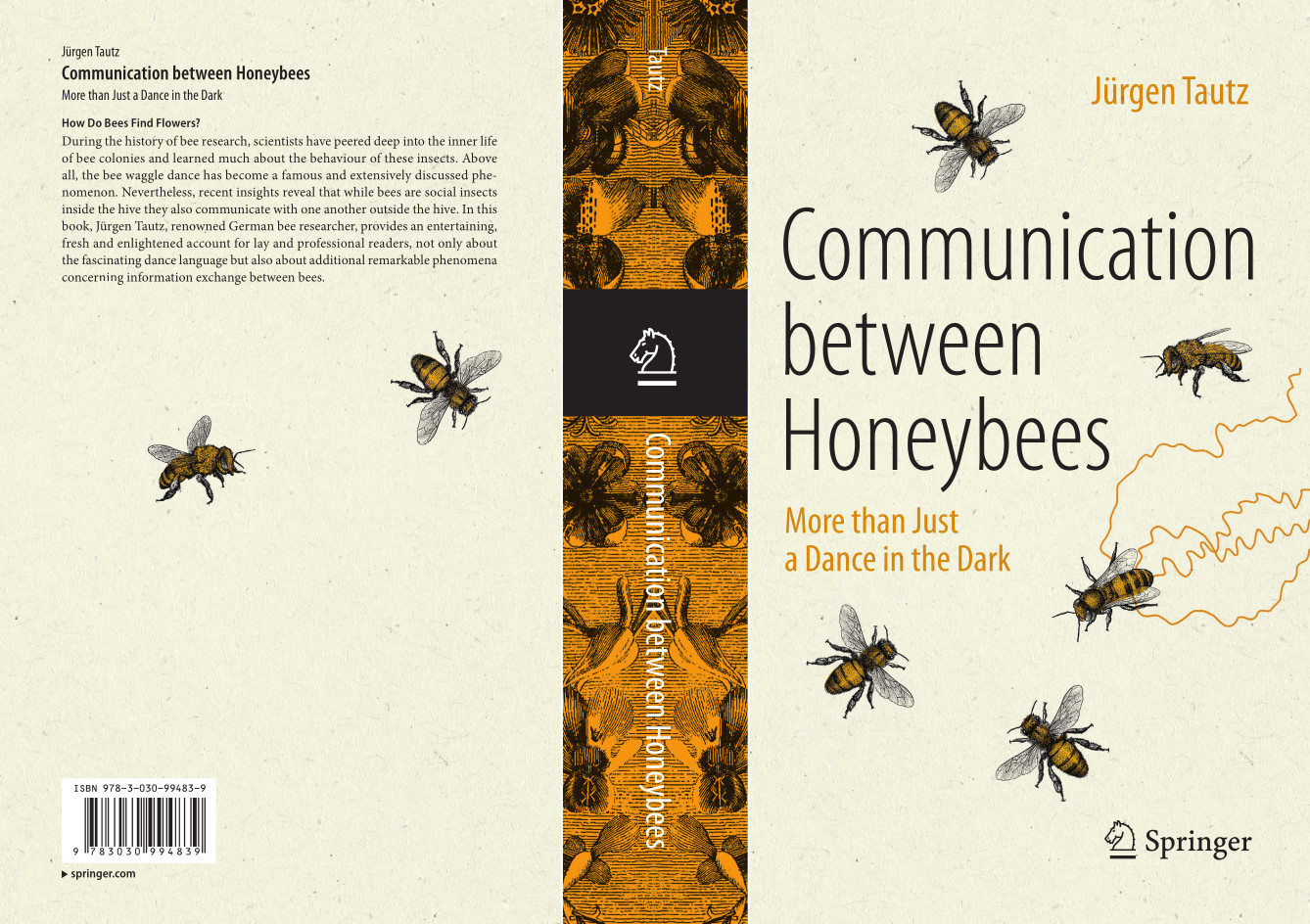
Book Review - Communication between Honeybees : More than Just a Dance in the Dark - Springer Nature


      Just when you thought you knew all there was to know about bee communication, along comes a book to dispel that myth!
     Jürgen Tautz is a renowned researcher and a formidable communicator, blessed with that rare ability to write a book filled with information for the scientific reader yet equally accessible to the lay person. The central theme explored in this work, as is implied by the subtitle "more than just a dance in the dark", is that while the waggle dance is an important source of communication among bees, it does not reveal the whole story. It is overvalued insofar as it ignores communication outside the hive.
     The waggle dance was first recognized by Karl von Frisch, who, along with Nikolaas Tinbergen and Konrad Lorenz, was awarded a Nobel Prize. It became established orthodoxy, accepted at face value by most researchers that the dance conveyed all information required to locate a source of food; to challenge a Nobel laureate requires a certain degree of bravery after all!
     Tautz does not question the central importance of the waggle dance, nor von Frisch's contribution to the science of bees, but he argues that it is useful only in conjunction with communication received outside the hive - "Previous research on the dance language of bees concentrated mostly on what happens in hives and at food sites and ignored events in the field" (p. 111).  Bees following a scent trail, for example, are using external stimuli to locate a foraging area, supplementing the primary information communicated by the waggle dance.

Communication in the open (Ingo Arndt)

     The following infographic succinctly illustrates the relationship between communication in the hive via the waggle dance and its fine tuning outside the hive.


     This should be displayed prominently as a poster wherever entomology is taught - on any level!     
     As the reader goes through this book, Tautz takes us on a tour of the research throughout the ages that leads us to where we are today, from Aristotle to Spengel, to Maeterlinck, to Gould - and many others.
     The waggle dance serves also to enable bee swarms to locate and occupy new homes, but this would be impossible without communication in the field. From the book beginning on page 122 -

"Everything that research has presented so far to confirm the classical thesis that despite inaccuracies the bee dance leads the bees directly to the food source falls away in the recruitment of small cohorts to a newly discovered nest site:

1. In this most critical phase, bees cannot derive an averaged correct instruction from many (half-true) dance rounds because at first only a single bee dances for the goal.
2. To spread out over an area, advantageous for a broad field of flowers, would be fatal. A single advertised hollow must be visited, virtually a single point in the landscape.
3. No goal-orienting signals emanate from the hollow.
4. Without a continuation of communication in the field, each scout bee would remain alone with her discovery and no recruit would arrive at the site." (Emphasis mine).

     Time and again, Tautz illustrates that the bee dance is the initial component of communication - but not the whole story, and acted on alone would result in failure.
     The book concludes with an excellent glossary and a magnificently comprehensive list of further references. 
     It has been a unique privilege for me to review this book, and I would find it impossible to adequately summarize what I have learned from it. Every so often, a text comes along that stands out from all others, written by a dedicated researcher possessed of the talent required to convey complex science to a wide audience. I take my hat off to Jürgen Tautz who has accomplished just that, and the world of bee research is all the better for it.

Communication between Honeybees: More than Just a Dance in the Dark - Springer Nature
Author: Jürgen Tautz
165 pages - 59 colour illustrations - 8 b/w illustrations
ISBN 978-3-030-99483-9
Publishing September 2022


Saturday, January 01, 2022

Book Review - Wild Honey Bees, An Intimate Portrait - Princeton University Press


     Before going any further, it behooves me to issue a word of caution. Be sure to leave yourself lots of time when opening this book. The photographs are so staggeringly beautiful that it is going to take you a couple of minutes to turn each page! The detail is incredible, especially the images from inside the nest, many of which have never been photographed before.

Land Acknowledgement

We acknowledge that the land on which we are situated are the lands traditionally used by the Haudenosaunee, Anishinaabe, and Neutral People. We also acknowledge the enduring presence and deep traditional knowledge, laws, and philosophies of the Indigenous Peoples with whom we share this land today. We are all treaty people with a responsibility to honour all our relations.

Followers