Showing posts with label Grey Jay. Show all posts

Wednesday, March 28, 2018

Weekend in Algonquin Provincial Park 24- 25 March 2018


     Last year we decided to take a late winter break in Algonquin Provincial Park and enjoyed it so much we decided to make it an annual event.
     Thus, for the second time, most of the members of The Tuesday Rambles with David group, namely Franc and Carol, Jim and Francine, Judy, and Miriam and I prepared for a couple of days of birding in the near north. This year we were joined by my daughter, Caroline, and son-in-law, Andrew, who journeyed from Ottawa and met us in the park.
     Last year we arranged with Spring Lake Resort in Dwight, ON to open up four rooms for us ahead of their normal opening date of 1 May, and this year they kindly obliged us with five rooms. It is an ideal spot for us to stay, about sixteen kilometres from the west gate of the park. Irene Pobojewski, our congenial host, permitted us last year and again this year, to swing by in the morning to plug in a crock pot of chili which was Francine's contribution to the dinner we would all enjoy together in one of the rooms that evening.
     Having taken care of this chore, we headed for the Spruce Bog Trail where Caroline and Andrew awaited us in the parking area. It was cold, minus 11.5°C, with a bit of a wind, but in the shelter of the dense stand of spruce the effect of the wind was mitigated. This is the best spot in the park for Spruce Grouse (Falcipennis canadensis), a species that will sometimes walk right up to you, but at other times can be frustratingly difficult to find. We had no luck today.


Carol, Caroline, Francine, Miriam, Judy, Jim
     Blue Jays (Cyanocitta cristata) were both numerous and noisy and they were quite happy to feast on the bird seed we left for them.


     As we moved across the exposed area of the bog, a classic northern peat bog by the way, the wind made its presence felt, and we were happy when we finally returned to the car to go down to the Visitor Centre to have lunch and check the feeders there.
     We had seen both Red Crossbill (Loxia curvirostra) and Two-barred (White-winged) Crossbill (Loxia leucoptera) feeding on minerals and grit at the side of the highway, but at the visitor centre we had much better views; with the male Two-barred Crossbill being the star of the show. Many Pine Siskins (Spinus pinus) were still present and a lingering cohort of about twenty Evening Grosbeaks (Hesperiphona vespertina) took advantage of the feeders.

Red Crossbill
Two-barred Crossbill (male)
Pine Siskin
Evening Grosbeak
      And a pair of Purple Finches (Haemorhous purpureus) was an added bonus and a lifer for Franc and Carol.

Purple Finch - male

Purple Finch - female
     It was good to sit inside with hot coffee and the lunches we had brought from home. There is a great book store to check out, but unlike last year, I don't recall anyone buying anything this year.
     After lunch we went back out on the deck where it was quite a bit warmer than it had been earlier and I ran into my old friend, Rayfield Pye, and it was great to do a little catching up. It was incredible to look back on the time we have known each other, and birded together and manned hawk watches - almost thirty-five years! Where does time go?
     Northern Raven (Corvus corax) has expanded its range south in recent years, but it is still one of the signature birds of the park, a wily opportunist that survives the worst of winter's challenges.


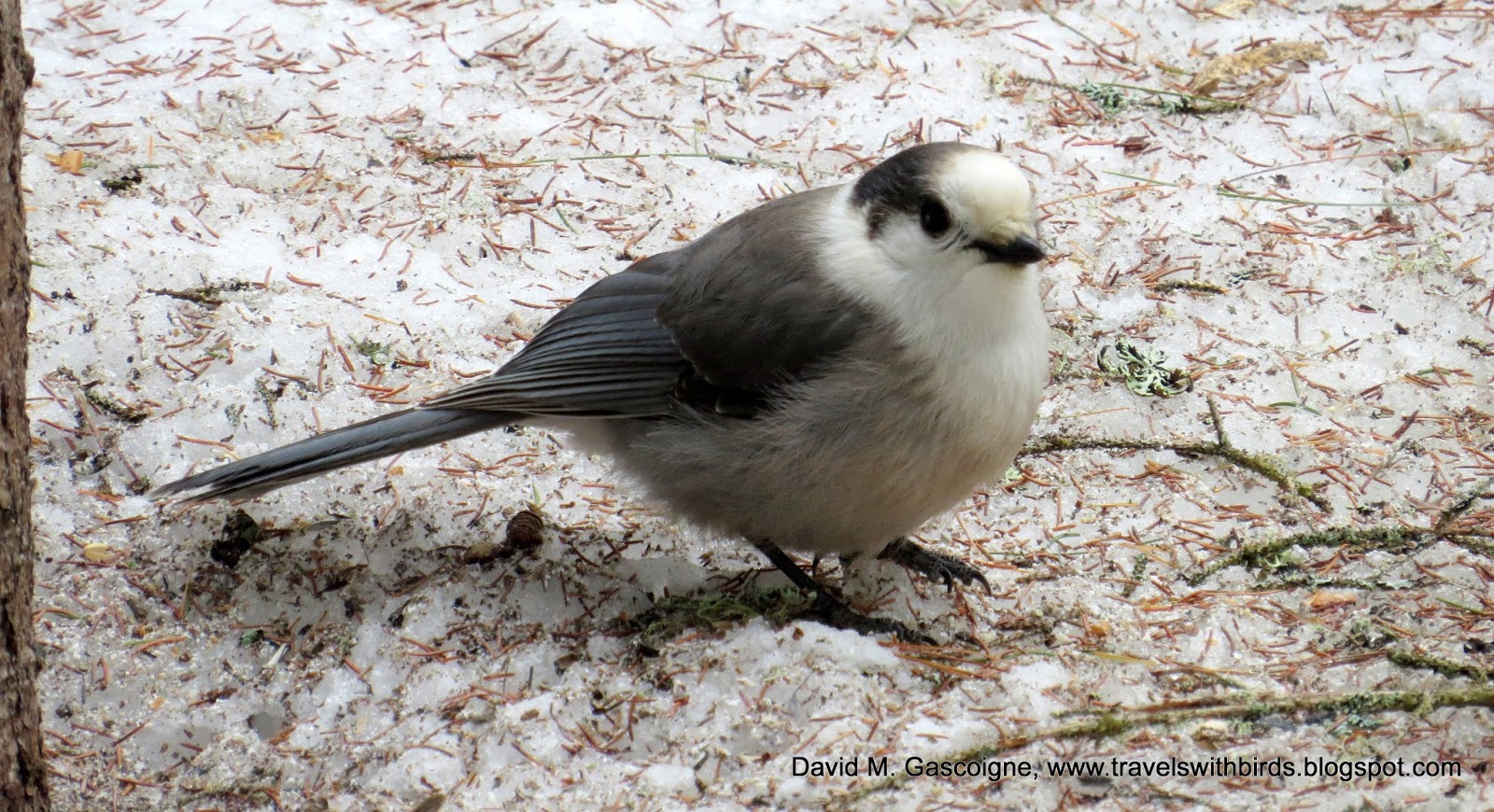
     After lunch we went down the Opeongo Road, one of the very best locations to see Grey Jay (Perisoreus canadensis) and we were not disappointed. This was the species Caroline had looked forward to seeing most of all and they put on a show for her. 


     Following the encounter with the Grey Jays we moved on to the Logging Museum where we spotted a Ruffed Grouse (Bonasa umbellus  almost right away and even though it played hide-and-seek with us a little we finally managed to get some fairly decent shots.


     Miriam decided this was a great spot for a group photograph.

Franc, Jim, Carol, Francine, Caroline, Andrew, David, Judy

     It was already late afternoon and we decided to head back to the motel. The Logging Museum is almost at the east gate of the park and from the east gate to the west gate is 57 km and we had a further 16 km beyond there to get to Spring Lake Resort. This is a big park, and the Highway 60 corridor cuts through the narrow part of it in the south.


     We checked in with Irene and paid our bills, then all assembled in Jim and Francine's room where the wine flowed and the food was plentiful. This really is a perfect way to end the day, much better than having to drive and find a restaurant. And the variety of food we all brought was fabulous.
    Following a good night's sleep we went to Judy's room where she made copious quantities of coffee for everyone, and even filled our thermoses for later in the day, and provided her homemade Morning Glory muffins, bran muffins and Caroline contributed a fresh fruit salad for a great breakfast. Birding on a full belly is always better than feeling hungry!
     Black-backed Woodpecker (Picoides arcticus), one of the two three-toed species in the park, is always high on the list of the special birds, but it is not an easy target to locate. We had checked the locations for recent sightings and tried our luck at the Tea Lake area, but we came up empty. The other area where a bird had been seen was the Mizzy Lake parking lot. Here we hit the jackpot. We parked and stationed ourselves at different spots around the perimeter of the parking area, and within about ten minutes Franc called with great glee, "I have it!" 


     We all saw the bird, but it then flew back and we lost sight of it. Again we all fanned out and checked different sections of the stand of dead trees where we had first seen it. Finally, Jim called us all over and the woodpecker was there in front of him feeding on a downed log.


      We watched it for at least fifteen minutes and even when it flew farther back it was still visible for us. 


     This is only the second time that I have had this kind of protracted session with this species. It was very special indeed.
     Following this excitement we went to the Visitor Centre where we had lunch from the ample leftovers from dinner the previous night and checked out the feeders again, but the activity was relatively subdued as more and more birds are moving off into their breeding territories. We decided to head home from there and bade farewell to each other, well satisfied with our weekend. We needed to go into Whitney for gas, but everyone else left to get on their way.
     We had an uneventful drive home happy in the knowledge that we will do it all again next year. Francine already has me on notice that she wants a Boreal Chickadee (Poecile hudsonicus)!

All species: Ruffed Grouse, Downy Woodpecker, Hairy Woodpecker, Black-backed Woodpecker, Grey Jay, Blue Jay, American Crow, Northern Raven, Black-capped Chickadee, Red-breasted Nuthatch, American Robin, Red-winged Blackbird, Purple Finch, Red Crossbill, Two-barred Crossbill, Pine Siskin, American Goldfinch, Evening Grosbeak.  Total: 18


Monday, March 26, 2018

Grey Jay (Mésangeai du Canada) in Algonquin Provincial Park

     We just returned from a weekend in Algonquin Provincial Park, one of the jewels in the Ontario park system, and a full report of this adventure will follow in the next day or two.
     In the meantime I would like you to meet the Grey Jay (Perisoreus canadensis), a bird which for me symbolizes the park.


     The great trove of research done on this bird was carried out primarily in Algonquin Provincial Park by Dan Strickland, a park biologist, now retired. The work that he did, and the techniques he developed to follow the birds and locate their nests is the stuff of legend. 
     

     Unfortunately, the birds in the park are in trouble. Their numbers have declined substantially over the last twenty-five or thirty years, due to the effects of global warming. It still staggers me to think that virtually the entire US government denies that it even exists and its leaders are actively rolling back measures enacted to combat it.
     One of the main issues facing the Grey Jay, which is already nesting in February, is its inability to successfully store winter food. Grey Jays have extra large mandibular glands that produce a sticky saliva for forming sticky boli (singular, bolus) of food which they then attach to the bark of trees and cache them away in various nooks and crannies. Winter in Algonquin used to mean solid freeze up from November through early April. Now repeated thaws are causing the food to rot, or at the very least develop the equivalent of freezer burn, which diminishes the nutritional value of the stored winter supply. Without adequate food to feed their young (and sometimes themselves) birds are simply not laying eggs.


     These birds are quite confiding and it gives visitors great pleasure to stretch out their hands and experience the joy that contact with a wild creature uniquely brings. Most people provide sunflower seeds or peanuts, a welcome supplement for the birds, but as we witnessed, visitor largesse is not always benign - we saw a well-meaning woman feeding them banana bread.


     Grey Jay is a northern species, and Algonquin Provincial Park is its southern limit. We can only hope that it will continue to do well in the vast boreal forests of northern Ontario and beyond.
     Grey Jay (also sometimes called Canada Jay, and in times past Whisky Jack or Camp Robber) is Canada's unofficial national bird. A poll was organized a couple of years ago by Canadian Geographic Society and Grey Jay was the clear winner (in case you are wondering it was not my choice!), but the Government of Canada has never officially enacted the necessary legislation to enshrine it as our national birds.


     It's understandable; they are far too busy trying to get pipelines approved, against the wishes of everyone who lives along their routes. People protesting construction and extension of pipelines routinely get arrested, including recently the leader of the Green Party of Canada. Now that's important stuff. Who has time for a national bird?

Friday, March 31, 2017

Algonquin Adventure

28 - 29 March 2017


28 March 2017
Waterloo - Algonquin Provincial Park - Dwight

     A while ago I proposed to the "Tuesday Rambles with David" group that we expand our reach a little and opt for a two day visit to Algonquin Provincial Park, about a four hour drive from Waterloo.
     The response was immediate and enthusiastic so I went ahead and secured accommodation and made plans to visit the park to see the unique species to be observed there. Algonquin encompasses habitat from the deciduous hardwood zone found in the southern part of the province, and the boreal forest which reaches its southern limit at Algonquin, so there are representatives of birds from both habitat zones.
     We set off from home at 06:30 and had a smooth and uneventful drive north. We were staying at Spring Lake Resort and stopped there around 10:00 so that Francine could plug in her crock pot of chili which would be part of our dinner that night. 
     A couple of Common Ravens Corvus corax flew overhead, croaking loudly, just to let us know we were in the north.
     We set off for the park and entered in high spirits, ready for a day of discovery.


     Algonquin is still firmly in the grip of the icy hand of winter with lots of snow on the ground. The bogs, lakes and wetlands are for the most part still frozen, although the first spring melt was starting to open up small patches of open water, and rapids flowed freely.
     Soon Black Bears Ursus americanus will awake from hibernation, Moose Alces alces 
will give birth to their young in late May and the park will be filled with warblers arriving from the neotropics. For now, however, the number of species is low and we set out to find the boreal specialties for which the park is renowned, and which we had come to see.
     Our first stop was at the Spruce Bog Boardwalk where, immediately upon entering the trailhead, Blue Jays Cyanocitta cristata descended from all around. After a whole winter of hikers, snowshoers and birders the jays have quickly recognized that the presence of humans means food.
      And we had sunflower seeds and peanuts with us and were happy to share.


    American Red Squirrels Tamiasciurus hudsonicus do not hibernate, but restrict their activity in the dead of winter to a couple of hours during the warmest part of the day. Clearly, spring had arrived for them, however, for we were seldom out of sight of several scampering around, looking for food and scolding us..


          The forest was still deep in snow with many animals locked in their burrows and dens beneath it.


     Red-breasted Nuthatches Sitta canadensis were very common and they had no hesitation in coming to us for seed.


     Carol did not even have time to take seed out of her jar before this bold individual landed on it, beating its competitors to the food.
     Set against the lichen on the conifers this tiny bird looks splendid indeed, the pattern of the lichen creating a Christmas card look.


     As we set off across the frozen bog, the landscape which will be buzzing with mosquitoes and black flies in a few months, looked foreboding and still. It had felt quite warm deep in the cover of the spruce, but the wind blowing unimpeded across the open space lent a frigid chill to the air.


     We were happy to regain the cover of the trees. 


     The temperature both days went above freezing and spring melt is starting to occur, but the mercury dips below freezing at night and deep snow is still the most common condition.


     Just before regaining the parking area we were both surprised and delighted to see three Snow Buntings Plectrophenax nivalis, in advanced moult; soon their breeding plumage will be complete.


     Algonquin Provincial Park does not have many open spaces with weedy fields, the preferred habitat of Snow Buntings, so it is a rare visitor.
     It was by now lunchtime and we went to the Visitor Centre where we could sit inside in the warmth and enjoy our meal together. Hot drinks were available too and most of us took advantage of them.


     The planners have done a magnificent job with this structure and the view from the deck is nothing short of sublime.


     One of the great attractions of the Visitor Centre is the presence of numerous well-stocked feeders attracting a variety of birds. Chief among the desirable species is Evening Grosbeak Hesperiphona vespertina, a spectacular bird by any standards. Here are several resplendent males.


     And the females look pretty spectacular too.


     Pine Siskin Spinus pinus was very common at the feeders.


      As they are right in our backyard, American Goldfinches Spinus tristis are transforming themselves from their olive drab of winter to their rich gold of spring.


     From the Visitor Centre we travelled farther east in the park to the Logging Museum and the East Gate where we encountered mainly Blue Jays and Pine Siskins.
     Our last stop of the day was at the Opeongo Road, generally a reliable spot to find Grey Jay Perisoreus canadensis, a species with northern affinities, which is found about as far south as it gets in Algonquin Park. We were not disappointed!


      This population has been studied intensively for years and most birds are colour banded. Much of what is known about Grey Jays is based on the lifelong work of Dan Strickland, a park biologist now retired.
      An added bonus was the presence of a pair of Red Crossbills Loxia curvirostra. This species, although common sporadically in irruption years, is generally rare, and it is many years since I saw one in the park.


Red Crossbill - Male

     Muskrat lodges thrust up above the ice; before long these animals which for so long formed a critical part of the fur trade, will be swimming  along the waterways unmolested by humans.


     We headed back to our accommodation after a full and very productive day of birding. We had a fine feast together, anchored by Francine's chili, but with a whole array of other food and lots of wine to help it all go down. Everyone contributed something different so we dined well to say the least.


Accommodation: Spring Lake Resort, Dwight, ON  Rating: Four stars

Cost: $99.00 per night plus tax - $111.87


29 March 2017
Dwight - Algonquin Provincial Park - Waterloo

     We slept well and had a coffee in the room, after which we all went for breakfast at a little quick stop/restaurant in Dwight.
     An American Robin Turdus migratorius was singing and several Common Ravens soared overhead uttering their loud cronking call.


      Along the road I spotted a pair of Red Crossbills and we wheeled around to get a better look and take some photographs.

Red Crossbill - pair
  
     We had been searching for Ruffed Grouse Bonasa umbellus yesterday, without success.
so we returned to the Visitor Centre, where this species sometimes feeds on seed spilled on the ground in the early morning. We did not find the grouse, unfortunately, but it was a great pleasure to revel in the species we had seen yesterday, including a very large congregation of Pine Siskins.


       As already mentioned, the Visitor Centre has been very well executed. This sculpture is located right inside the entrance.  


     We made a trip into Whitney on the east side of the park to get gas, since Jim felt he was sufficiently low he might not have enough to make it back out of the park, and we would all need to refuel before heading home anyway.
     We then returned to the Spruce Bog Boardwalk where we had  enjoyed so much success yesterday. Blue Jays and Black-capped Chickadees Poecile atricapillus immediately descended on us and scrounged for a quick meal.


     We had only been standing there for a few minutes when Franc called out "Grey Jay" and a bird came in really close. Eventually we discovered that there were two or three individuals in the vicinity.


     It truly is a delightful species and was recently named Canada's National Bird based on a nation-wide vote. All that needs to be done now is to have parliament vote to make it official.
     We were all thrilled to see a Red Fox Vulpes vulpes come to visit us.


     This animal was in prime condition with a sleek, glossy coat. There was a large suet feeder nearby and we figured that the fox had probably been attracted to it during the winter when birds drop morsels onto the ground and it had become accustomed to humans. It was wary and maintained a safe distance between itself and us, but it was nevertheless unafraid, and sufficiently habituated to know that it could get an easy meal.


     Miriam took the time to gather us all together for a group shot......


     ..................and I took one of her and the illustrious Judy Wyatt.


     A fine representation of Canadian womanhood if ever I saw one!

     As we walked along we saw Grey Jays and two female Hairy Woodpeckers Picoides villosus exploiting the forest resources.


     Finally, we decided that it was time to head for home and we meandered back to the parking area. Miriam, the picture taker, was obviously bringing up the rear.


     It had been a fine outing and we saw most of the species we had hoped to see. There were a few misses, but we'll have to save those for next year.
     Our drive home was uneventful and we were back at our house, where Judy had left her vehicle, by a little after 16:00.
     To Franc and Carol, Jim and Francine, Judy and Mary (who couldn't make this trip) thanks for great companionship every single week. It is a delight to hang out with you guys.

Land Acknowledgement

We acknowledge that the land on which we are situated are the lands traditionally used by the Haudenosaunee, Anishinaabe, and Neutral People. We also acknowledge the enduring presence and deep traditional knowledge, laws, and philosophies of the Indigenous Peoples with whom we share this land today. We are all treaty people with a responsibility to honour all our relations.

Followers