Showing posts with label Caspian Tern. Show all posts

Monday, August 15, 2022

More Odds and Ends

02 August, 2022
Columbia Lake, Waterloo, ON

     There is cause for despair over the long period of drought we have been experiencing, although our situation in southern Ontario is nowhere near as dire as in many parts of the world where entire ecosystems are being incinerated.


     When I see this parched lake-bed, baking in the sun, I cannot help but fume at the folly of continuing to ignore climate change. Entire trophic chains are obliterated under conditions such as this; how much they can recover is anyone's guess given that the planet is on target to get hotter over the next few decades. There are no benthic invertebrates to feed the myriad small creatures that inhabit the lake bottom, in turn preyed upon by small fish which fall victim to large fish, to provide food for obligate piscivores like ospreys, terns, kingfishers and so on, to say nothing of majestic eagles and stealthy herons - and on it goes. The link has been broken, and for those who think we are not affected by it, a rude awakening lies  in store.
     As John Donne so eloquently phrased it, "..... never send to know for whom the bell tolls; it tolls for thee."
     On the few areas where a little water persisted, and mud was created, Semipalmated Plovers (Charadrius semipalmatus) plied their trade.


     A couple of Spotted Sandpipers (Actitis macularius) flew in to join the parade, one of them disappearing almost immediately. How well they can blend into a rocky shore.


     This wonderfully attractive maple is an Amur Maple (Acer ginnala), native to eastern Asia, but now localized in the landscape of the temperate zones of North America.


     Attractive though it may be, it nevertheless competes with native species for scarce resources.
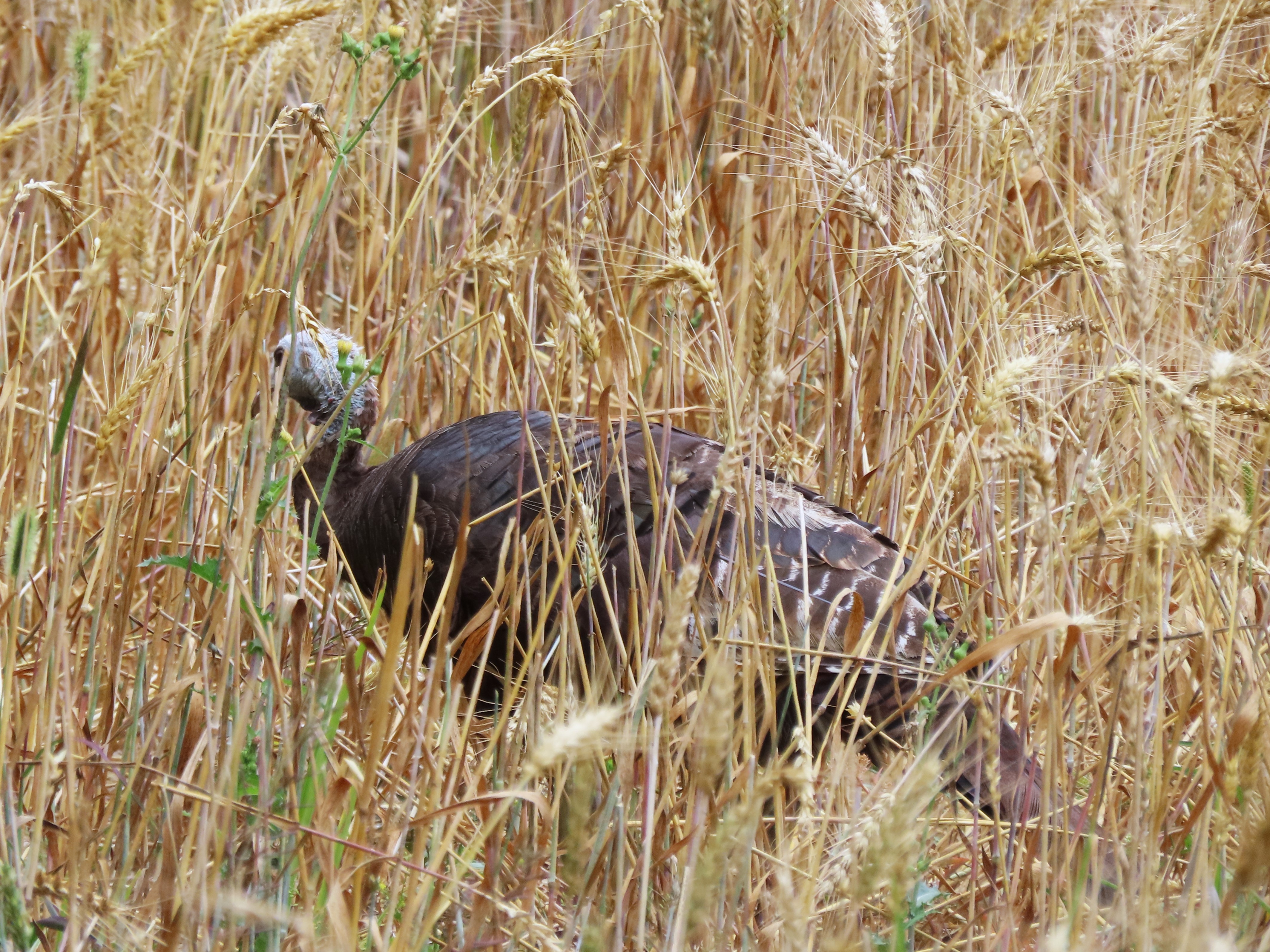
     A Wild Turkey (Meleagris gallopavo) exploits every nook and cranny of woodland and meadow with great success.

05 August, 2022
A Country Drive

     We went for a leisurely drive, primarily motivated by the desire to pick up fresh corn for dinner. In terms of birding, the dog days of summer are upon us, with most species busy raising a family, and with no need to sing, stillness descends on the landscape. Many species will already be winging their way south by month's end.
     A Great Blue Heron (Ardea herodias) claimed a rock to himself; he was indeed king of the castle. 


     With lightening reflexes and a stiletto for a bill, I doubt there would be many challengers.
     Barn Swallows (Hirundo rustica) and their young are fattening up for the long journey ahead.


09 August, 2022
West Perth Wetlands, Mitchell, ON

     This location has long been one of our favourite destinations and over the years has delivered some outstanding species.


     Today we met a species brand new to us - our first genuine climate migrant. We chatted with a couple (and their dogs) who had moved to Mitchell from interior British Columbia, sick of dealing with the constant smell of smoke, with its attendant threat to respiratory health - to say nothing of the real possibility of losing their home to rampant, uncontrollable wild fires. There will doubtless be more to follow.
     Wood Ducks (Aix sponsa) have been a presence on the wetland for many years, and after a successful breeding season may be seen in very large numbers, in every stage of plumage from day-old duckling to adult, with males in transition from eclipse plumage back to their breathtaking splendour.


     Lesser Yellowlegs (Tringa flavipes) arrive from their Arctic breeding grounds and are happy to associate with ubiquitous Mallards (Anas platyrynchos).


     A Wood Duck joined the party to make it a trio.


     A Burr Oak (Quercus macrocarpa) had a prodigious crop of acorns.


     There will be many happy squirrels this year!
     No doubt Cedar Waxwings (Bombycilla cedrorum) and American Robins (Turdus migratorius)  will be equally delighted with the fine crop of berries on Guelder Rose (Viburnum opulus).


11 August, 2022
Columbia Lake, Waterloo, ON

     Miriam and I were sitting at home, unusually for us not doing much of anything, so we decided to visit Columbia Lake, a mere five minutes from our house, where a substantial contingent of Great Egrets (Ardea alba) had been reported. 
     All but one had departed, but one was enough for us, and we revelled in the graceful elegance of this denizen of the waterways.


     It is sobering to reflect on the fact that it was almost driven to extinction by feather traders seeking to satisfy the fashion for egret plumes for women's hats. And if you had a few stuffed hummingbirds to go along with it so much the better! 
     A Great Blue Heron is perhaps no less elegant than the egret, but pristine whiteness seems to confer extra cachet, probably because we are less familiar with it, and for no darker meaning than that.


     A Caspian Tern (Hydroprogne caspia) is an impressive bird with that blood-red bill looking vaguely like a carrot. Adult and juvenile together is a fine study.


     Inside the mouth of the bird is as crimson as the mandibles.


     Ring-billed Gulls (Larus delawarensis), as gulls are prone to do on a hot day, were happy to loaf at the water's edge.


     All of the foreground you see would normally be underwater, and as you may see from the standing gulls, it will not take many more days of heat to evaporate what water remains.
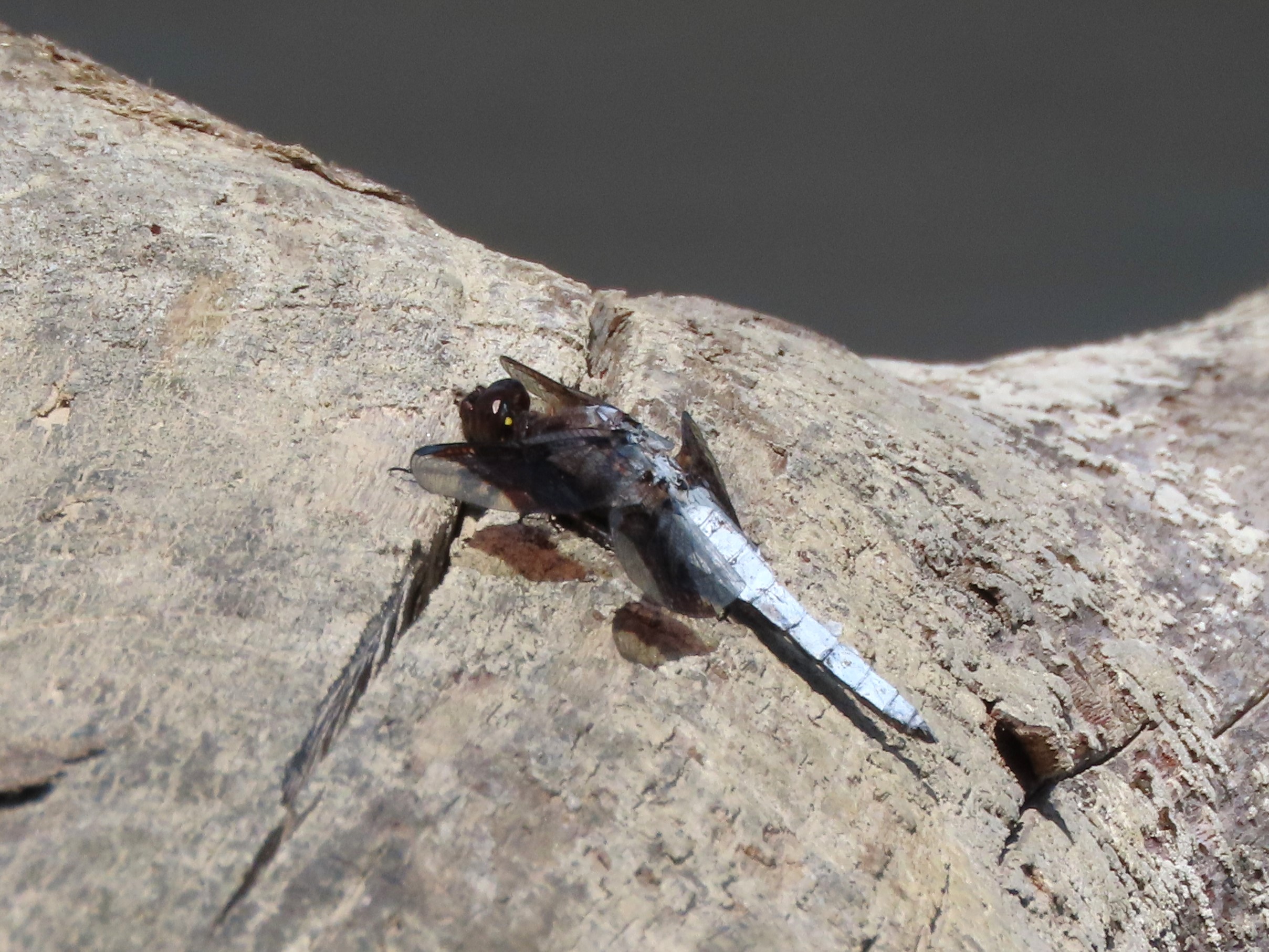
     A Common Whitetail (Plathemis lydia) is very common in July and August.

     Coneflowers have passed their prime, probably at least in part due to being starved for moisture.


     Ants appeared to find what they were looking for on Wild Carrot (Daucus carota), otherwise known by the grander name, Queen Anne's Lace.


     At the far corner of the lake, partly shaded by trees is an area that holds water longer than anywhere else and the Caspian Terns were feeding there. Can you see them almost at dead centre in the picture?


     We saw them make a couple of successful plunges; no doubt the fish are compressed into ever smaller pools making for easy pickings. A second Great Blue Heron seemed to reinforce the point.


     Thanks for stopping by my blog today.

Wednesday, June 10, 2020

Regulars and a Rarity

04 June 2020
River Song Banquet Hall, St. Jacobs, ON

     The nest of Western Osprey (Pandion haliaetus) at this location is perhaps the most accessible in all of Waterloo Region and is tailor-made for photography. As usual an adult was on the nest when we visited, panting in the hot summer sun, protecting her nestlings.


 Three Bridges Road, St. Jacobs, ON

     There are a number of nest boxes along Three Bridges Road, erected by farmers interested in conserving nature alongside their agricultural operations, and some installed by bluebird volunteers.
     This nest box at the Mennonite meeting house is occupied by Tree Swallows (Tachycineta bicolor) and the female sitting on the eggs perhaps decided to take a short break.


     Eastern Bluebird (Sialia sialis) is a bird that has captured everyone's attention, and its return to relative abundance in recent years is a testament to the hard work of many people drawn from every walk of life, united in their love of bluebirds.
     The blue of the male is enchanting.


     The female is somewhat muted by comparison. I am not quite sure why this dimorphism has developed in this species; as a cavity-nester she has no need of inconspicuous plumage at the nest.


     The sky seemed alternatively threatening and benign.


     Ultimately benign won the day and everywhere was green and lovely.


06 June 2020
Three Bridges Road, St. Jacobs, ON
   
     On the outward part of my trip I noticed two Turkey Vultures (Cathartes aura) circling on the thermals, but descending all the time. Finally they landed and had evidently discovered food. The carcass of whatever they had located was small, and I could not make out what it was, the birds being at some distance from the road.


     One of the two took off and left the other to enjoy the feast.
     A couple of Killdeer in the next field (Charadrius vociferus) seemed to be getting along without squabbling so perhaps they were a pair.


     On the way back home, I glanced over to where I had seen the Turkey Vultures earlier, and two Bald Eagles (Haliaaetus leucocephalus) had taken their place, equally intent on feeding on whatever creature had met its demise in the field. One departed almost immediately after I stopped the car, but the other continued to feed for several minutes, and finally left carrying part of the carcass in its talons, shielded from the prying eyes of a nosy human, perhaps.


07 June 2020
Killbear Storm Water Management Area, Waterloo, ON

     The banks of this humble little pond have become heavily overgrown and it is a bit of a chore to get to the water's edge. There were few birds, but I was delighted to see this Northern Leopard Frog (Lithobates pipiens).


     A few loud plops indicated that others had leaped into the water to disappear from view, but I believe the following individual is also a Northern Leopard Frog, albeit of browner colouration.


07 June 2020
SpruceHaven, St. Agatha, ON

     The Yellow Pond-lilies (Nuphar variegata) are beginning to emerge and even at this early stage are delightful.


     Soon they will cover the surface of the water almost completely and will provide a highway for the Green Herons (Butorides virens) to trip the light fantastic across them, an evocative and long-remembered sight for all who experience it. 
     Our success with the nest boxes erected on behalf of the WRN Teens continues unabated. Out of six boxes, one has Tree Swallow eggs, and two have Tree Swallow young.


     The nest box occupied by Eastern Bluebirds now contains five eggs, and incubation is well underway.


     A fifth nest box previously unused due to a door that did not fasten has been repaired (by Jim Huffman, without whom we would be sorely bereft) and now contains a nest, almost complete, but I am not sure of the species to whom it belongs. 


     I waited for a while, at a respectable distance, to see whether the builder would return to the box, but that didn't happen, so the mystery remains. I hope that by Sunday, when I check again, the nest will have been completed and eggs laid, and that will solve the mystery.
     The remaining nest box appears to have been used by a bird as a roost, overnight perhaps, for it contains bird droppings. I had nothing with me to clean out the box but I will be sure to take along a tool to do so, and perhaps we will be able to attract nesting birds to that box too. That will be six for six and you can't do much better than that!
     When I checked one of the Tree Swallow nests, the female refused to budge as you may see below.


     I closed up the box and then she left! A quick check revealed hungry chicks who mouths opened as I passed my finger in front of them. Given the prodigious growth of young passerines they should be "real" little Tree Swallows by Sunday.

08 June 2020
Columbia Lake, Waterloo, ON

     Herein lies the rarity mentioned in the title to this post,
     An American White Pelican (Pelecanus erythrorynchos) touched down at Columbia Lake, and stayed for at least two days that I know of. 


     This species breeds across vast swathes of western North America, and there is a substantial colony straddling the area of SW Ontario and SE Manitoba - but that is as close as the bird normally gets to here.


     Everyone who saw it was no doubt delighted.
     A couple of Killdeer barely registered on the same excitement scale!


10 June 2020

     Today was a bit of an adventure for Miriam and me. 
     Miriam decided, for the first time since Covid-19 restrictions were imposed, to have three of her girlfriends over for lunch on a hot, sunny day, eating out on the patio with chairs suitably spaced, and all sensible precautions observed.
     I decided to enjoy a full day of birding at favourite locations I have not visited since the Coronavirus hammer was dropped. 
     It was a successful and enjoyable day for both of us.

DesJardins Canal, Dundas, ON

     I have been unable to fathom exactly what misfortune befell this Ring-billed Gull (Larus delarensis).


     Its feathers are in state of disarray, and I am not sure whether it has somehow impaled itself on a plastic straw, that indispensable accoutrement of western civilization, to be tossed away at random by all and sundry, but the bird was distressed. My attention was momentarily distracted by a wail from a child, and when I turned back to the bird it was flying away with somewhat laboured flight.
     A research project has been initiated since I last visited DesJardins and seems to involve Tree Swallows.


     A huge number of boxes have been installed, at least some of which have been successful as you may see.


     A substantial skein of Double-crested Cormorants (Phalacrocorax auritus) passed by overhead.


     Someone with an eye for decor, a frustrated designer maybe, or a child with a sense of whimsy had decided that feather decoration was needed and every single fence post was the beneficiary of these creative urges.


     In an admirable display of consistency each feather was pretty much a replica of the others, courtesy of shedding Canada Geese.
     Yellow Flag (Iris pseudacorus) bloomed in profusion.


Bronte Harbour, Oakville, ON

     The star attractions at Bronte Harbour are Red-necked Grebes (Podiceps grisegena) that have bred there for several years. Whether this will continue in 2020 is a bit of a question based on what I saw. The male was ardently pursuing the female and bringing gifts of nest building material, and she showed not the slightest interest. Two tires have been set out for the birds as is customary, but neither one showed any evidence of occupancy.


     I took a couple of pictures of Canada Geese (Branta canadensis) just to prove to Valerie (https://bastelmania-craftattack.blogspot.com/) that a few still reside in Canada; she thinks they have all moved to Germany.


     I counted nineteen Caspian Terns (Hydroprogne caspia), some diving in pursuit of fish, but mostly loafing along the breakwater.


     They were joined by a couple of Double-crested Cormorants.


A.E. Crookes Park, Mississauga, ON

     The park was well patronized by citizens confined too long, and anxious for sun and fresh air, but I did not see anything overtly foolish taking place.
     The high point of this visit was to see American Cliff Swallows (Petrochelidon pyrrhonota) industriously building nests. 


     As an unintended consequence of children playing at the water's edge, with those quintessential necessities for a visit to the beach, a bucket and spade, there was lots of mud for the swallows to gather for nest construction. It is too bad that such serendipitous synergism does not occur more frequently.


     I could not fail to notice many House Sparrows (Passer domesticus) closely observing the Cliff Swallows at work, and it was difficult not to wonder whether upon completion of their nests these industrious little swallows will see them usurped by aggressive sparrows, as happens all to often. I earnestly hope not.

A. E. Crookes Headland, Mississauga, ON

     At the nearby headland more Cliff Swallows were building nests, providing a rare opportunity to observe this activity at close hand.


Colonel Samuel Smith Park, Toronto, ON

     There were many people in the park, but once again I did not see any rampant disregard for social distancing requirements.
     A couple of Mute Swans (Cygnus olor) were resting on the bank, trying to escape the heat one might imagine as the temperature soared up to thirty three degrees.


     Finally they decided that a paddle in the water might be even cooler, and certainly more refreshing!


     The Ring-billed Gull shown below looked far more wholesome than the unfortunate individual I photographed this morning.


     When I returned home Miriam and I had a glass of wine together, and dinner, and agreed that it had been a fine day for each of us. Perhaps this is the start of a slow retreat from enforced confinement. One can only hope so!

Land Acknowledgement

We acknowledge that the land on which we are situated are the lands traditionally used by the Haudenosaunee, Anishinaabe, and Neutral People. We also acknowledge the enduring presence and deep traditional knowledge, laws, and philosophies of the Indigenous Peoples with whom we share this land today. We are all treaty people with a responsibility to honour all our relations.

Followers