Showing posts with label Bernd Heinrich. Show all posts

Monday, December 26, 2022

Birds in Winter

      Winter has shown the worst of itself over the past week, so there is not much to report from any one location.This post is a collection of unrelated sightings from a couple of outings, and activities in the backyard where the feeders are well stocked, no matter how deep the drifts or how fierce the wind.

20 December, 2022
Hillside Park, Waterloo, ON

     We enjoyed a pleasant walk with Judy, but photographic opportunities were not great, due at least in part to the wind adding considerably to the frigid conditions and Miriam was reluctant to expose her fingers.
     A Golden-crowned Kinglet (Regulus satrapa) is a tiny little bird, weighing from 4 - 7.8 grams, (barely more than a quarter of an ounce at best), yet it survives our winters here - a remarkable feat. For a comprehensive account of its survival strategies see Bernd Heinrich's excellent book Winter World.
     Our only decent shot is a dorsal view unfortunately, but it does show you the crown from which the bird gets its name.


     These birds are not easy to photograph under any conditions; they are constantly in motion and usually partly hidden behind leaves.
     American Crow (Corvus brachyrynchos) has little difficulty dealing with winter conditions and exploits every opportunity for food and shelter.


     They come into the city at night to exploit its island heat effect and it is a great spectacle to see them streaming in by the hundreds. By the time they have all settled in for the night it is estimated that around 10,000 birds are nestled in the trees.

21 December, 2002
A Drive Through the Hinterland

     We set off to see whether we could find our first Snowy Owl (Bubo scandiacus) of the winter, but failed to do so. In fact, we saw few signs of life at all in the cold and snowy landscape that is southern Ontario.


     A Cooper's Hawk (Accipiter cooperii) was conveniently perched on a building not far from the road, and showed no intention of moving.


     It had perhaps recently eaten and was was digesting its meal.
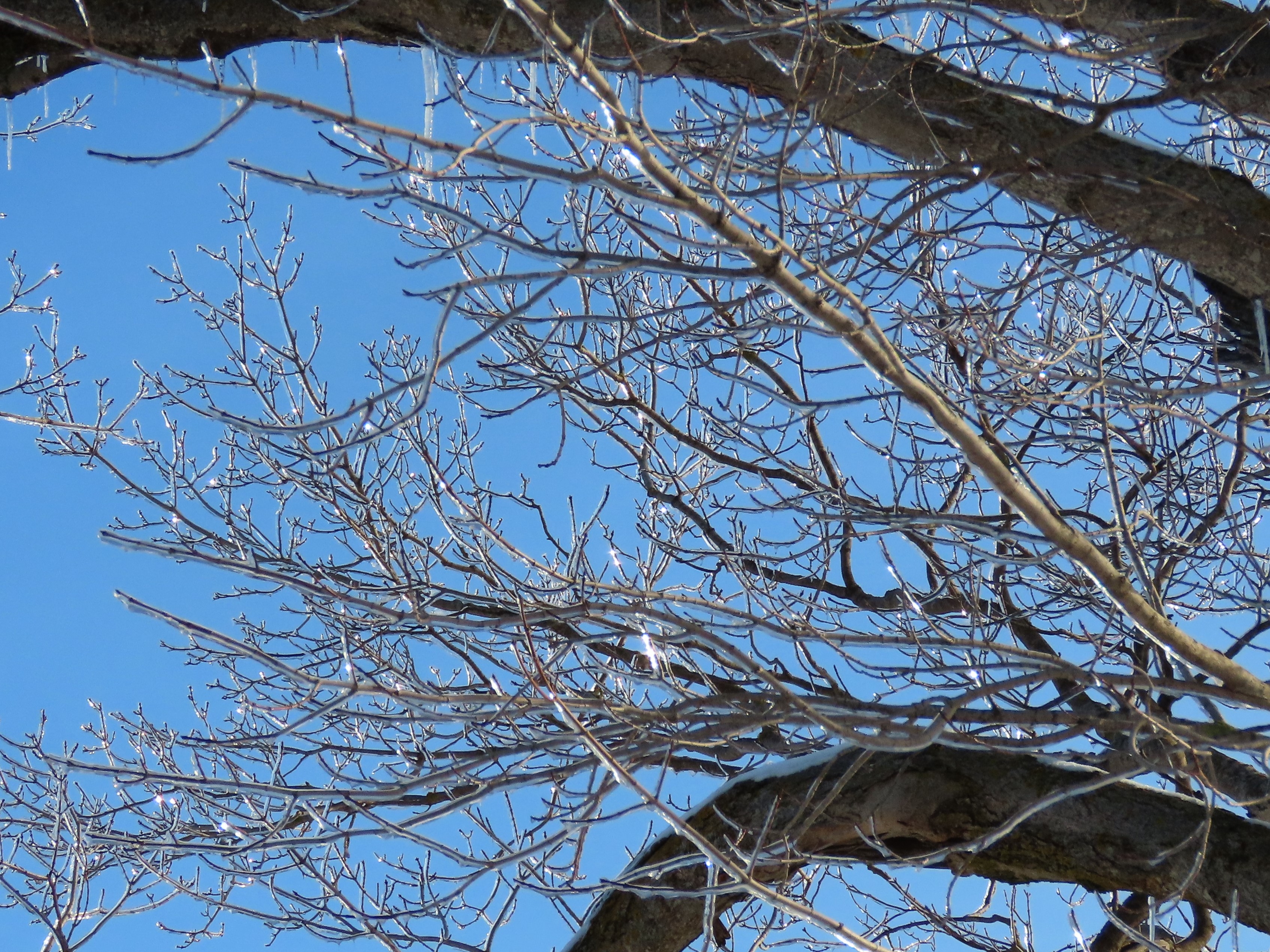
     The wildlife may have been absent but the sparkling magic of the winter landscape was there to bring us joy.

23 December, 2022
At Home, Waterloo, ON

     The wind was fierce and we stayed inside where we were snug and warm. There was no such luxury for a Hairy Woodpecker (Leuconotopicus villosus), buffeted by the winds, but feeding determinedly on the suet feeder, at times swinging to and fro but tenaciously holding on.


     Who cannot but admire the perseverance and fortitude of birds in winter? 
     Again, let me give a shout out to Bernd Heinrich - "Heinrich is a scientist and naturalist of the first rank, champion ultramarathoner, woodsman of skills, seldom seen in modern times...and a nature writer of uncommon talent," (E.O. Wilson).If you have not read Ravens in Winter you owe it to yourself to do so. 

24 November, 2022
At Home, Waterloo, ON

     In a behaviour for which I have no ready explanation, a White-breasted Nuthatch (Sitta carolinensis) - and possibly two - has been showing an inordinate amount of attention to one of the nest boxes in the backyard. It enters at will, sometimes stays in for a while, exits, and frequently re-enters. We obviously don't watch it all day long, but even based on our observations, there seems to be no discernible pattern to the activity. 


     Perhaps the bird is simply seeking shelter from the wind. This nest box, by the way, was used by Black-capped Chickadees (Poecile atricapillus) during the last breeding season, and they successfully fledged four young from it.


     You will forgive that our pictures are not as clear as we might like, but they are taken through a window often coated with patches of snow.
     Here is an extreme case.


     And here is what it looks like when the visibility is a little better.


     More normal behaviour for a nuthatch is to stash seeds for later retrieval, a hedge against hard times when food is concealed beneath snow and ice.


     Perhaps it says, "Thank goodness for bird feeders and kind humans."


     I suspect it does!
     Every day a dozen or more Dark-eyed Juncos (Junco hyemalis) spend much of their time in our backyard. They are generally the first birds to arrive as the darkness yields to the first glimmer of daybreak.
     I strew cracked corn for the Mourning Doves (Zenaida macroura) but the juncos seem to relish this too.


     Numerically, American Goldfinch (Spinus tristis) is  the most abundant species.


     Downy Woodpecker (Dryobates pubescens) is also a daily guest; today when topping up the feeders three individuals were present.


     You too can enjoy birds in your backyard, and by simple observation learn a great deal about their lifestyle and adaptations to survival in a Canadian winter.
     Other species visit too, but we were unsuccessful in getting pictures. Perhaps we'll have those for next time.

Friday, March 25, 2022

Tree Swallow (Hirondelle bicolore)

       As March winds down, and April approaches, our thoughts turn to Tree Swallows (Tachycineta bicolor), soon to return to southern Ontario to dazzle us with their brilliance.


     These entertaining hirundines exhibit enough varied behaviour, with both predictability and the possibility of the unusual, to keep us occupied and entertained all day. 


     There are many aspects of Tree Swallow behaviour that defy immediate explanation, one of which is the preference for white feathers for the nest.
     In a fascinating book, (White Feathers, The Nesting Lives of Tree Swallows) by that most consummate of naturalists and authors, Bernd Heinrich, an interesting hypothesis is advanced.
     It is an established fact that some level of egg dumping occurs with Tree Swallows, meaning that a female not having a nest of her own, or for some other reason, will lay her egg in the nest of another pair. This action can only be successful if the resident female has already started to lay eggs, otherwise a strange egg suddenly appearing would be instantly apparent, and rejected. Furthermore, once the rightful occupant of the nest has laid even one egg, she would no longer be able to differentiate her own egg from the parasite egg since they are identical. It is postulated that a canopy of white feathers camouflages eggs in the nest, so the would-be dumper looking in would be unable to see the existing clutch.
     Francine Gilbert took several pictures of a swallow carrying a white feather, finally angling it to get it into the nest.


     In contrast with the male's fabulous gleaming plumage the female is quite drab, shown here peering from a nest box.


     This nest is amply lined with feathers, but not all are white, or even pale-coloured.


     One must conclude that white feathers are gathered preferentially, but other feathers are used when nothing else is available. Heinrich found that white feathers were so desirable, especially those in the 8 - 10 cm range, that the male swallow would take them right from his hand.
     The base of the nest is always made of dried grass as is shown below.


     The feathers are added at the end, with the point facing downwards and anchored into the substrate forming a canopy over the eggs.


     In addition to functioning as camouflage the covering of feathers probably also has a thermo-regulatory function.
     Here is a female at the lip of the nest hole, with a male flying by.


     It is an accepted fact that cavities are in short supply, with many species competing for them, so it has always been a puzzle to me that every year at SpruceHaven, perfectly good nest boxes remain unused, while others, identical in every way, become home to Tree Swallows, Eastern Bluebirds (Silia sialis), House Wrens (Troglodytes aedon) and Black-capped Chickadees (Poecile atricapillus).
     Heinrich makes the interesting observation, "I now had the hunch that the swallows were protecting sky space rather than one nest box or another." Why this would deter other species, however, remains unclear.
     Males are not usually tolerant of each other during the breeding season, but here is an interesting example of two males seemingly interested in the same nest box, without antagonism - at least none that we observed.


     A mated pair is more to be expected.


     Here are a few more pictures of this delightful bird, the first of a male and the second and third of females.


     The goal of all species is to pass on their genes and here is the result of a successful Tree Swallow season, as recent fledglings gather to practice their flight and food-gathering skills.


     They have a long and arduous journey ahead of them, with many dangers along the way, to winter in Central America, primarily in Honduras, with some birds even going as far as northern South America. 
     Many will not make it, but those who do will set out to return to their place of birth the following spring.
     As always, we will be here to welcome them and provide a snug nest box they can call home. It's the least we can do.  


Land Acknowledgement

We acknowledge that the land on which we are situated are the lands traditionally used by the Haudenosaunee, Anishinaabe, and Neutral People. We also acknowledge the enduring presence and deep traditional knowledge, laws, and philosophies of the Indigenous Peoples with whom we share this land today. We are all treaty people with a responsibility to honour all our relations.

Followers