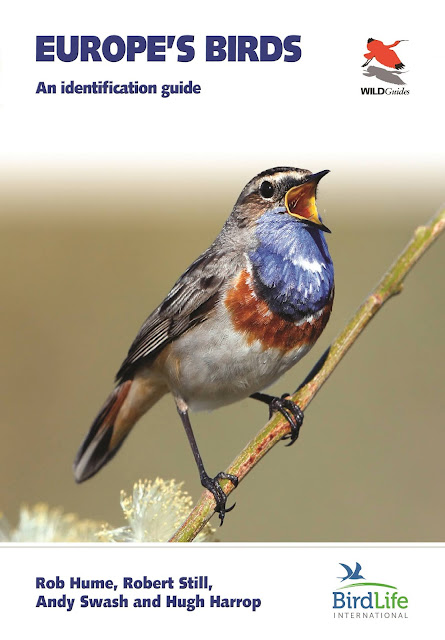
One develops an expectation that WILDGuides will produce consistently high quality field guides, and in keeping with that tradition Europe's Birds does not disappoint.
Showing posts with label Andy Swash. Show all posts
Wednesday, November 24, 2021
Tuesday, January 26, 2021
I have just reviewed two other guides in the WILDGuide series, one on butterflies and a second one on spiders, and for those organisms, as for all others, habitat is key. Put simply, they have to have a place that provides food, shelter, cover and the conditions to breed successfully.
The coverage of Britain's varied and diverse habitats in the current volume is nothing short of spectacular. This second edition, produced in collaboration with rewilding britain, states that it is fully revised and updated - a modest assertion if ever I saw one.
The introduction furnishes a succinct summary of Britain's natural habitats, with commentary on climate, topography and geography, and an examination of the numerous factors affecting habitat, including human impact and natural forces at work. There is an important section on the conservation of habitats, arguably one of the most pressing issues of our time.
I think that what sets this work apart from other studies of habitat, is the detailed breakdown of conditions which at first glance seem uniform, into a comprehensive examination of climatic and physical features within a given habitat, giving rise to significant differences that together constitute a biome.
For example - the vast swatches of heathland, primarily of Scotland and Wales, are broken down into Lowland Dry Heath, Lowland Wet Heath, Upland Dry Heath, and Upland Wet Heath. Full attention is paid to similarities and differences, comparison with like habitats, a discussion of the flora and fauna of each type, and notes on conservation.
The photographs throughout the book - on every single page - are glorious, featuring not only the landscape, but images of iconic (and not so iconic) organisms found there. The maps are well done and give a visual overview of the extent of the habitat under discussion.
At the end of each section there is a brief statement, both informative and slightly whimsical. After "Garden", a habitat familiar to most, take pleasure in the following: "Jennifer Owen, a zoologist who studied the wildlife in her modest suburban garden in Leicester over a 30-year period, recorded over 2,600 species of animals and plants including 20 insect species new to Britain). Oh what potential there exists for all of us!
Enjoy this book, learn from it, get to know the wonderful regions of the British Isles, and above all cherish and protect them. There can be no better challenge ahead of you.
Britain's Habitats - Princeton University Press - WILDGuides
Authors: Sophie Lake, Durwyn Liley, Robert Still and Andy Swash
Paperback - US$32.50 - £25 - ISBN:9780691203591
Published: 24 November 2020
416 pages - 700 colour photographs and maps - 5.88" x 8.25"
Monday, January 18, 2021
Book Review - Britain's Butterflies - Princeton University Press (WILDGuides of Britain & Europe)
Andy Swash
One might be forgiven for thinking that WILDGuides have been around forever, and I would suspect that a survey of naturalists would reveal that many, if not most, have used one title or another at some stage in their lives. For many of us, old editions are dog-eared and battered, having served us well in the field, and continue to do so to this day.
It is hard to believe that this is the fourth edition of the butterfly guide, and it is more complete than ever, filled with a stunning array of coloured photographs of every species known to occur in the British Isles.
It is significant that the book was produced in cooperation with Butterfly Conservation, the leading UK organization involved in such matters. Such a synergistic relationship can only enhance the prospects for a serious attempt to restore endangered populations.
This guide is really well done. It serves as an excellent reference for neophytes but fits equally well into the library of seasoned entomologists.
The entire sequence of the butterfly life cycle is covered, with a remarkable collection of photographs depicting every stage from egg to caterpillar to chrysalis to butterfly.
A section is devoted to butterfly habitats with a series of pleasing images that represent typical landscapes where different species may most easily be found. Further, the foodplants of the various species receive serious attention, and I can't think of a better way to enhance one's chances of finding a target species than to know where and upon what it might be feeding.
The glossary is well done, and the range maps that accompany each species account are easily understood, with an accompanying diagrammatic key to the period of the year when the different stages in the organism's life cycle may be observed.
Links to further reading and to important internet sites are given, and there are notes on butterfly conservation and legislation.
No guide today would be complete without a comment on the potential effects of climate change (some of which are already evident) and such is the case in Britain's Butterflies. One must hope that in the next edition one does not read of a litany of extinctions and species in peril. Surely we can come to our senses and embark on the long journey to reverse the deadly forces we have set in motion.
One of the beneficial effects of restrictions on "normal" activities brought about by COVID-19 has been an increased awareness of nature. People confined to their backyards have begun to notice creatures they had formerly paid no attention to, chief among them gloriously coloured butterflies, floating like ephemeral fairies on a bright summer's day. Planting for wildlife is on the increase and suburbia is becoming ever more critter-friendly.
You too can make your garden friendly for butterflies. The authors hope you will.
Britain's Butterflies - Princeton University Press (WILDGuides)
Authors: David Newland, Robert Still, Andy Swash, David Tomlinson
Paperback - US$24.95 - £17.99 - ISBN: 9780691205441
Published: 3 November 2020
256 pages - 600+ colour photographs - 10 line illustrations
5.88" x 8.25"
Monday, June 22, 2020
Book Review - Europe's Dragonflies - A Field Guide to the Damselflies and Dragonflies - Princeton University Press
Andy Swash
The Wild Guides series has produced an array of high quality field guides over many years, and this guide to the dragonflies of Europe is no exception. Like all modern guides, it benefits greatly from the advent of digital photography and the consequent availability of many outstanding pictures.
One would be hard pressed to find two more qualified authors for a work on odenates. Dave Smallshire is a renowned British dragonfly expert, and Andy Swash is a prolific writer who is well qualified to expound on many taxa. The work they have produced sets a high standard for this type of guide, all done without excessive use of technical terms.
Its primary objective is to act as a field guide for the dragonfly enthusiast to take into the field, and it acts as an indispensable tool for that purpose. It is filled with information about odenates, however, and for anyone wishing to expand beyond mere identification, a wealth of knowledge is provided.
There are only 140 regularly-occurring species in the order Odenata in Europe, 47 of which are damselflies (Zygoptera) and 93 are dragonflies (Anisoptera). Thus, it is very possible for a disciplined observer, with a travel budget on hand, to observe and correctly identify all of them.
Detailed distribution maps are a key feature of this guide, and reflect up-to-the-minute knowledge of the locations where different species may be found.
Many photographs are used for each species; males and females are covered, and key features are highlighted with arrows and a descriptive note.
An excellent glossary is provided.
As everyone who keenly pursues dragonflies knows, some of the characters need to clinch identification, are only accessible by capturing the insect. Differences in claspers, secondary genitalia, female genital plates and other esoteric details differentiate one species from a virtually identical other. These characters are extremely difficult to detect by pure observation of the organism in the field, although specialized binoculars designed for butterfly and dragonfly viewing have made the task easier in recent years.
Few observers are willing to capture their quarry (in fact I know of none) since it often involves the demise of the individual, and field observation skills are constantly being honed.
Notes are provided on conservation and legislation and a wonderful checklist is included at the end of the book.
The degree of scholarship and the first class presentation of both facts and images combine to make this work a highly desirable addition to the library of every odenate enthusiast.
Europe's Dragonflies: A field guide to the damselflies and dragonflies
Dave Smallshire and Andy Swash
US$29.95 - £25.00 - 9780691168951 - over 1,200 colour photographs - 360 pages - 5.87 in. x 8.25 in.
Publication date: 14 July 2020
Marcadores:
Andy Swash,
Dave Smallshire,
Europe's Dragonflies,
Princeton University Press
Subscribe to:
Posts (Atom)
Land Acknowledgement
We acknowledge that the land on which we are situated are the lands traditionally used by the Haudenosaunee, Anishinaabe, and Neutral People. We also acknowledge the enduring presence and deep traditional knowledge, laws, and philosophies of the Indigenous Peoples with whom we share this land today. We are all treaty people with a responsibility to honour all our relations.
Followers
Welcome
My name is David. I'm a lifelong birder, fiercely committed to all of nature, however. Married to Miriam Bauman. I love to travel. I Enjoy a good book and a good glass of wine. To read more about me, click my ABOUT page.