30 April 2020
Laurel Creek Conservation Area, Waterloo, ON
The conservation area itself is now off limits to the public but it is still possible to view some of the property, especially the lake, from the road.
The water is surrounded by marshes comprised of cattails and other native reeds, and harbours a vast network of breeding Red-winged Blackbirds (Agelaius phoeniceus). This is a polygynous species and a handsome male like the one shown below will doubtless attract several females into his harem.

30 April 2020
Hawkesville, ON
American Avocet (Recurvivostra americana) is a species that usually is found both south and west of Ontario. Occasionally, a straggler shows up here, but nearly always a single bird. In fact these vagrants have become almost an annual event in recent years.
But to have a flock of sixteen birds present is a rare spectacle indeed!

I was alerted to the fact that this is what had occurred and that the birds were resting in Hawkesville. I immediately left home to go and see them!

I have to admit that the pictures are quite dreadful, but I was shooting through heavy, driving rain, and the birds were a hundred metres or more away.


What an exciting day, however, in my 2020 birding calendar! I was delighted to see these beautifully patterned birds.
It was a stroke of good fortune that I wasted no time in going to see them. By the following morning when Miriam and I went back to see if we could get better pictures the birds had already left, and were reported later that day in Woodstock, over in Oxford County.
01 May 2020
Three Bridges Road, St. Jacobs, ON
On the way home from Hawksville we meandered a little and visited a couple of our favourite birding locations.
Miriam commented that even the trees are maintaining social distancing!

There is a Mennonite meeting house on Three Bridges Road where for many years we have been able to locate Eastern Bluebirds (Sialia sialis) with a good degree of regularity. We were not disappointed today.
We first spotted a female perched on a tombstone in the graveyard.

It was not long before a male put in an appearance and he was downright cooperative in having his picture taken, even though he turned his back to us for the final shot!


02 May 2020
Benjamin Park Trail, Waterloo, ON
It was the kind of day that begged for a walk and the trail behind the house seemed like a good place to start.
Before leaving we admired the Primula (Primulacae) that are blooming so beautifully at the front of the house.


The woodlands of southern Ontario are filled with early spring flowers, and Trout-Lily (Erythronium americanum) was starting to bloom everywhere.

White Trillium (Trillium grandiflorum) is about to burst open and will soon form a glorious carpet on the forest floor.

Red Trillium (Trillium erectum) was already making a showy splash, seeming to be a few days ahead of the more common White Trillium.

A Brown Thrasher (Toxostoma rufum) was flipping leaves to seek out juicy prey hidden beneath.
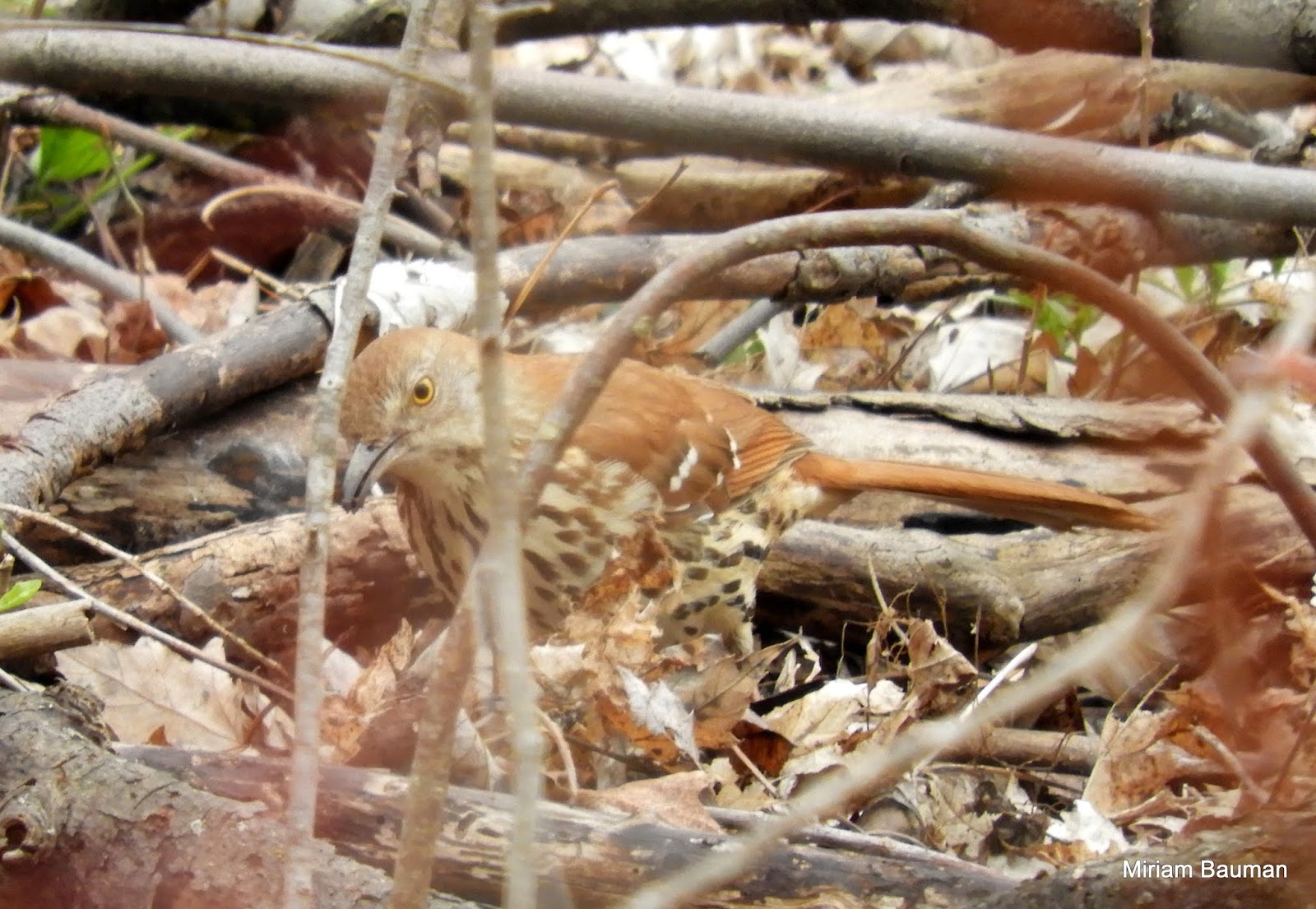

It was great to see the bird but its location left a little to be desired from a photographic standpoint.
There never seems to be a similar issue with a Northern Cardinal (Cardinalis cardinalis) - always in position for a picture.

A female Hairy Woodpecker (Dryobates villosus) was a little more elusive as it foraged on a trunk, often disappearing to the back side, but finally permitting a picture or two.

Many people, like us, had concluded that it was a good day for a walk, and at times the trail was quite busy. Everyone seemed conscious of distancing requirements in this era of avoidance, and moved aside as necessary.

Quite often, when we are birding, people are curious as to what we are seeing, and many is the time we have passed over our binoculars so that others can share in the splendour of the bird. Not any more! At least not yet. Surely the day will come when we will all relish contact and sociability again.
Bloodroot (Sanguinaria canadensis) had no issue in being cheek by jowl with its neighbours!

Common Lungwort (Pulmonaria officinalis) could be found blooming prolifically and merited our close attention.

In many natural areas around Waterloo, Daffodils (Narcissus sp.) can be found and I am never quite sure whether this is a wild plant or not. Certainly they cannot have all been planted by humans, and I wonder whether squirrels are responsible for transporting the bulbs. No matter their origin, they are a wonderful sight along the trail.

Coltsfoot (Tussilago farfara) is tough, and seems to thrive even in inhospitable areas, and is one of the earliest plants to appear in spring.

Lakeside Park, Kitchener, ON
02 May 2020
We have not previously visited Lakeside Park, other than for a very brief period in the winter, but based on its reputation as a bit of a hot spot for spring warbler migration decided to give it a shot after lunch.

On the way into the park an interesting tree, a species of willow perhaps, presented itself, with a very large cavity part way up the trunk.

The inner child in Miriam surged immediately to the fore, and she could not resist clambering up to have her picture taken.

Did any child ever look happier? Sheer glee is written on her face.
There were lots of people in the park, and the birding was far from exceptional, and we saw not a single warbler, but we had a fine time nonetheless.
I wonder whether this Downy Woodpecker (Dryobates pubescens) was impressed with Miriam's tree climbing skills, certainly not as good as a woodpecker one must admit!

The marshes were filled with Red-winged Blackbirds (Agelaius phoeniceus) and it was encouraging to see a few females, which seem to have been in short supply this spring.

The undoubted stars of the day were a pair of Canada Geese (Branta canadensis) with young barely more than a day old I would guess.


Is anything quite as adorable?
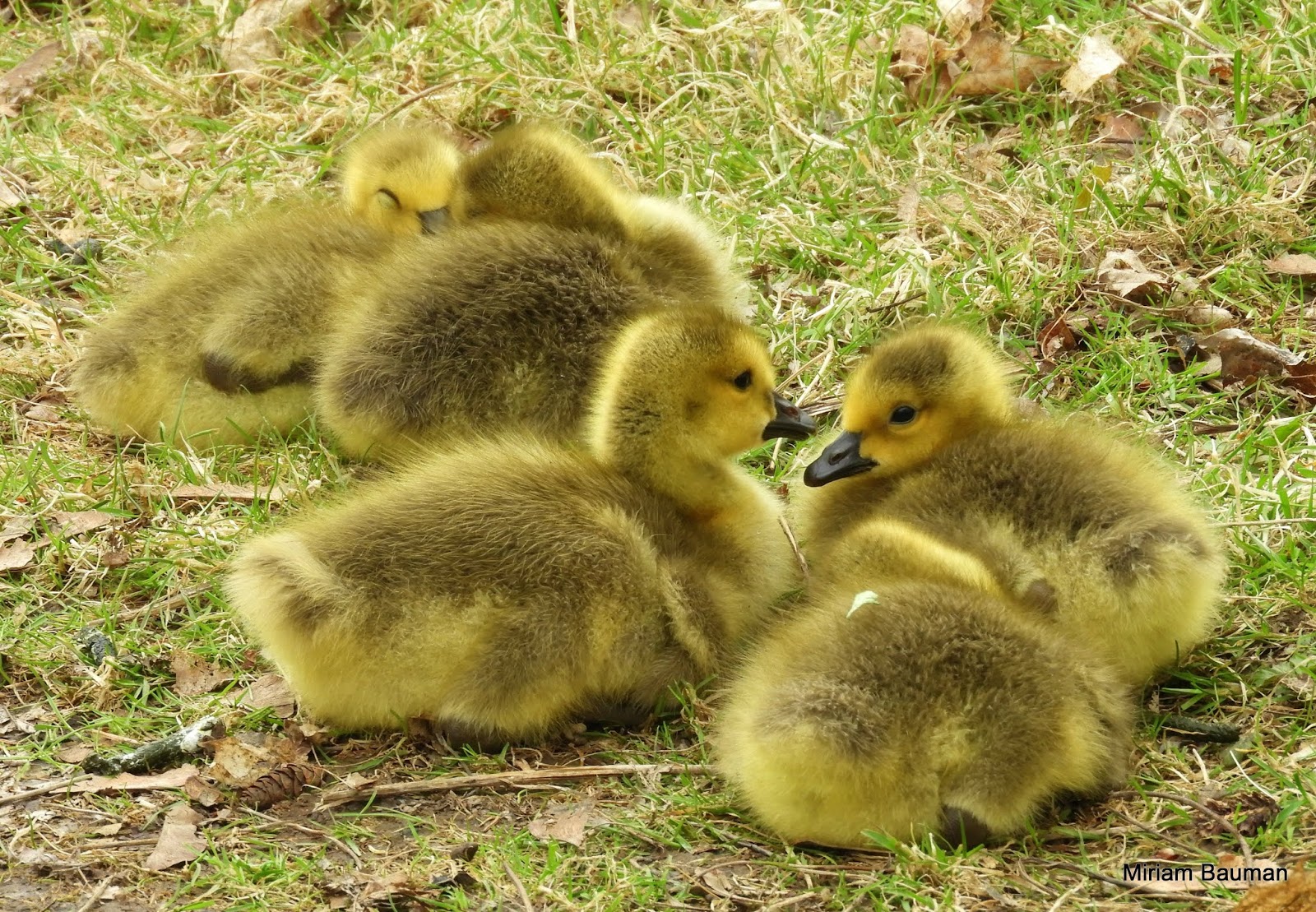
Few people simply walked by without stopping to take a look. As a measure of how accustomed to humans these park parents are, they never hissed at nor threatened anyone who approached the goslings.
Wanna snuggle up and have a nap?

More is better.


A Hairy Woodpecker foraged quite close by.

Hairy Woodpeckers are in most respects like bigger versions of Downy Woodpeckers and some people have difficulty telling them apart, since it is rare that the two are sighted together permitting a size comparison. One sure way is to notice the split red crown on the Hairy Woodpecker; on a Downy it is continuous.

This female Mallard (Anas platyrynchos) looked quite splendid.

It is at this time of year that males are mainly observed, with most females already incubating eggs. Soon baby ducklings will rival baby geese in the cuteness parade.
As was the case on the Benjamin Park Trail in the morning Trout Lilies were ubiquitous.

It started to rain just as we were about to leave and we made it back to the car without getting too wet.
Another fine day of enjoyment with nature in Ontario.