Saturday, December 14, 2019

Birds, Bread and a Brisk Walk

13 December 2019

     I was sitting at the computer where, like many of us I suspect, I spend far too much time, and Miriam sidled up to say, "Let's go for a walk." I think it took all of a nanosecond for my bum to leave the chair.
     Hillside Park is mere minutes from home, and we needed bread from our favourite bakery which is in a small shopping plaza nearby, so that is where we headed.
     It was a gorgeous day, the kind that makes you rejoice in winter. The sun was shining, there was little wind, and the temperature was hovering right around zero, sometimes edging just over into positive territory, the kind of day to walk forever.
     The park looked splendid. There was ice still on the creek, but it was giving way to open water, and the play of sunlight verged on magical. 


     It pays to pause a while and take it in. The patterns of nature are varied, glorious and ever changing.


     Thank goodness for urban parks. 


     They are not perfect, but any area bearing even a resemblance to a natural state is appreciated, providing a respite from the unceasing presence of a burgeoning humanity.
     Bare branches against the sky told the tale of trees in dormant mode, waiting for the warm days of spring and increasing hours of daylight to renew their cycle of leafing out and bearing fruit.


     The green of conifers stood in stark contrast to denuded limbs.


     European Buckthorn (Rhamnus cathartica) is found throughout southern Ontario. It is a serious invasive pest, extremely difficult to eradicate, which was originally used by early settlers for fencing purposes since it grows quickly and forms a dense barrier.
     The berries, however, are greatly favoured by birds, and many species take advantage of them.


     One of the great problems is that the berries function as a natural laxative and pass through the bird very quickly, which means that seeds are deposited where they were taken from the tree, and in short order the multiplier effect creates whole stands of the offender. And the process repeats itself. It is noteworthy that the berries are toxic to humans but pose no equivalent danger to birds.
     House Finches (Haemorhous mexicanus) were unconcerned with such matters. Food was the only thing on their minds. The males seem exceptionally handsome this year in their scarlet livery.


     For the first time ever, we saw Wild Turkeys (Meleagris gallopavo) in the park. The picture is quite unsatisfactory, but it serves to record this initial sighting of a species that has thrived in spectacular fashion in recent years, habituating to suburban backyards with aplomb.


     I had a presentation to give early in the afternoon, so we could not tarry more than an hour; otherwise we might still be there, it was so lovely.


     So, back to the car and a visit to the bakery before heading home for lunch.


     A loaf of freshly baked Kalamata Olive bread seemed just the ticket for a lunchtime sandwich.


     We had grilled eggplant, a superb smoked Gouda cheese and fresh tomatoes for the filling. 


     Does life get much better than this? I don't think so. How about you?

Wednesday, December 11, 2019

Congratulations, Greta! Bravo!


Snow Buntings and Horned Larks


     Last evening I gave a presentation to the Stratford Field Naturalists Club and during the segment where people report their recent bird sightings, a fellow mentioned that he had seen a flock of about 1,500 Snow Buntings (Plectrophenax nivalis). This reminded me that I have not seen any so far this winter, but as soon as we get some serious snow cover they will start to appear, often in large flocks, and frequently in the company of Horned Larks (Eremophila alpestris).  Flocks of the two species combined can sometimes reach staggering proportions and careful scrutiny will reveal a few Lapland Longspurs (Calcarius lapponicus) mixed in with them too.


Snow Bunting

Horned Lark

     If you ask me why winter in the north can be very pleasant, there is no better reason than that we get to enjoy these two species. 
     It sometimes confounds the imagination that they can make a living in a bleak winter landscape, but they are adept at finding seeds on grasses and dormant wildflowers poking above the snow, and exploiting micro climates wherever they find them. They can be found on rural roads feeding on minerals and grit, and in fields of corn stubble where there is  much food to be found. Corn spilled while loading trucks, or residue not harvested by mechanical means is quickly discovered and hundreds or even thousands of birds will descend to feed.


     Upon first encountering the birds they are generally quite skittish, but by remaining in a vehicle, which effectively becomes a blind, they will return and often feed quite close, sometimes walking right alongside the car.


     A few hardy folks brave the winter weather in the interest of science, retrieving and banding birds with bare hands, for these two species are easily attracted to a baited trap, where they feed merrily until removed from the cage. It always amazes me that some birds get banded, and on the very next round of the cages we find that they have re-entered. The lure of corn seems irresistible. 


     It is snowing right now. Maybe it is time for a drive through the rich farmland just north of here. Who knows what winter treasures may be awaiting us?


     I know that Miriam will be eager to grab her camera and binoculars to come along with me. How great it is to have a birding spouse!
     And come to think of it, we haven't yet come across a Rough-legged Hawk (Buteo lagopus), recently arrived from the Arctic. It really is time to get out there and search!

Tuesday, December 03, 2019

Tuesday Rambles with David - Hillside Park, Waterloo, ON

      Having spent the weekend in Ottawa with my daughter, Caroline, and her family, we were happy to be back with our "gang" for our regular Tuesday ramble. Mary was unable to make it this week, so we were seven today.
     The past few days have brought full-on winter conditions to southern Ontario, and it was with great delight that we embarked on a walk through Hillside Park in crisp, clean snow with the temperature a very pleasant minus 4°C.
     The winter scene was little short of exquisite.


     The air was still and clear with no wind, and bright sunshine. It was a Christmas card made to order, with birds aplenty to complete the scene.
     We could have been forgiven at several points along the way had we concluded that a convention of cardinals was taking place (the important kind, not those ancient celibates in Rome). Northern Cardinals (Cardinalis cardinalis) were vivid exclamation marks against the whites and greens of the season as they sought winter provender. 


     Mourning Doves (Zenaida macroura) no doubt were also finding food throughout the snowy woods.


     The creek runs swiftly enough through Hillside Park that there is always open water, even in the depths of winter.


     We knew that last year a male Belted Kingfisher (Megaceryle alcyon) had remained throughout the winter, maintaining a territory in anticipation of the return of a female in spring, so we mounted a search to see whether he had stayed again this year. It did not take long to find him, with Francine's sharp eyes detecting him first. Miriam's picture was taken at a distance, but it serves to record this significant sighting.


     There were no takers at the bench this morning.


         But we cast a long shadow on the trail.


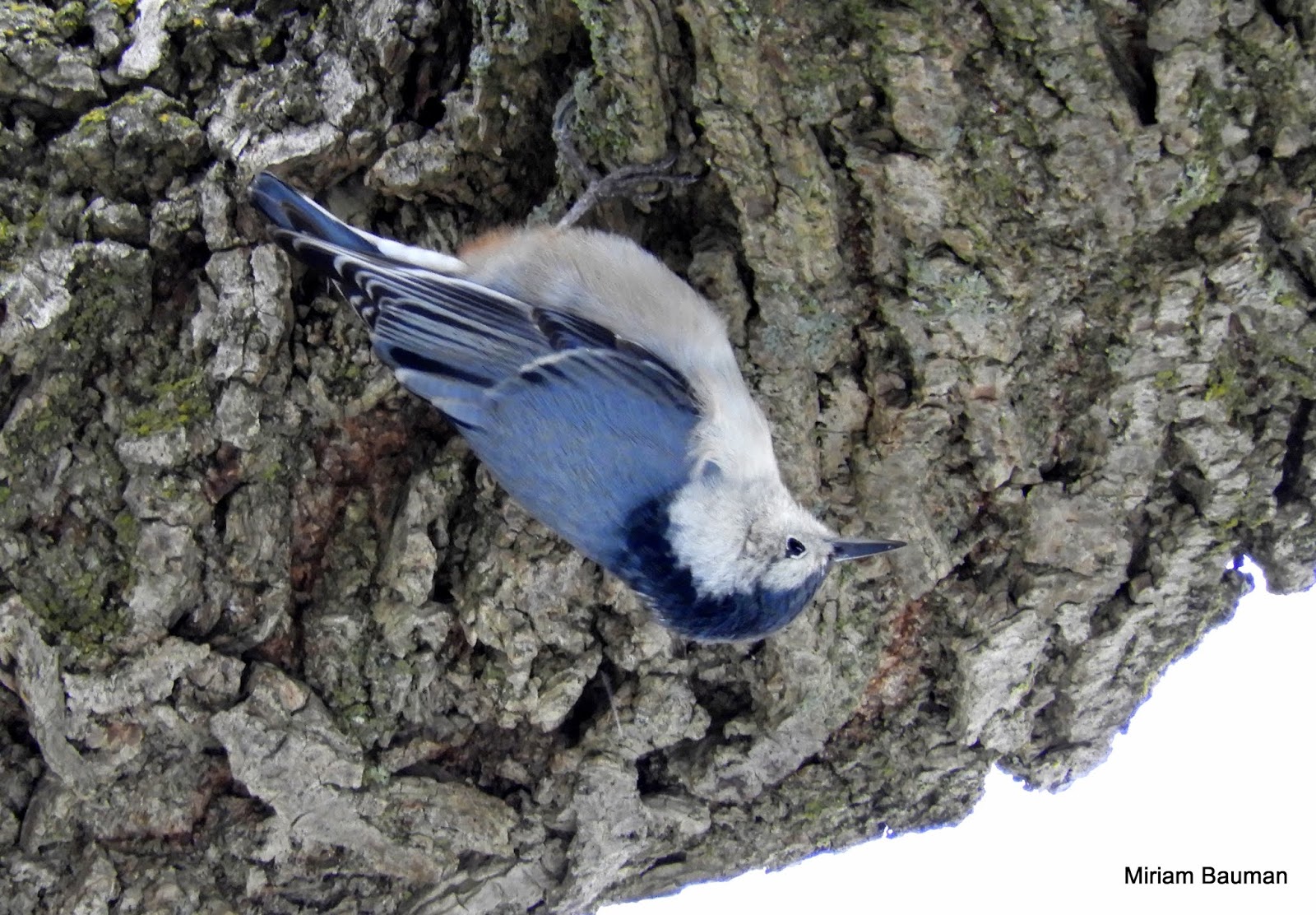
     White-breasted Nuthatches (Sitta carolinensis) were both vocal and visible, foraging along trunks and branches in that most characteristic nuthatch way; upside down is all in a day's work for a nuthatch.


     Black-capped Chickadees (Poecile atricapillus) were never far from us either.


     And Blue Jay (Cyanocitta cristata), that gallant cavalier of the woodland, had no hesitation in showing off his finery.


     A few forlorn leaves still clung to a branch here and there.....


     ..... and the snow on the evergreens was magical to say the least. Be sure not to walk under the tree when a squirrel is scampering across the branches, however, or you will be wearing that snow!


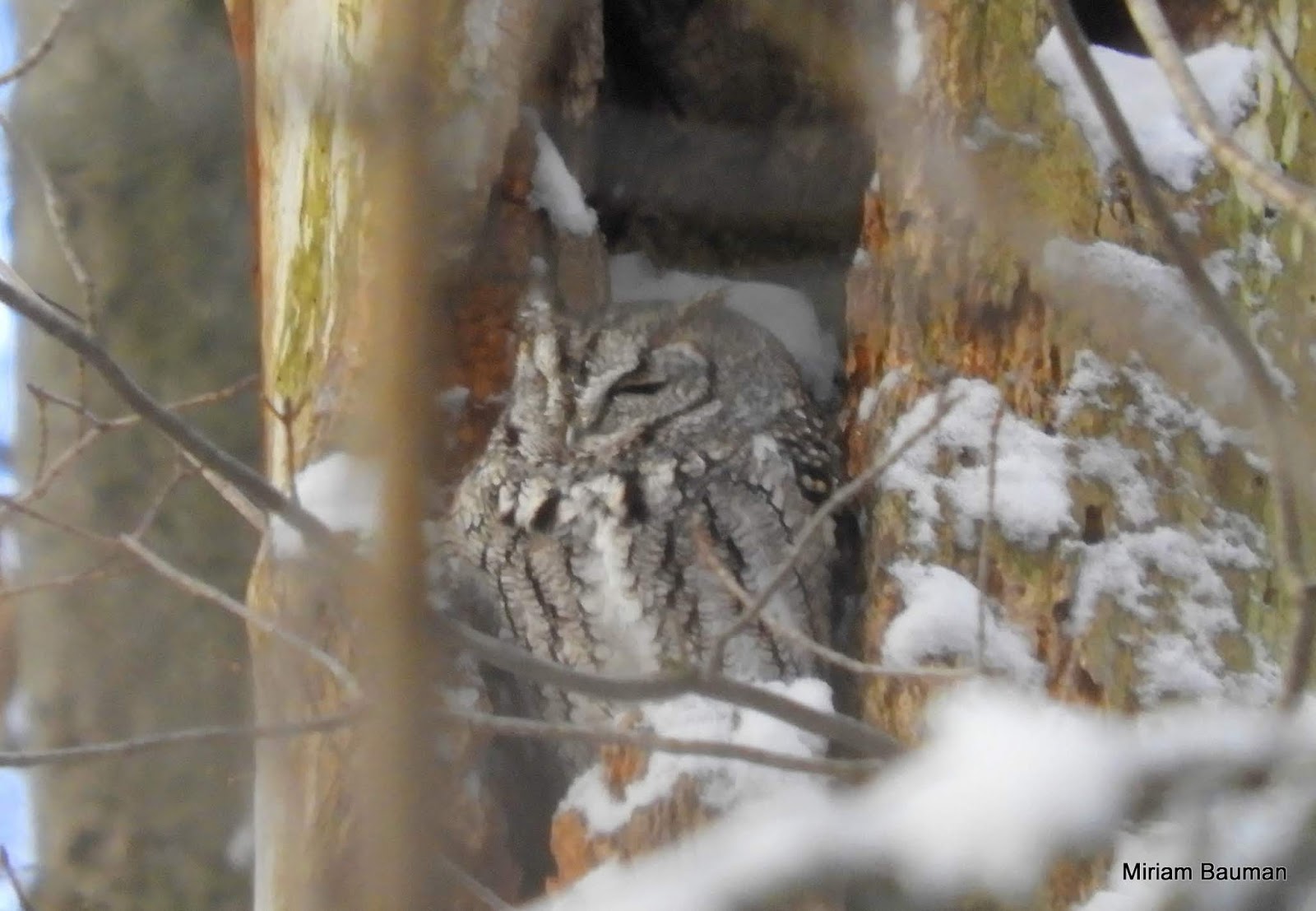
     At some point during every walk we muse about "the bird of the day." And since we all agree that any day when we find an owl is a banner day, kudos must go to Jim Huffman for locating an Eastern Screech Owl (Megascops asio).
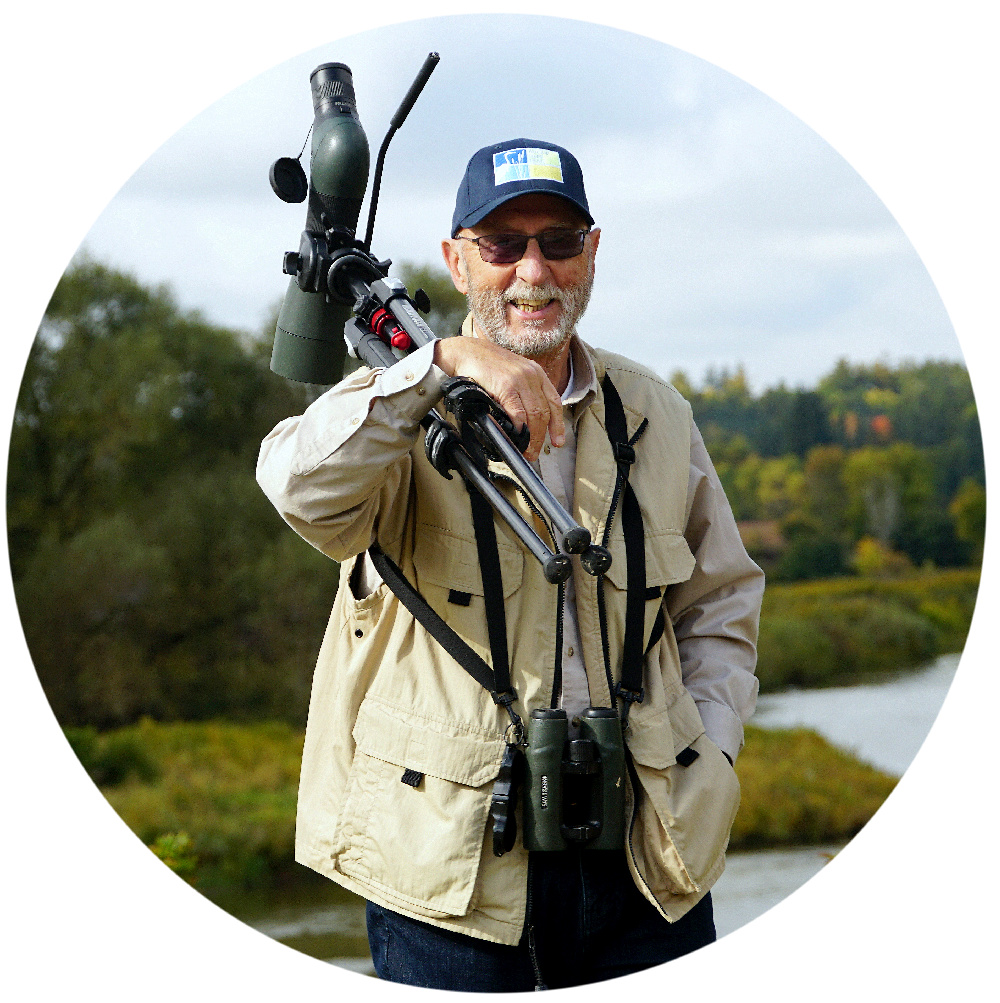
     Here is Jim:


     And here is the owl:


     I will leave it up to you to decide who looks the wiser. Francine is not allowed to vote on this one!
     A Red-bellied Woodpecker (Melanerpes carolinus) was not in the best position for a picture, but it did not escape unphotographed.


     Franc and I were a little ahead of the group when we saw a Muskrat (Ondatra zibethicus) come out of the creek and scurry into someone's backyard where it was grubbing around for food of some kind.


     It spent several minutes there so we assume its quest was successful.
     The resident House Sparrows (Passer domesticus), perched in a stand of Red Osier Dogwood (Cornus stolonifera) had their own affairs to take care of.


     At a section of the creek where houses are located on the opposite side of the path, Mallards (Anas platyrynchos) are prone to congregate and as soon as they see a human they all approach as one, knowing that often food will be dispensed.


     We could be forgiven for thinking this was dessert left out for us. Snow cone anyone?


     We made our way back to our cars and just a couple of minutes from the end of the trail a Pileated Woodpecker (Dryocopus pileatus) graced us with its presence.


     What a great way to end a walk, already made memorable by the kingfisher and the owl. 
     I wonder where we will go next week?

Land Acknowledgement

We acknowledge that the land on which we are situated are the lands traditionally used by the Haudenosaunee, Anishinaabe, and Neutral People. We also acknowledge the enduring presence and deep traditional knowledge, laws, and philosophies of the Indigenous Peoples with whom we share this land today. We are all treaty people with a responsibility to honour all our relations.

Followers