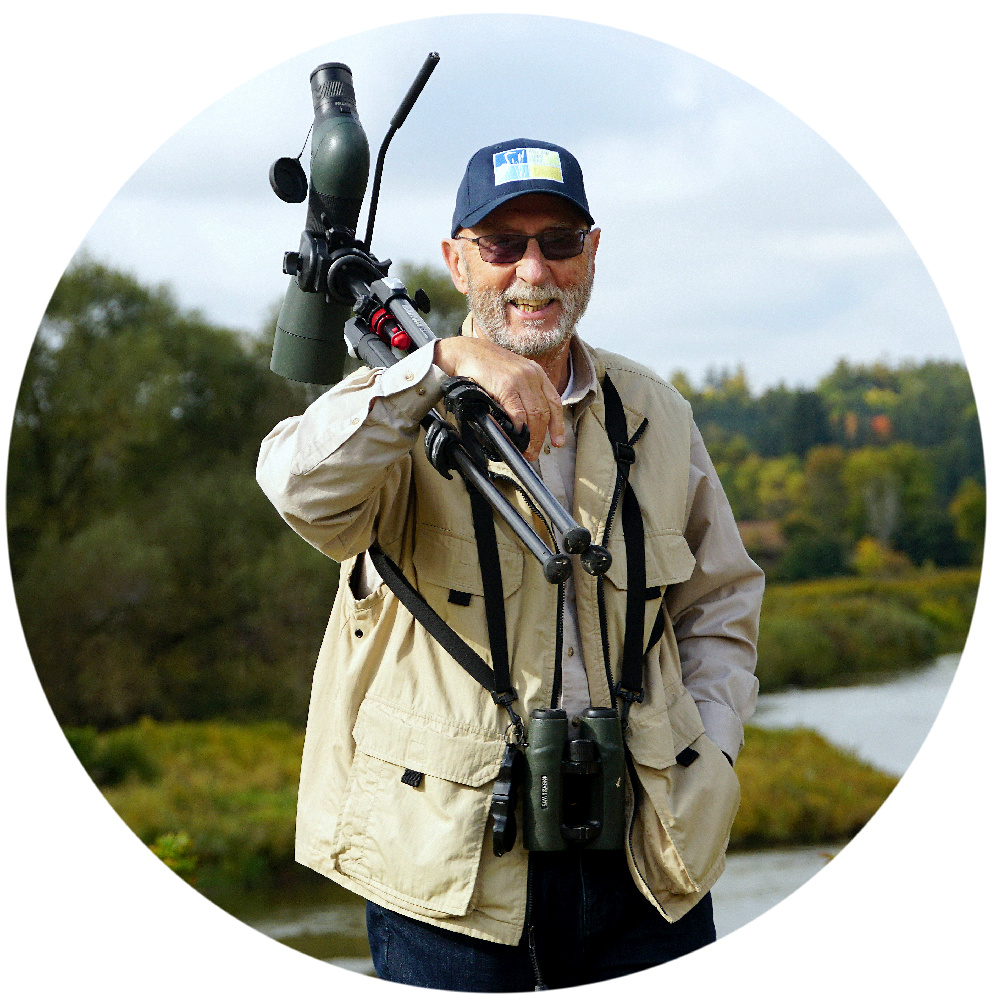
What is ever more important to us is our closer awareness and our richer understanding of nature, of the flight of birds, the changes in the sky, the pattern of the stars. These wonders, contemplated from day to day, will bring us the peace from which we have been too long estranged.
Calvin Rutstrum
16 August, 2022
The Mill Race Trail, St. Jacobs
One of the great satisfactions about going for a walk along the Mill Race is that we know, even before leaving home, we will have a wonderful excursion and return in a state of tranquility.
Today was a classic Mill Race experience with interesting and exciting aspects of nature at every turn.
What could be better than a friendly, inquisitive Eastern Chipmunk (Tamias striatus) to welcome us to its world?

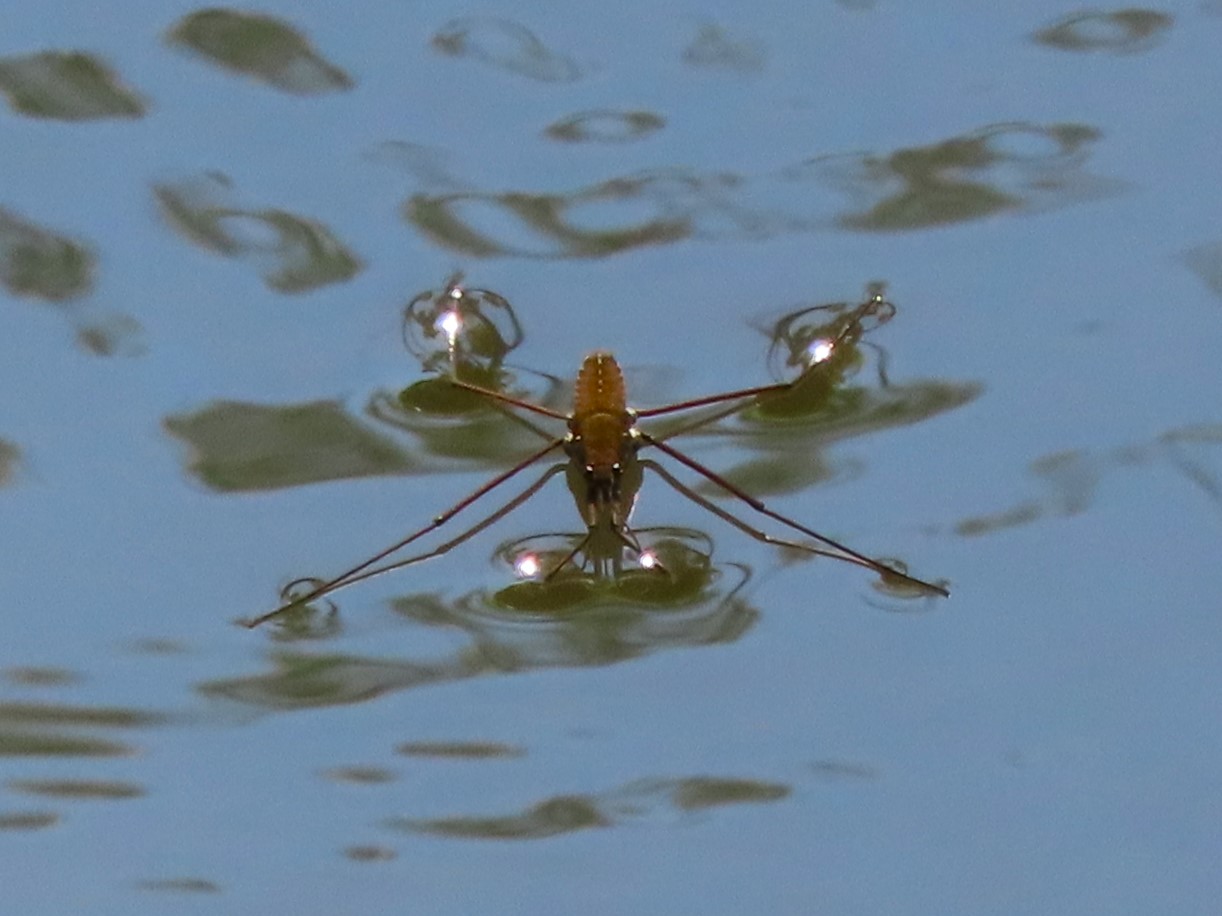
Anywhere that branches overhung the water to provide shade there were hundreds of Common Water Striders (Aquarius remigis) zipping across the surface.

It's not the season where we customarily take seed with us to feed Black-capped Chickadees (Poecile atricapillus) - and we had none today. The birds, however, seem to have developed an affinity with humans and in a couple of spots we were surrounded by chickadees displaying no hesitation to perch on my hand.

There are critics and naysayers who might assert that we have encouraged an unhealthy tendency for birds to associate humans with food, but I cherish this intimate contact with a wild creature, and see only benefit for both species. If we can encourage children to become involved with nature through this connection to a friendly bird it is all to the good.
The nomenclature Common Flesh Flies (Genus Sarcophaga) always seems a little macabre to me, but I have no idea why I feel that way since most humans are devoted consumers of flesh.

Green Stink Bug (Chinavia hilaris) is such a handsome insect it seems a shame it doesn't have a more distinguished name!

Hover Flies are not always easy to identify as to species, but I believe this individual is Thick-legged Hover Fly (Syritta pipiens). Indeed part of the satisfaction of taking the picture is to return home and invest the time necessary to identifying the species, along the way learning a great deal I might add.

Cabbage White (Pieris rapae) is perhaps at the peak of its flight; I doubt that at any point there were less than two or three in view.

I know very little about fishes, and the best I can offer for these little beauties is that they are True Minnows (Leuciscidae).

There is a robust population of American Beavers (Castor canadensis) along the Mill Race and they have obviously been busy.

We continued to be fascinated by Water Striders, whose legs are covered in tiny hairs that trap air and increase the buoyancy of the insect. At the point where their legs make contact with the water it appears as if tiny glow lights are present.
Miriam and I were standing looking at something that had caught our attention when this chickadee perched no more than 15 cm from my face and stayed there for several minutes, at times looking as though it was winking at me.

Moments like this are hard to beat.
Dryad's Saddle (Cerioporus squamosus) is one of the most common fungi in the forest.

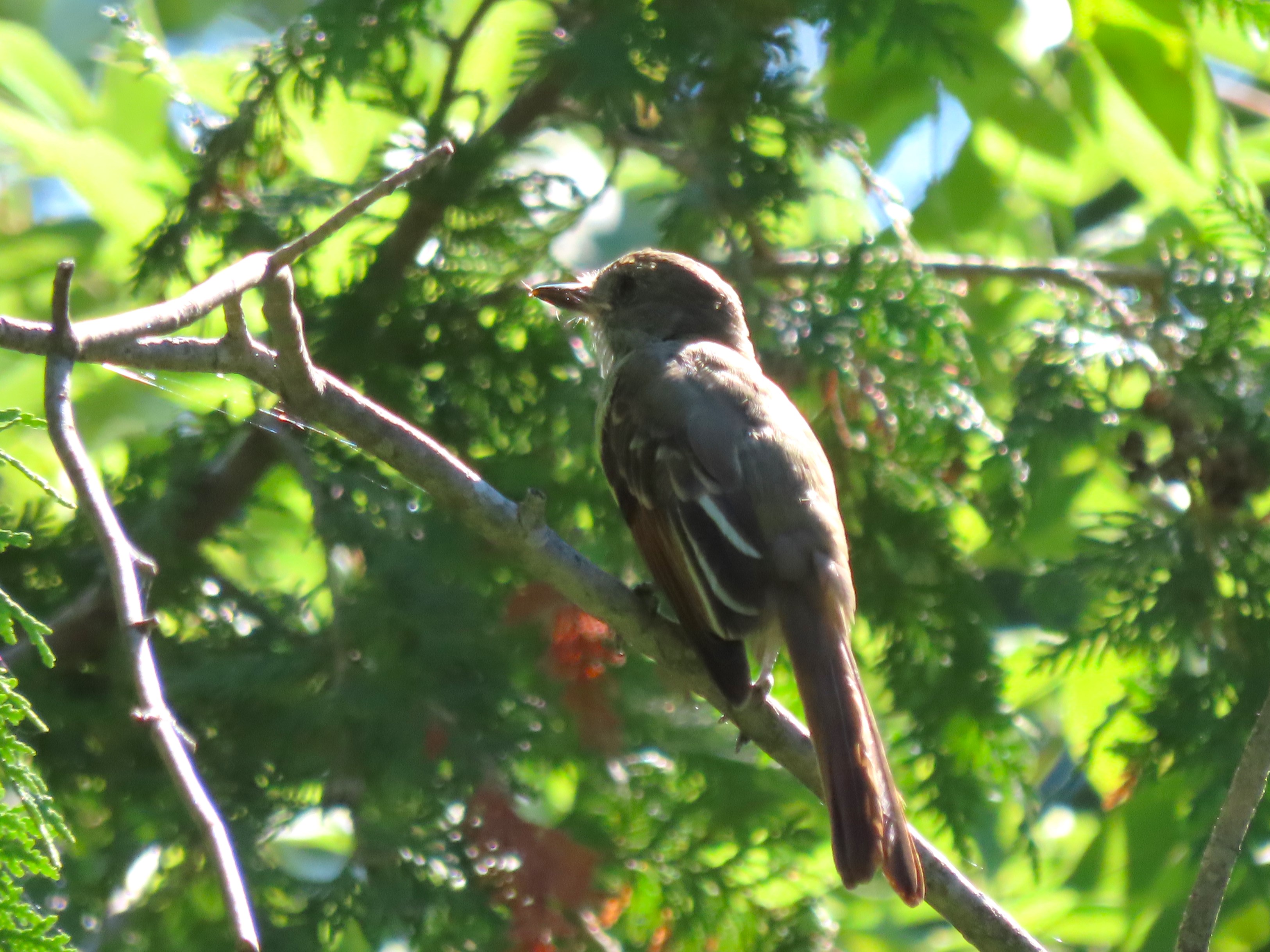
The Mill Race Trail provides an abundance of suitable cavities for breeding Great Crested Flycatchers (Myiarchus crinitus) and it is a reliable location to see this handsome species.
A family was feeding on the ground (uncharacteristically) and we were elated to see evidence of breeding success.


Unfortunately the birds were in deep shade and the pictures are not what we might have hoped for.
Even when the birds dispersed into the trees they stubbornly resisted giving us a good line of sight for a picture.
A fellow had made the eminently sensible decision to take his book down to the river to read, and his dog peered wistfully over the bench.

I suspect that it longed to go and chase some chipmunks.

Seen below is a Honeysuckle Moth (Ypsolopha dentella). If I have seen this species before, I don't recall it.

A type of Giant Mayfly (Hexagenia) landed on my trousers, prompting us to remember how long it is since we have seen a mayfly of any description.

I recently read a report on the status of mayflies in Britain where it was found that even modest pollution in English rivers is enough to kill 80% of their eggs, increasing concerns over insects which are vital to all ecosystems. They are a key part of the food chain, supporting fish, birds and mammals.

I have little doubt that this scenario is replicated here.
We were happy to see a couple of Two-banded Petrophila (Petrophila bifascialis), a lovely moth.

While many people have an irrational fear of wasps it is probably best not to irritate a Dark Paper Wasp (Polistes fuscatus), or you may come to regret it!

Mallards (Anas platyrynchos) are content to go about their business.


Canada Geese (Branta canadensis) no less so.

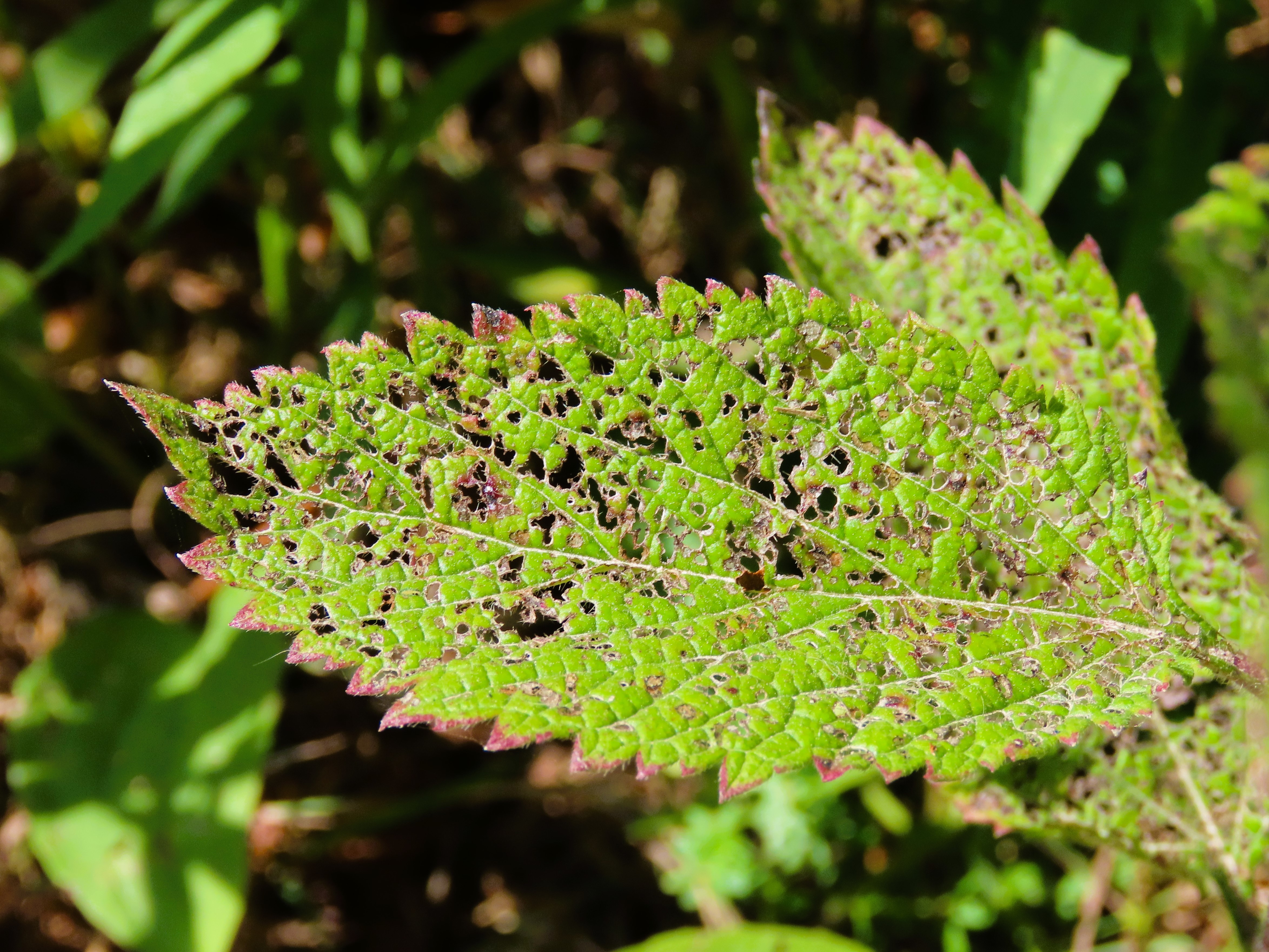
This is an example of the degree of damage that can be inflicted on a leaf by insect larvae.
The Honeysuckle family (Caprifoliaceae) is well-represented along the Mill Race.

It appears that children have been motivated to install bird houses along the trail. This one is too small to be of use as a nest box, but someone has put seed inside (it looks to be shelled sunflower) and chickadees have been quick to exploit it.

Stream Bluets (Enallagma exsulans) patrolled up and down the water as befits their name.

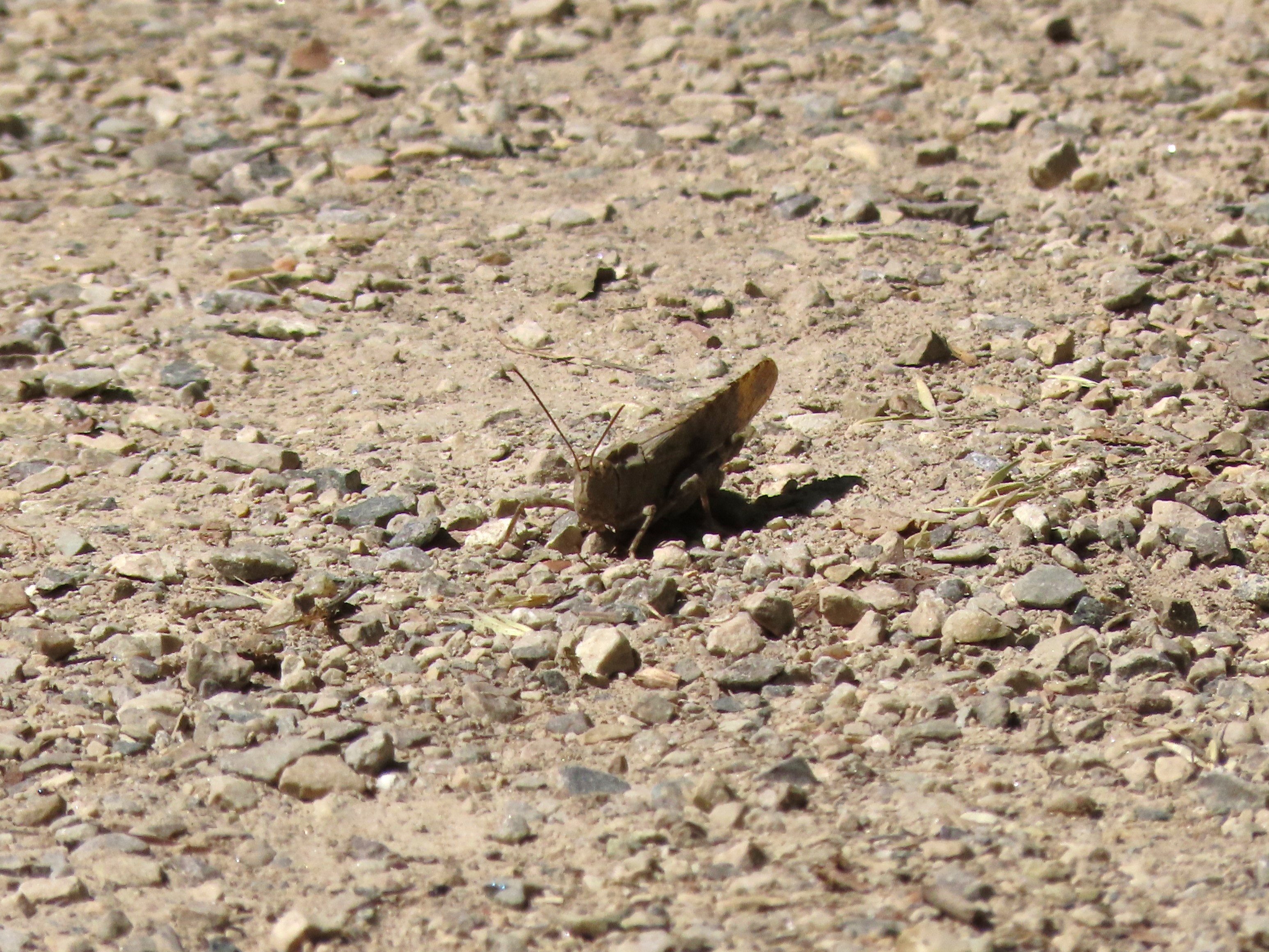
Carolina Grasshoppers (Dissosteira carolina) vaulted from beneath our feet.
A couple of youngsters from a nearby farm had been fishing and one of them had caught an impressive Northern Pike (Exos lucius).

We were delighted to see him return it to the water.
Oscar Martin was a renowned presence on the trail for many years, always with a friendly greeting to everyone who crossed his path. When he passed away a bench was installed in his memory. Unfortunately, in the way of humans, it was tarnished and desecrated, and the plaque obliterated. A new bench has replaced the old one and we can only hope that a little more civility and respect will be shown this time.


Spotted Jewelweed (Impatiens capensis) is a favoured food source of Ruby-throated Hummingbirds (Archilocus colubris) at this time of year as they enter hyperphagia and accumulate fat reserves for their long and arduous migration to southern Mexico and Central America.

A Northern Cardinal (Cardinalis cardinalis) pursued a zig-zag path through the woodland, obstinately refusing to face us for a picture.

The insect below is a parasitic wasp in the genus Cratichneumon. I doubt that I will be able to refine the ID beyond that.

We were almost back to the parking area before we saw our first woodpecker, when a male Downy Woodpecker (Dryobates pubescens) posed coyly behind a branch.

Three Killdeer (Charadrius vociferus) demonstrated to all the world that they are truly handsome birds.


A Mourning Dove (Zenaida macroura) coming in to drink, joined them at the water's edge.

What a fine morning we had!
I recently re-read William Fiennes' poignant and moving book, The Snow Geese, an account of despair and hope, of nostalgia and home, of homecoming and a sense of place - no less for fragile humans than for geese.

It is delicately written with style, skill and descriptive flair. I recommend it to anyone who has not read it - and even if you have.
I was struck by a conversation Fiennes had with an 82-year old man on the northern plains, a plain-spoken, ordinary fellow, without advanced degrees and mostly lacking in sophistication, who made a pellucid statement that really says it all, "I try to share my love of the beauties of wildlife, how wildlife is part of us, because they demand the same things we do, and if they can't make it, we sure as hell can't either."
If only we would listen.