24 January 2019
Waterloo - Pearson International Airport - Liberia - El Coco
It was cool when we left home at 03h:30 to drive down to Kitchener to car pool with Jim and Francine to the airport. Given the fact of freezing rain the previous day we thought that the roads might be treacherous, but in fact they were quite dry and we lost no time on the expressway. We loaded our luggage into Jim's vehicle and in mere minutes we were underway. The drive to the airport was uneventful and we soon had the car parked and took the shuttle to the terminal.
We were late taking off due to the need to deice the plane, and we were advised from the flight deck that adverse weather over Florida would mean that we would have to take a slightly longer route to Liberia.
Franc and Carol had rented a place in El Coco for two months and we would be staying with them; Jim and Francine had rented a studio apartment about a five minute walk away. Franc picked us up at the airport, where the heat was stifling, and Carol had sent water and mandarin oranges - very welcome indeed.
We stopped on the way to El Coco to add a second driver to the rental car. Other than that it was smooth sailing all the way.
We were happy to arrive and were delighted to see the lovely spot Franc and Carol had taken for their winter sojourn in Costa Rica.


Carol had lunch ready; bread, cold meats, cheese, boiled eggs and lots of ice-cold water. After lunch I took a nap and Miriam immersed herself in the pool.
The bird life right around the complex was active and varied, with delightful Rufous-backed Wrens (Campylorhynchus capistratus) chattering to us as we sat and relaxed.


Great-tailed Grackles (Quiscalus mexicanus) were ubiquitous throughout the trip and this female was perched on a balcony rail.

In fact a pair had a nest in a palmetto close to the pool.
Hoffmann's Woodpecker (Melanerpes hoffmannii) was also common and there was barely a day we did not see it working on the various trees in and around the complex.

Squirrels were always active and they were equally adept at chasing each other at high speed through the branches or sidling along the wires. As far as I know this species is Variegated Squirrel (Sciurus variegatoides) and seemed to be the only species we saw.

Iguanas, geckos and lizards are common throughout Costa Rica and this Black Spiny-tailed Iguana (Iguana negra) was right at home in the trees or low on the bushes feeding on succulent green vegetation.

Despite its name, the Black Spiny-tailed Iguana is seldom black; rather its colour pattern consists of broad, black transverse bands on a background of tan, olive-brown or bluish grey.
Jim and Francine came over from their apartment to join us for dinner. Carol had made a delicious chicken cacciatore with pasta and salad, washed down with a fine Chilean Cabernet Sauvignon.
We turned in well before 22h:00 and looked forward to starting to explore the beach the following morning.
All species 24 January: Turkey Vulture, Black Vulture, Rock Dove, Inca Dove, White-winged Dove, Cinnamon Hummingbird, Hoffmann's Woodpecker, Orange-fronted Parakeet, Tropical Flycatcher, White-throated Magpie-Jay, Mangrove Swallow, Rufous-backed Wren, Great-tailed Grackle, Summer Tanager.
25 January 2019
Playa del Coco area
Great-tailed Grackle was invariably the first bird we saw each morning, often having heard them while still lying in bed.

White-winged Dove was equally common with a mournful, oft repeated call, vaguely reminiscent of the "Who cooks for you?" refrain of a Barred Owl (Strix varia) at home.

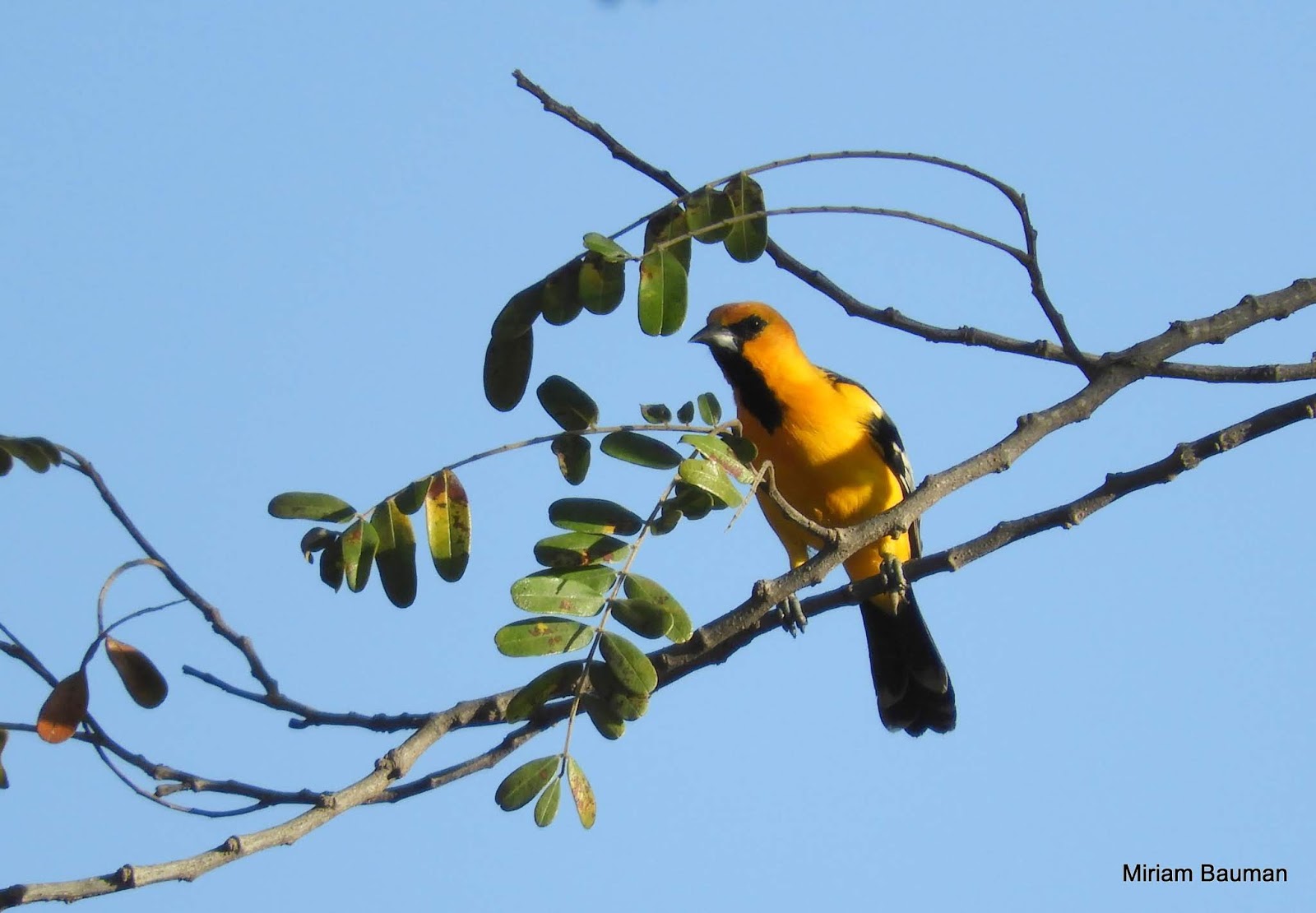
A Streak-backed Oriole (Icterus pustulatus) perched briefly high in a deciduous tree, never really in position (or close enough) for a decent photograph unfortunately.
We took advantage of the relative cool of the morning to explore the beaches and the bird life to be found there. In the early hours they were uncrowded, with mainly people out for exercise joining us at the edge of the Pacific Ocean, and given the general reluctance of people to exercise, that meant that fellow humans were sparse.


One of the great spectacles, which I enjoyed more every time I saw it, was the sheer number of Magnificent Frigatebirds (Fregata magnificens).
 |
| Magnificent Frigatebird - female
Generally they were far out when we first arrived at the beach, mere specks against the horizon, but gradually they moved closer to shore, until finally some individuals were soaring above our heads. Their mastery of flight made me ponder the superiority of various species in conquering realms we humans can only dream of. The frigatebirds cruised with ease, at times seeming to remain motionless as they found and used an air current, only to accelerate at will and with a few flaps of their broad wings disappear from view in seconds. They seem so primitive, so representative of life forms long extinct, as to transport one to a time rooted only in imagination, when dinosaurs flourished and pterodactyls ruled the sky.
Brown Pelicans (Pelecanus occidentalis), Brown Boobies (Sula leucogaster) and Royal Terns (Thalasseus maximus) rounded out the group of aerial specialists. The show in the sky above us was far more pleasing than any air show could ever be, without noise, the stink of fuel, or choreographed stunts. The birds were executing maneuvers with a precision born of necessity, a proficiency that is key to their very survival.
There are numerous species of parrots in Costa Rica, White-fronted Amazon (Amazonia albifrons) being quite commonly seen in the Playa del Coco area.
  |
Perhaps hearkening back to my childhood, when I was enraptured by tales of pirates and buccaneers, a parrot seems more emblematic of the tropics than any other species. I have visions of Long John Silver with a parrot on his shoulder. I cannot count how many times I entered a world of fantastical adventure when reading Treasure Island by Robert Louis Stevenson. Jim Hawkins was my hero; perhaps even now there is a vestige of that in me.
The most satisfying encounter of all was with a Ferruginous Pygmy Owl (Glaucidium brasillianum). I heard the bird call and I called back to it. It responded immediately and we knew the general area where it was perched. A kind Tico realized what we were looking for and upon spotting the owl, motioned for us to enter his garden to see it. For most bird lovers any day with an owl is a good day!

A Streak-backed Oriole in the same vicinity hardly gave us a better picture than the one we had taken earlier.

Trogons are enigmatic birds and Costa Rica is blessed with several species. We saw Black-headed Trogon (Trogon melanocephalus) more often than any other, usually perched quietly on a branch, and despite its bright colours difficult to see if it remained motionless.

Reptiles abound and another Black-tailed Spiny Lizard scaled a tree.

Second only in size to the Green Iguana (Iguana iguana) Black-tailed Spiny Lizards can attain 100 cm including the tail.
Much more modest is the following individual, which I believe it is a young Black Spiny-tailed Lizard, but my proficiency in identifying Costa Rican reptiles is seriously deficient.


The White-throated Magpie-Jay (Calocitta formosa) is an impressive bird and fairly common in appropriate habitat. It appeared right at home in close proximity to human settlement, but despite its size was not always easy to see, being very capable of hiding from view.


The loud, far-carrying roar of the Mantled Howler Monkey (Alouatta paliata) was a familiar sound, and we were delighted to come across a troupe of them on our way home.


We think of siesta time as early afternoon; I think that for the monkeys any time at all is good for a nap!
A group of Black Vultures (Coragyps atratus) at the side of the road drew our attention to what appeared to be a dead opossum, a hearty breakfast for a hungry scavenger!

Road kill is quickly consumed by these ubiquitous birds, nature's own highly efficient sanitation crew.
We returned to the apartment and were content to sit in the shade, read, dip in the pool and eat lunch, before leaving again around 16h:00 for a stroll along a different route.
Great Kiskadee (Pitangus sulphuratus) frequently announces its presence by calling its name; it is common and often perched in the open where it can sally forth to snag passing insects.

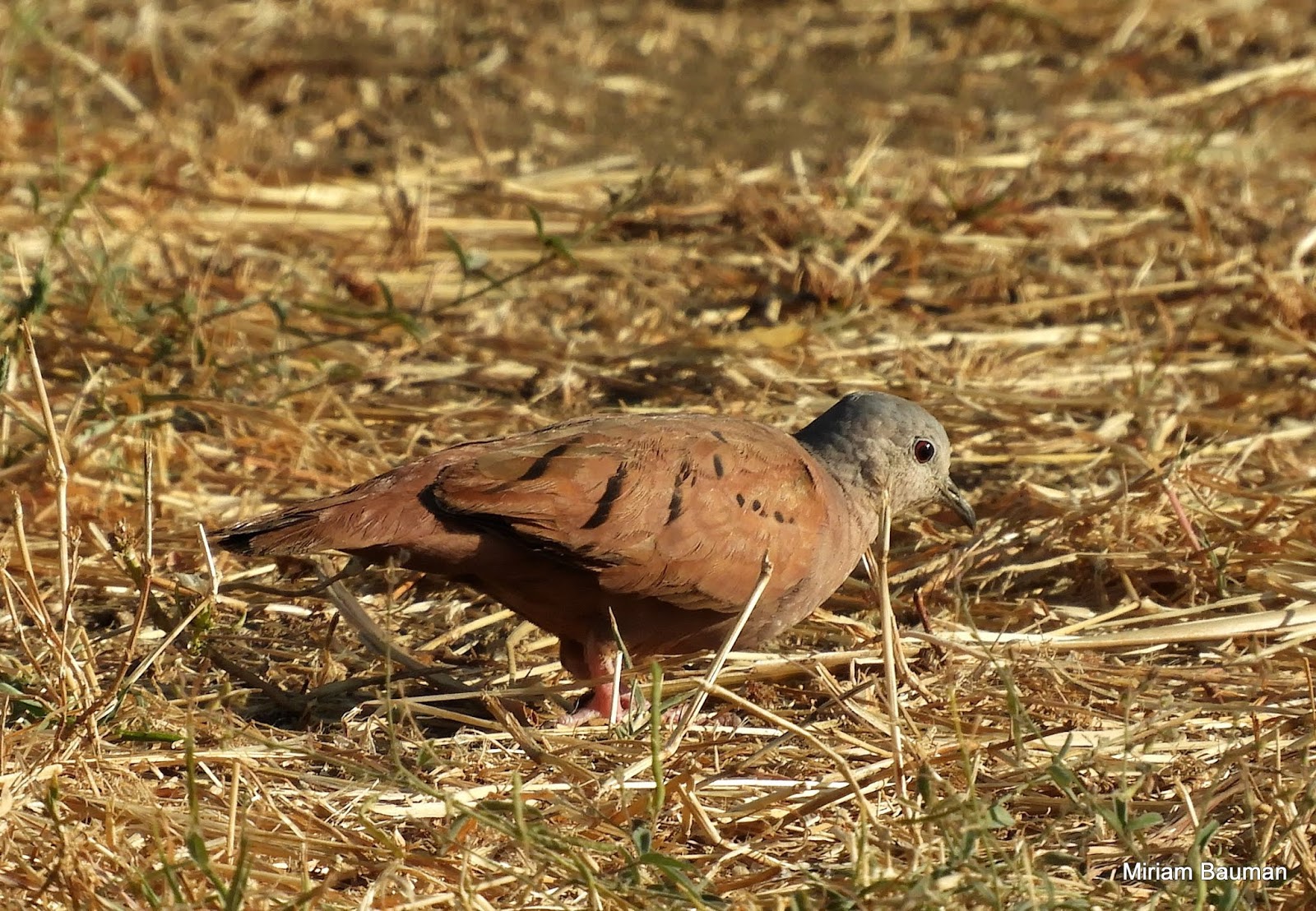
Several species of dove swagger along the ground in normal dove fashion, all singularly beautiful in their own way, none perhaps more so than Ruddy Ground Dove (Columbina talpacoti).
The diminutive Inca Dove (Columbina inca) seemed to favour dry sandy or dusty areas, or patches of dead grass, and could be difficult to see against a neutral backdrop.

It is clearly distinguishable from other small doves by the distinctive shingled look to its plumage.
We traversed an area where many Scissor-tailed Flycatchers (Tyrannus forficatus) were coming to roost for the night, but the light was waning and they were very high in the treetops, and we were unable to get pictures of this gorgeous bird.
A Summer Tanager (Piranga rubra) posed no such problem.

As indicated earlier, Black-headed Trogon could be found with a little diligence, but this one was perched right in front of us, easily visible from the path.

Several Orange-chinned Parakeets (Brotogeris jugularis) joined us in the waning light as we headed for home.

My daily journal on this trip was at times non existent, so for some details I have to count on my not always reliable memory, or Miriam's recollection. Neither of us can remember what we had for dinner, but it doubtless was good, as always!
We retired fairly early and read for a while in bed until our eyelids sagged whether we wanted them to or not. I decided a while ago to reread some of the classic literature I had read and enjoyed many years ago and had started on John Steinbeck's monumental work "East of Eden" on the plane coming down, and was totally immersed in it. It is not hard to appreciate that Steinbeck was indeed worthy of his Nobel Prize for Literature.
All species 25 January: Brown Pelican, Magnificent Frigatebird, Black Vulture, Royal Tern, Inca Dove, Common Ground Dove, Ruddy Ground Dove, White-tipped Dove, White-winged Dove, Ferruginous Pygmy Owl, Canivet's Emerald, Cinnamon Hummingbird, Black-headed Trogon, Hoffmann's Woodpecker, Northern Crested Caracara, Orange-chinned Parakeet, White-fronted Amazon, Orange-fronted Parakeet, Great Kiskadee, Tropical Kingbird, Scissor-tailed Flycatcher, White-throated Magpie-Jay, Mangrove Swallow, Rufous-backed Wren, Clay-coloured Thrush, Streak-backed Oriole, Baltimore Oriole, Melodious Blackbird, Great-tailed Grackle, American Yellow Warbler, Summer Tanager, Rose-breasted Grosbeak, Blue-grey Tanager.