25 June, 2022
Leader: David M. Gascoigne
Members: Miriam Bauman, Victoria Ho, Sandye Moores, Jen Oakum, Shannon Pennington, Selwyn Tomkun
Guests: Trevor Lewis, Pooja Soni and 11 year-old daughter, Meher (our little princess).
,

Soni, Meher, David, Sandye, Jen, Selwyn, Shannon, Trevor, Victoria
DesJardins Canal/Urquart Butterfly Garden, Dundas, ON
It was a hot day already by early morning when we gathered to begin our day, with the promise of good birding from the moment we stepped out of our cars. Soni and Meher had ridden with Miriam and me and they were eagerly looking forward to their first organized nature tour.
There were many Canada Goose (Branta canadensis) with young, always a bit of an added treat for children, I think.

Mallards (Anas platyrynchos) were not to be outdone.

We had seen a goose with a damaged wing, and were saddened to view an additional injured bird with a broken bill.

It is always a cause for dismay to see injured animals, knowing that unlike us, they have no access to care for their injuries, and often fall victim to predators seeking to make a meal of them.
In general, however, Canada Geese were both numerous and healthy.

A male Brown-headed Cowbird (Molothrus ater) posed very nicely for us.

We were delighted to find a Crambid moth, new to all of us if I am not mistaken.

White-spotted Sable (Anania funebris glomeralis), a diurnal species, flies in June and July and is difficult to identify in motion due to its odd spinning flight. It is found in Europe as well as North America, glomeralis denoting the North American subspecies.
Floating islands have been towed out into the canal, providing a resting place and nesting substrate for birds and other creatures. A Northern Map Turtle (Graptemys geographica) has clambered onto this one, with a couple of others in the water behind it.

It's not the greatest picture, I confess, but it serves to show the functionality of these devices.
Speaking of such matters, I should mention that for the first time, an old industrial chimney that had been left standing, was occupied by Chimney Swifts (Chaetura pelagica) and we saw them going into the chimney where presumably they have young to feed.
Our group was very keen, always looking out for new wonders to share. Soni is pointing something out to Meher.

In addition to her mom, everyone went out of their way to help this blossoming young naturalist, who charmed us all, and impressed us with her enthusiasm.
Large fish were seen in the water, but none of us know a great deal about fish so any ID we might attempt would be tentative at best.

Meher was seriously impressed with the stunning beauty of a Tree Swallow (Tachycineta bicolor).

A male House Sparrow (Passer domesticus) is a fine looking bird too.

A large flock of Double-crested Cormorants (Nannopterum auritus) flew over giving us the chance to introduce Meher to the basics of avian aerodynamics - just what every eleven-year old is dying to know!

An Eastern Kingbird (Tyrannus tyrannus) put on a textbook flycatching clinic for us.

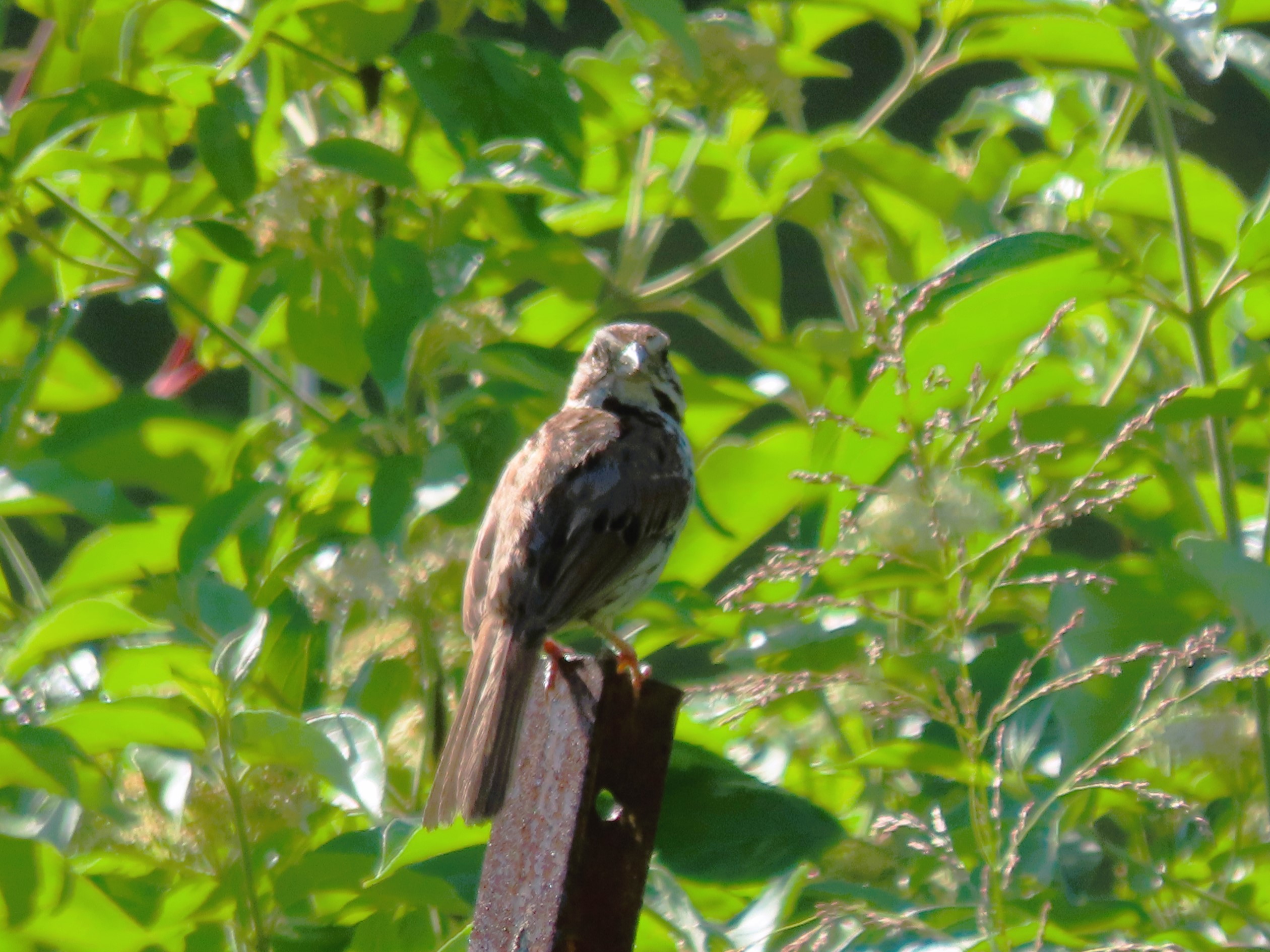
I don't think we were ever out of earshot of an ardent male Song Sparrow (Melospiza melodia).
If ever I have seen Fragrant Sumac (Rhus aromatica) before, I don't recall it, but it is an exceptionally handsome plant.
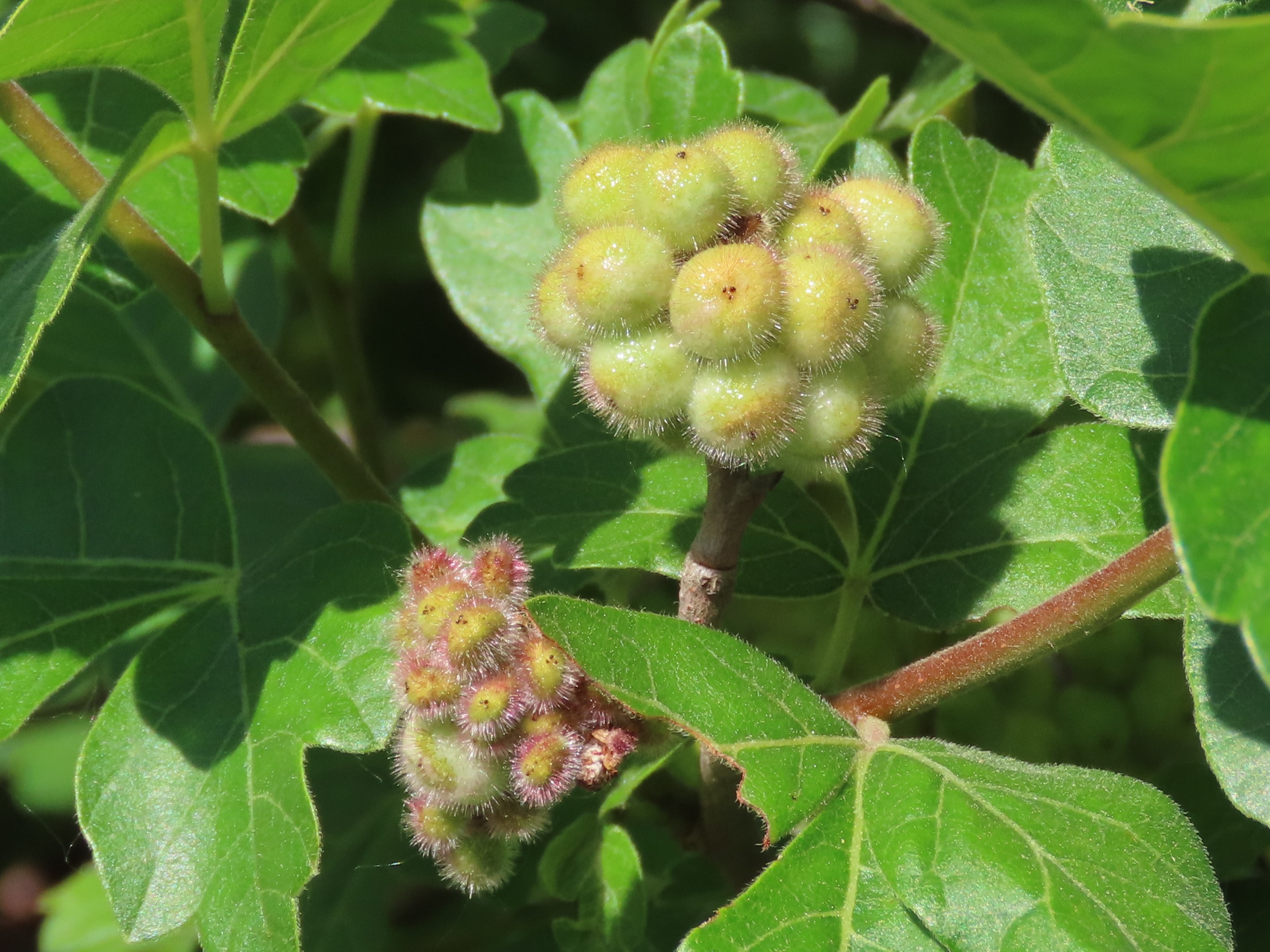
Its spring flowers are exploited by bees and the fruit serves as winter food for birds.
Butterfly Milkweed (Asclepias tuberosa) on the other hand is very familiar, and is surpassingly beautiful.

This plant produces copious amounts of nectar and is in consequence attractive to several butterflies. Monarch (Danaus plexippus), however, is not among them, due to its rough leaves. Furthermore it is one of the lowest Asclepias species in cardenolide protection, offering little defence against predatory birds and other insects.
Beauty Bush (Linnaea amabilis) lives up to its name and is very attractive to hummingbirds and pollinators.

The flowers in the butterfly garden were exquisite.

Shannon was especially delighted to see a Catalpa tree (family Bignoniaceae), a Carolinian species at the northern limits of its range.

Its large leaves shelter small songbirds during periods of heavy rain.

Is there anyone who does not love a Common Poppy (Papaver rhoeas)?

The larva of some insect found Tickseed (genus Coreopsis) to its liking.

Mute Swan (Cygnus olor) is a very handsome bird, well known throughout the temperate world. I am quite sure that this individual had only one aim today and that was to impress Meher.

I am equally sure that it succeeded in its goal.
A Hairy Woodpecker (Leuconotopicus villosus) did not tarry for long, but I think most of us got a good look.

Elegant Zinnia (Zinnia elegans) is an attractive addition to the butterfly garden.

It is much loved by pollinators.
This Mute Swan claimed possession of the floating platform, and I doubt that anyone would mount a challenge to its occupancy.

It was happy to be joined by its mate.

The canal, once the scene of industrial barges plying their way to grimy factories, was tranquil and beautiful.

I was a little surprised to see a lone female Hooded Merganser (Lophodytes cucullatus), but it was one more species for Meher to get to know.

Safe to say that insects are attracted to Chicory (Cichorium intybus)

Grindstone Creek, Hamilton, ON
A family of Mallards (Anas platyrynchos) had obviously been feeding in the mud.

Pretty soon they were joined by their mother and like moms everywhere she seems to have urged them to clean up a little.

A Ring-billed Gull (Larus delawarensis) can always be counted on to pose for a picture.

The flight period for Common Whitetail (Libellula lydia) begins in June, and this male was the first we had seen this year.

I know that Soni was especially taken with White Water-lily (Nymphaea odorata) - and with good reason.

A couple of Caspian Terns (Hydroprogne caspia) patrolled up and down the waterways, periodically diving for fish and displaying their awesome mastery of the air.

Canada Geese seemed to be everywhere, with many goslings accompanied by attentive parents, often blocking the road. Some, however were content to be "far from the madding crowd".

Red-eared Sliders (Trachemys scripta elegans) have been all too frequently released by uncaring pet owners who tire of them, and they are now established in southern Ontario.

Midland Painted Turtle (Chrysemys picta marginata) on the other hand is native to this area.

Here is the long and the short of it - or should that be the big and the small of it?

Several Red-winged Blackbirds (Agelaius phoeniceus) mounted a display for us, flashing their epaulets to flaunt their splendour, and strutting along the paths to assert their dominance.

We were delighted to see another Catalpa in full bloom.

Sandye had brought sunflower hearts with her, and we had been telling Meher that she had a good chance to feed birds and animals from her hand.
In no time at all Eastern Chipmunks (Tamias striatus) were sidling up to us looking for a handout.
Meher was delighted to accommodate them.


Next on the list was a White-breasted Nuthatch (Sitta carolinensis), a more difficult challenge - or so we thought.

Little did we realize that Meher is possessed of a special bird-attracting pheromone, for no sooner had she extended her hand than a nuthatch came for its first treat.

The nuthatch did not go far and was joined by a few others, and Meher's hand was seldom free.

At times it seemed as though a Northern Cardinal (Cardinalis cardinalis) might be tempted to snatch a seed too, but he remained aloof.

Meher's next quarry was a Black-capped Chickadee (Poecile atricapillus) and success was not long in coming.


We do not have a picture of the bird on her hand, but rest assured it happened. Next time we'll try to add a Downy Woodpecker (Dryobates pubescens) to her list.
Meher was also keen to collect feathers and went home with quite an assortment.

There were more Mute Swans to add joy to our day.

A Red-tailed Hawk (Buteo jamaicensis) was way off on the far side of the lake, but we have a shot "for the record."

A Western Osprey (Pandion haliaeetus) was scanning the water for fish, and I had no sooner finished explaining to Meher the way in which the bird is able to align the fish for maximum aerodynamic efficiency, when the osprey caught a large fish and performed exactly that manoeuvre. It made two passes in front of us, but we were unable to obtain a picture, so I am including an image of an osprey with a fish from our archives.

Barn Swallows (Hirundo rustica) were kept busy feeding ravenous young.

Another family of Mallard ducklings was a pleasure to see.

Possibly, somewhere in the world there are responsible fisherfolk; I have yet to meet them. This Canada Goose had become entangled with discarded fishing line and hooks, the hook having embedded itself into the side of the bird. As we were debating how best we could catch it to remove the offending item the bird was able to take care of it itself, as you will see in the sequence below.


Sadly, the ending more often results in infection, reduced mobility and ultimately death for the poor bird.
I saw this image on the internet recently.

It's enough to make you weep.
I hope this Great Blue Heron (Ardea herodias) can stay away from discarded line and tackle, but there's no guarantee of that.

LaSalle Park and Marina, Burlington, ON
The first order of business when we arrived at LaSalle was to have lunch. We were able to find shaded spots away from the glare of the sun beating down ferociously, although not all together. Jen had brought fresh Ontario strawberries and shared them with anyone who cared to indulge.
There are around 2,800 species worldwide in the family Rosaceae and I can tell you confidently that this flower belongs there, but I am unable to identify it as to species.

American Redstart (Setophaga ruticilla) was spotted several times, but was extremely difficlut to photograph.

Reed Meadowgrass (Glyceria grandis) was both prolific and beautiful, making it easy to forget that this is an invasive plant that can overwhelm native ecosytems.

I doubt that we were ever more than a few metres from Eastern Grey Squirrels (Sciurus carolinensis), true denizens of woodlands throughout southern Ontario and the bane of every backyard bird feeder!

The pure white form of Mallard, selectively bred by humans, is generally known as Pekin Duck. No doubt this individual escaped from a wildfowl collection and is now keeping company with its wild cousins.

Sandye has discovered something and is pointing it out to everyone, while Meher kept company with Victoria.

Poor Selwyn is suffering from a painful knee ailment and had taken a seat earlier to await our return.
Mallards lined up on a log.

Northern Rough-winged Swallows (Steglidopteryx ruficollis) were perched almost directly above them, but they paid little attention to each other.


Miriam spotted the nest of a pair of Eastern Kingbirds and noticed the adults visiting periodically to feed their young.

There was a huge concentration of Double-crested Cormorants and we explained to Meher why the birds need to dry their wings following their dives in pursuit of fish.


Ring-billed Gulls were ubiquitous.

Cabbage Whites (Pieris rapae) were easily the most numerous butterfly, and this female even settled long enough for a picture.

As mentioned above representatives of the rose family are widespread and beautiful.

Paletta Lakefront Park, Burlington, ON
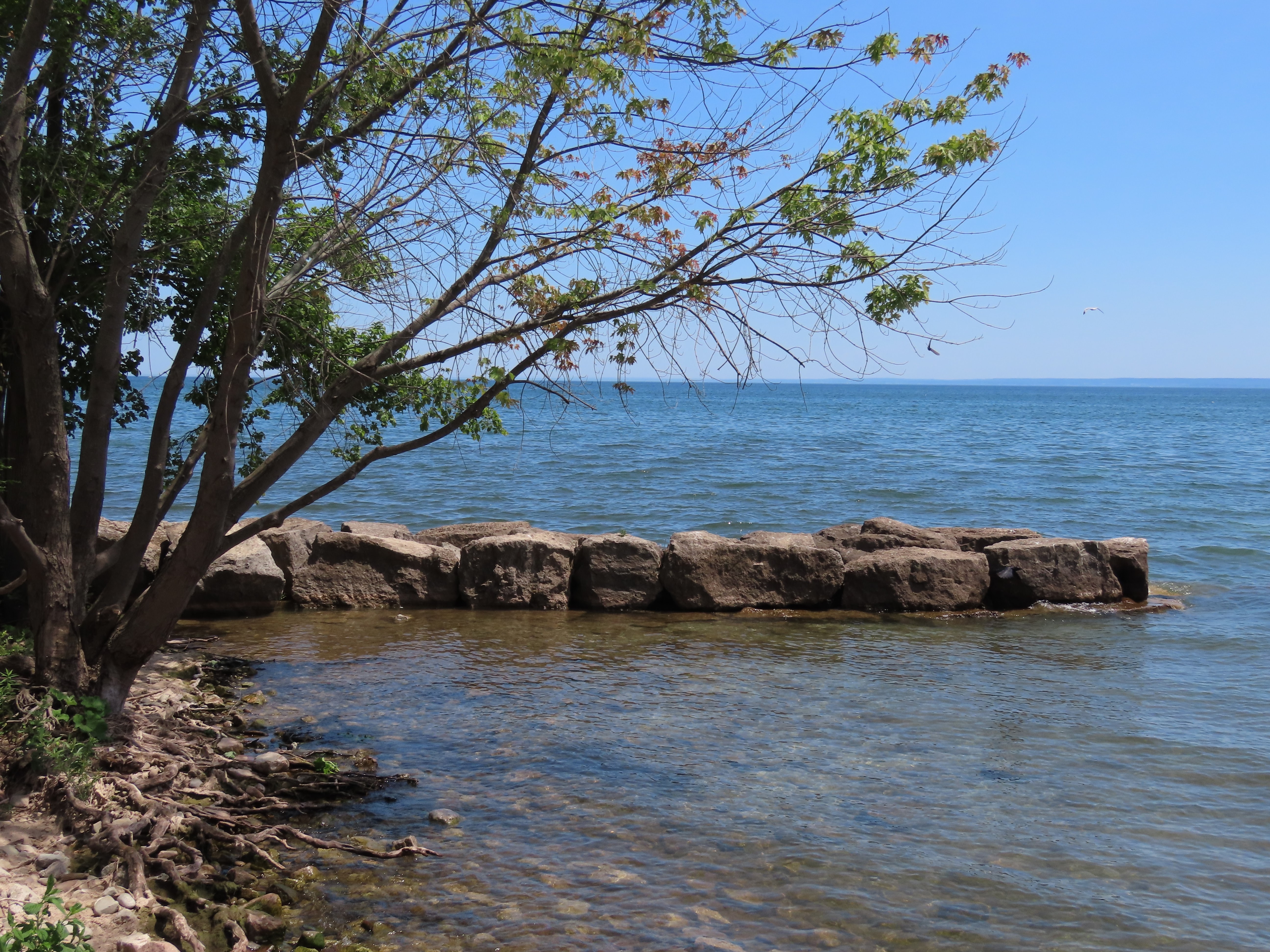
Given the heat, a state of lassitude was staring to overcome some of us, and the cool of the wooded area was a pleasant break from the relentless sun.

Cedar Waxwings (Bombycilla cedrorum) were unfazed by it all and gorged on berries of various kinds.

This tree has seen much history come and go and bears the signs of old age with dignity and grace.


Multiflora Rose (Rosa multiflora) is always a pleasing sight.

The temperature had by now climbed to 32 degrees, and it was past mid-afternoon. Even though I had planned two more stops, we decided to call it a day, well satisfied with excellent sightings and the very best of companionship.
I think we had worn out Soni and Meher who both slept on the way home; the sleep of happiness, however; I know they were pleased with their excursion.
As for Miriam and me, we look forward to doing it all again with our little princess and her mom! We can hardly wait.