14 December, 2022
We have a birding trip to Cuba planned for February for a group of eight including Miriam and me, and we thought it would be great to spend a day together enjoying the winter residents of the inshore waters of Lake Ontario and the adjacent terrestrial habitat.
Tina lives too far away to take part in a day trip and Selwyn and Victoria were otherwise occupied, but Miriam and I were joined by Lisa, Jim and Barb, and we spent a very enjoyable and productive day along the lake.
Even before leaving home the sky put on a show to bid us welcome to the day.

Humber Bay Park West, Toronto, ON

A Mute Swan (Cygnus olor) was busy getting breakfast.

Buffleheads (Bucephala clangula) were pleasingly common and often at close quarters.


Photo courtesy of Jim Bowman
The thermometer registered minus 6.5 degrees and the benches and picnic tables were unoccupied.

Two Northern Mockingbirds (Mimus polyglottos) were incredibly cooperative and this one perched no more than a metre from my head.

A couple of police cars were present, blocking a car and apparently waiting for the driver to return. It's hard to believe, I know, but they showed not one bit of interest in these birds. Catching criminals was on their mind I suppose. Birding is much more fun.
Ample berries provided the mockingbirds with their early morning sustenance.


It was such a memorable encounter with a bird that is still far from common here. I would imagine it was the highlight of the day for everyone.
I am sure that had Victoria been with us she would have danced a Bollywood routine in a frisson of delight, and Selwyn would have been working on the scientific name.
White-winged Scoter (Melanitta deglandi) is usually seen far out from shore, so this lone male no more than twenty metres away was a special delight for all of us.

Photo courtesy of Jim Bowman
The parking enforcement officials at this location are like zealous worker bees in enforcing fines, so we all made sure to pay for parking and display the receipt on our dashboards.
Now to the important stuff - birding!
A Porter Airways plane flew overhead, no doubt to remind us that for all our technical wizardry, we have still not been able to emulate the skill and manoeuvrability of a bird.

Buffleheads were once again common and the following picture gives a good idea of just how small this diving duck is, with a Mallard (Anas platyrynchos) behind to show the contrast.

All around us were Rock Doves (Columba livia).....

..... and House Sparrows (Passer domesticus).....

These are two species that we have deliberately introduced into North America, yet now routinely disdain. I find them charming, however, and I suspect that most of the population does too. It is only people "in the know" about birds that resent House Sparrows evicting native species from nesting sites, and probably think the only good thing about Rock Doves (aka pigeons) is that they provide food for urban Peregrine Falcons (Falco peregrinus).
But how many times have you seen people dining outdoors tossing crumbs to the perky little sparrows under their table, and relishing this brief inter-species intimacy. They are enjoying the sparrows. Before it was decided that pigeons and public monuments in Trafalgar Square in London didn't go together, an adoring public flocked there to feed the birds, and many a photo album is filled with pictures of children bedecked with pigeons on their heads and outstretched arms.
So, embrace them, I say. I know I do.
Everybody loves a Hooded Merganser (Lophodytes cucullatus).


Photo courtesy of Jim Bowman
A group of waterfowl gathered together, each species feeding in its own fashion, is the source of great contentment for a bird lover.

All seems well with the world to see such an aggregation.
Compare the size of a female Bufflehead with a Canada Goose (Branta canadensis) - such a difference!

Don't ever undervalue the subtle beauty of a female Mallard. Not for her the gaudy green sheen on the head, nor a perky curled-up tail, but she is outfitted with elegance aplenty.

Several Common Mergansers (Mergus merganser) were present. Here is a parade of males.

The sightings of Redhead (Aythya americana) are still spotty, but more will arrive soon.

A Northern Shoveler (Spatula clypeata) declined to show the bill from which it derives its name.

Northern Cardinals (Cardinalis cardinalis) were quite common.

This is a species that despite a long association with people does not seem to have abandoned its wariness.
Long-tailed Duck (Clangula hyemalis) needs no further comment from me.


If only I were an artist!
Downtown Toronto loomed large in the background. Many people there work underground in a labyrinth of shops and businesses, like ants in a formicarium. Oh horror!

Like Redheads, Common Goldeneyes (Bucephala albeola) have not yet arrived in their usual numbers, but Jim managed this fine picture of a male.

Colonel Samuel Smith Park, Toronto, ON
I haven't been able to find out much about Colonel Samuel Smith, other than that these lands were part of his property in the 1800s. I'd vote for a name change to reflect its importance as a natural site and an important spring stopover site for Hudsonian Whimbrels (Numenius hudsonicus). Harry Lumsden Park has a nice ring to it, or Murray Speirs Nature Reserve perhaps. I suspect this is not going to happen!
American Robins (Turdus migratorius) and Common Starlings (Sturnus vulgaris) were flocking together and were drawn to to Staghorn Sumac (Rhus typhina), feeding on its fruit.


American Wigeon (Mareca americana) is a lovely little duck and we were enchanted by its presence.


A Ring-billed Gull (Larus delawarensis) bobbed up and down on the water.

It is not often that a Cooper's Hawk (Accipiter cooperii) gives you a good look, and today's bird followed the rules to a tee!

Gadwalls (Mareca strepera) were congregated exactly where we expected them to be.


It was picturesque indeed to see them massing at the shore with wigeons. Such a beautiful sight!


Lakefront Promenade, Mississauga, ON
The harbour was deserted at the this time of the year, as boats have been hauled out of the water.

There was not much of a breeze and the flag was flapping limpidly.

We didn't see many birds at this location, so I will not break the areas down into their different pods.
A Black-capped Chickadee (Poecile atricapillus) was pecking away at what seemed to be pita bread, although how it found its way into the tree is unknown.

A Downy Woodpecker (Dryobates pubescens) was foraging in a more conventional fashion.

This American Herring Gull (Larus smithsonianus) appeared to be stepping out on the town.

And a Ring-billed Gull surveyed the world from its favourite perch.

Lakeshore Boulevard, Oakville, ON
This Red Fox (Vulpes vulpes) had become a casualty of the carnage inflicted on wildlife by vehicular traffic. Distressing to see.

LaSalle Park and Marina, Burlington, ON
This, our final stop of the day, was as agreeable as it always is.
A Bufflehead showed its colours, only seen in the right light.

At least a dozen American Coots (Fulica americana) plied the water, diving frequently to secure food.

Picture courtesy of Jim Bowman
Mallards were both common and appealing.

LaSalle Park is the best place I know to find American Black Duck (Anas rubipres).

There were many Canvasbacks (Aythya valsineria) present, mostly far out, but a few close enough for a decent picture.

I am sure there was no less than a hundred Trumpeter Swans (Cygnus buccinator) at the park and it makes me happy to see how successful their recovery has been.

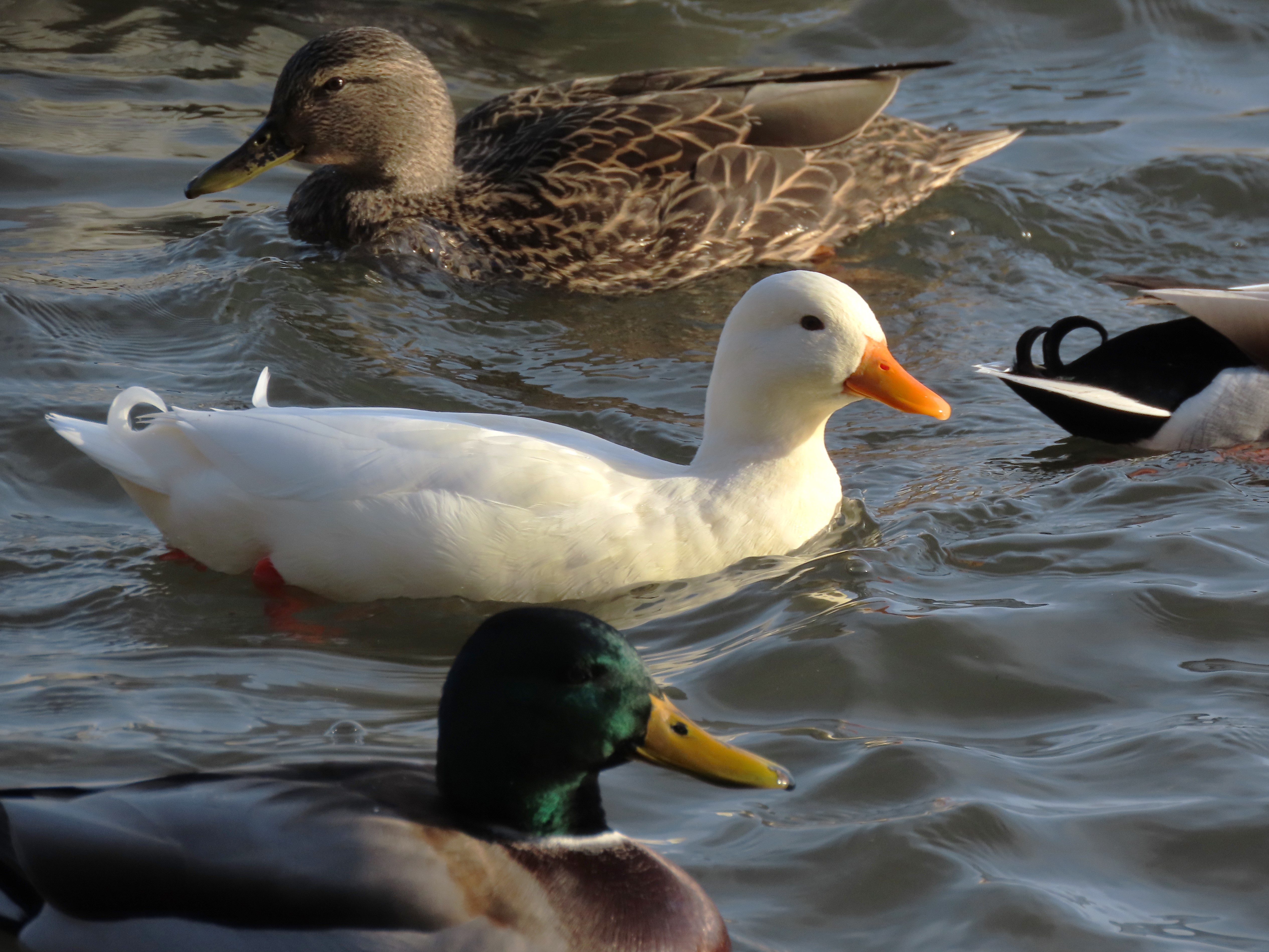
The pure white domestic Mallard we saw last week is still present, charming people with its beauty.
Back on shore it was time for a stretch.

Photo courtesy of Jim Bowman
Several Red-breasted Mergansers (Mergus serrator) were observed.

Red-breasted Merganser ♀

Red-breasted Merganser ♂
Common Goldeneye was a little more common than at earlier locations but still in nowhere near the numbers that might be expected as the winter advances.

Common Goldeneye ♂

Common Goldeneye ♀
Wherever we walked Black-capped Chickadees followed us, often little groups of a half dozen or more, accustomed to people bringing food. Alas, we had none with us.
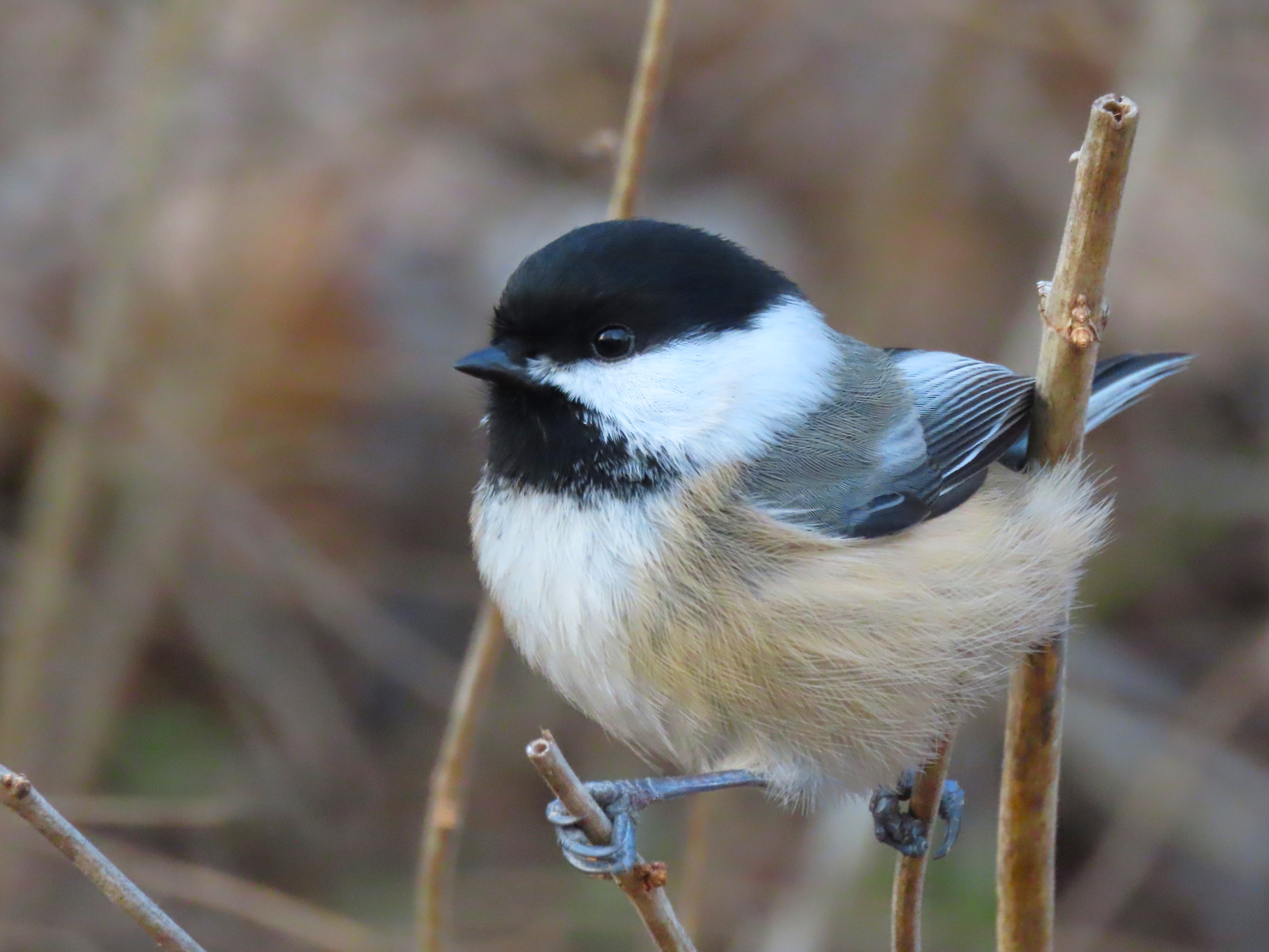
White-breasted Nuthatch (Sitta carolinensis) often travels with chickadees; uncharacteristically this individual was on the ground.

The light was fading and Jim, Barb and Lisa had already left and we made our way back to the car.
A Canada Goose swam towards us as if to declare, "See you again soon."

It was a fitting end to a splendid day.