18 March 2017
Leader: David M. Gascoigne
Club members participating: Miriam Bauman, Scott Beemer, Alice Buehrle, Roland Buehrle, Anne Godlewski, Nathanael Harper, Denise Leschak, Greg Michelenko, Sandra Moores, Jen Oakum, Janet Ozaruk, Roger Suffling, Judy Wyatt.
Guest: Stephen West
Every year, sometime during the second half of March, I lead a WRN outing to check out the bird life along the north shore of Lake Ontario.
The weather is extremely variable at this time of the year, and today's outing was characterized by foul or fouler! However, hardy Canadians that we are, we did not permit the adverse conditions to deter us and we ventured forth in good spirits, looking forward to an agreeable excursion into nature. Miriam had agreed to act as the official photographer for the day allowing me the freedom to concentrate on the group, help them locate species and answer their questions.
I decided that we would detour first to the Desjardins Canal in Dundas, where Hooded Mergansers Lophodytes cucullatus are virtually a certainty, with far less likelihood of encountering this species at other planned stops. Here is the scene that greeted us when we parked at the canal.

The temperature hovered right around zero with wet, heavy snow.
Our group quickly coalesced and we set out to see what we could find.

We had barely taken a few steps when a male Downy Woodpecker Picoides pubescens announced his presence as he hammered away on the trunk of a tree.

Anyone who felt even mildly disconsolate about the weather was immediately put in a better frame of mind. A cheery woodpecker will do it every time!
It was not long before we found our target - Hooded Merganser - but the conditions were such that it was impossible to get a decent picture.

This Ring-billed Gull Larus delawarensis seemed unbothered by it all.

On the way down to Dundas we had seen a few vehicles that had slid off the road, obviously driving too fast for the conditions; we took it easy, had no difficulty staying together and had no problems. One pick up truck had driven straight off the road and since there were no skid marks or indications of fishtailing we assumed that the driver had not been paying sufficient attention (texting perhaps) and had simply driven off the road.
On our way back from the canal to rejoin the highway, a tow truck had been requisitioned to pull the vehicle back onto the road. A police car was stationed right at the top of a small hill, lights flashing, but not angled in any way to block the road, and with no officer visible. I, followed by Roland, drove around the cruiser and proceeded very slowly down the hill. A cop then jumped out of the vehicle and came running after us to tell us to turn around and go back. He was, to say the least, less than polite, but we were sufficiently humble and apologetic and there were no further consequences, other than the group getting separated.
Why the officer had been sitting in his cruiser rather than being outside it directing traffic, or why he had not blocked off the road farther away from the incident, was a question none of us could answer.
None the worse for the delay, we all met up again at LaSalle Park and Marina in Burlington.
LaSalle, as always, presented us with a smorgasbord of waterfowl, close enough that despite the gloom we could see them well. There were many Common Goldeneye Bucephala clangula and a little flotilla meandered by as though to congratulate us for braving the weather.

To the right of the goldeneyes you can see a female Greater Scaup Aythya marila and this male was not far away.

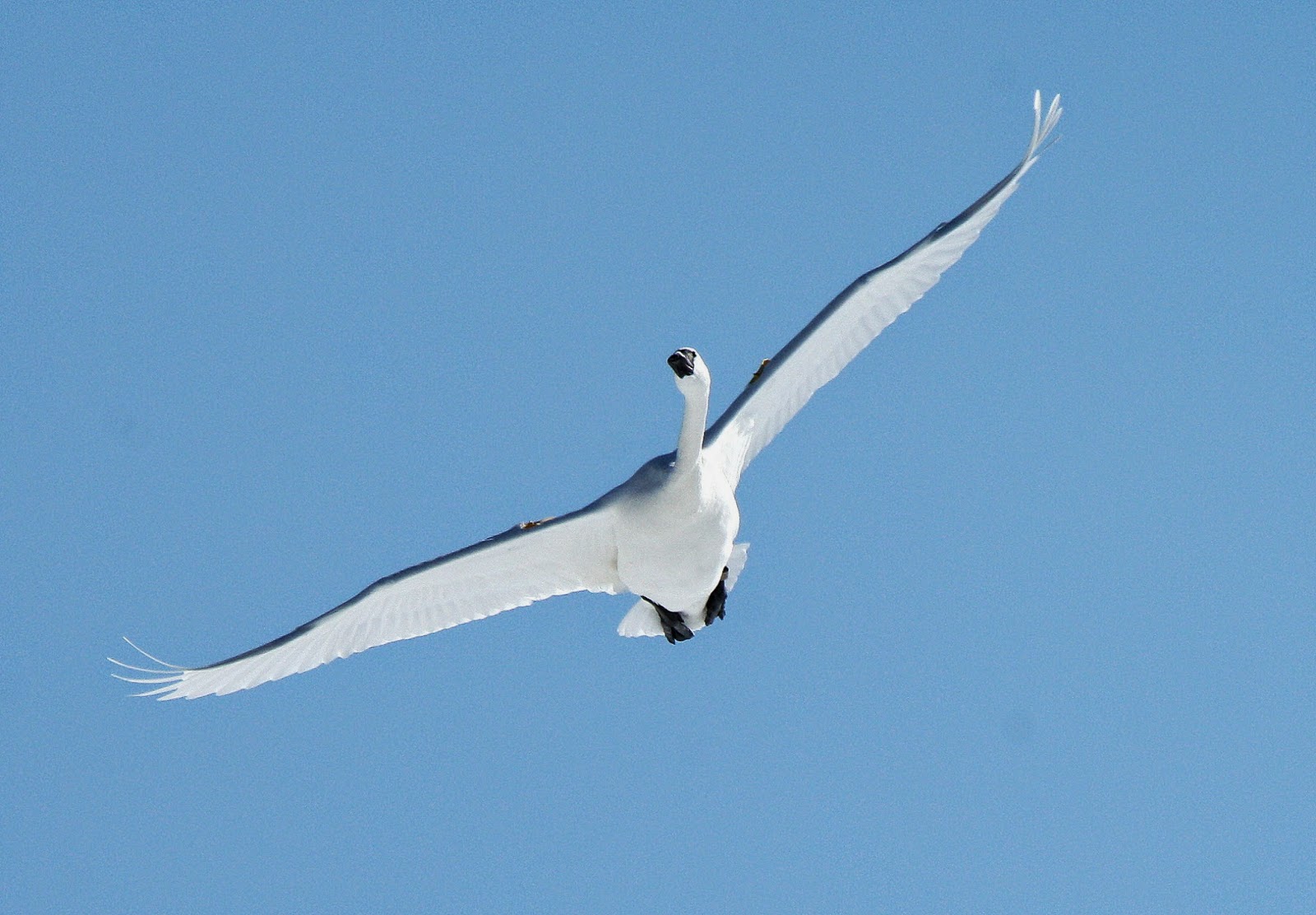
Several members of the group were not especially familiar with waterfowl and were happy to have the opportunity to compare Mute Swan Cygnus olor, a non native species with Trumpeter Swan Cygnus buccinator, the dean of North American Swans.
It is not hard to understand why the Mute Swan in Britain is considered a royal bird. It looks regal as it swims by with its wings in heraldic position, graceful and dignified.


Trumpeter Swan is all business by comparison. Here is an individual loafing on the boat slip with the ubiquitous Mallards Anas platyrynchos.

Judy Wyatt made the very apt observation that there are probably few places where you can walk among the swans and be surrounded by them, an experience to warm the heart of any bird lover.
Many people have commented to me personally and via my blog that the large yellow tags are "obscene" and while I admit that they are not the prettiest ways to mark the birds, I am assured that it is the most effective way for the birds to be identified at a distance, and to alert less than scrupulous hunters that they should not be shooting this bird.
Many Long-tailed Ducks Clangula hyemalis were present, always a favourite with waterfowl enthusiasts.

Red-breasted Merganser Mergus serrator was also quite common with many pair bonds apparently having been struck.

I was there to explain the field marks of the birds and other salient facts, but there was always time to check the field guide too and prepare oneself for the next venture. Here is Janet studying intently.

As I have mentioned in previous posts American Black Duck Anas rubipres interbreeds extensively with Mallard, but LaSalle is one place where one can usually find pure Black Ducks.

This odd looking Mallard was present and I believe it is a partially leucistic female. It could be a "barnyard" species I suppose, but that categorization didn't seem right to me.

A woman was sitting by the water's edge with a long lens on her camera bemoaning the fact that she had not seen a Wood Duck Aix sponsa. In the blink of an eye one of our group said to her, "Like that one there," pointing to a stunning male no more than three metres from where the photographer was sitting.


The following shot of the Wood Duck with a Ring-billed Gull clearly illustrates what a tiny duck this is.

A walk along the woodland trail was not especially productive, although we did get fleeting glimpses of Carolina WrenThryothorus ludovicianus.

Gadwall Anas strepera, that most understated of ducks, was pleasantly close and easily visible from the shore.

Far out across the bay a Common Loon Gavia immer could be seen. We saw a loon out there in January so I suspect the same bird has spent the winter here.

As we made our way back along the trail we noticed the Wood Duck preening - and who can resist one more picture of such a Jim Dandy?

For me, the highlight of the day was about to occur. I noticed Bev Kingdon (the Angel of the Swans) there and went to say hi, and she informed me that Harry Lumsden was in her car. Harry is truly one of the great figures in Ontario Ornithology (see previous commentary here) and I could not wait to introduce everyone to him. He is still robust, vigorous and commands everyone's attention at the age of ninety-four. Without Harry's dogged determination there would be no Trumpeter Swans in Ontario.
Roger Suffling remembers Harry from way back when he (Roger) was a student at the University of Guelph. Roger was very happy to have his picture taken with his old mentor. The swans behind them are a fitting backdrop.

Some of our group had already hightailed it back to their vehicles to warm up and eat lunch, but those of us who remained were delighted to have our picture taken with Harry. I daresay no one will forget this encounter with an ornithological legend, and a humble, gracious man to boot.
Our final stop of the day was at Bronte Harbour in Oakville, where we looked forward to seeing Red-necked Grebes Podiceps grisegena up close. This species breeds every year in the inner harbour, and by now they are already into high courtship behaviour. Unfortunately, most areas were still iced over and we had to be content with distant and hardly satisfactory views.

 |
| Bev Kingdon, Scott Beemer, Greg Michalenko, Judy Wyatt, HARRY LUMSDEN, David Gascoigne, Roger Suffling, Nathanael Harper, Alice Buehrle, Stephen West, Anne Goldlewski
After lunch we headed off to Sioux Lookout Park where we expected to find many Long-tailed Ducks in close to shore, along with a range of other diving ducks, but the lake was devoid of birds other than for small rafts of ducks very far out.
Our next stop was at Paletta Park where the winds were bitter coming across the lake and the waves were crashing on the shore, even causing a backwash in the creek.

Undeterred, our group slowly meandered along the path, birding all the while.

An American Mink Mustela vison was perfectly at ease in the icy water and on the snowy ground and entertained us with its antics.
 |

A male Red-breasted Merganser came close to the breakwater.


Our final bird of the day was a fitting conclusion to a cold, windy outing. A female Snowy Owl Bubo scandiacus was perched on the wall of the outer barrier, calmly surveying the world around it, and Miriam was able to get a fairly decent shot, especially taking into account the poor light and the fact that she had to keep the camera still in the strong wind.


Our final bird of the day was a fitting conclusion to a cold, windy outing. A female Snowy Owl Bubo scandiacus was perched on the wall of the outer barrier, calmly surveying the world around it, and Miriam was able to get a fairly decent shot, especially taking into account the poor light and the fact that she had to keep the camera still in the strong wind.

Despite the conditions we had an excellent day of birding with a final tally of 40
species. We enjoyed each other's company and are committed to do it all again next year.
List of species: Canada Goose, Mute Swan, Trumpeter Swan, Wood Duck, Gadwall, American Black Duck, Mallard, Canvasback, Redhead, Ring-necked Duck, Greater Scaup, Bufflehead, Common Goldeneye, Hooded Merganser, Common Merganser, Red-breasted Merganser, White-winged Scoter, Long-tailed Duck, Great Northern Loon, Red-necked Grebe, Horned Grebe, Double-crested Cormorant, Red-tailed Hawk, Ring-billed Gull, Mourning Dove, Snowy Owl, Belted Kingfisher, Downy Woodpecker, Hairy Woodpecker, Blue Jay, American Crow, Black-capped Chickadee, Carolina Wren, White-breasted Nuthatch, American Robin, House Sparrow, American Goldfinch, Red-winged Blackbird, Dark-eyed Junco, Northern Cardinal.
species. We enjoyed each other's company and are committed to do it all again next year.
List of species: Canada Goose, Mute Swan, Trumpeter Swan, Wood Duck, Gadwall, American Black Duck, Mallard, Canvasback, Redhead, Ring-necked Duck, Greater Scaup, Bufflehead, Common Goldeneye, Hooded Merganser, Common Merganser, Red-breasted Merganser, White-winged Scoter, Long-tailed Duck, Great Northern Loon, Red-necked Grebe, Horned Grebe, Double-crested Cormorant, Red-tailed Hawk, Ring-billed Gull, Mourning Dove, Snowy Owl, Belted Kingfisher, Downy Woodpecker, Hairy Woodpecker, Blue Jay, American Crow, Black-capped Chickadee, Carolina Wren, White-breasted Nuthatch, American Robin, House Sparrow, American Goldfinch, Red-winged Blackbird, Dark-eyed Junco, Northern Cardinal.