We are starting to see the first chink of light in the tunnel of COVID darkness, and a little more freedom is now possible. I hope we are not plunged back into lockdown, having endured three such periods, for I fear the good citizens of the province will go mad!
21 May 2021
Wilmot Township, Waterloo, ON
I was surprised, when driving along Berlett's Road en route to SpruceHaven to see a lone Wild Turkey (Melagris gollopavo) strutting across a field as only turkeys can, appearing to capture invertebrate prey as it did so.

Our backyard, Waterloo, ON
The perennials in our garden are putting on quite a show now, and it is quite intoxicating to sit outside and enjoy bloom all around us.
Snowdrop Anemones (Anemone sylvestris) are both prolific and beautiful.

It is now warm enough to enjoy our morning coffee on the patio, and anemones make fine companions.

Common Blue Violet (Viola sororia) is no less delightful.

22 May 2021
Lakeside Park, Kitchener, ON

Cerulean Warbler (Setophaga cerulea) is one of several neotropical warblers in trouble, due principally to habitat loss in its home in South America, and here in North America where it breeds.
It is seldom seen and ranks very high on the roster of species a birder wishes to add to her life list. A single male, at Lakeside Park, therefore, was cause for great excitement in the birding community, and as news of its presence spread, the pilgrimage of birders and photographers increased by the minute! It was staggering to contemplate the total value of expensive optical equipment and telephoto lenses in that one small clearing in an urban park.
The bird stayed high in the canopy, at the very top of the trees, and for the most part this is what one saw.

We do not have sophisticated cameras and $10,000 lenses, and Miriam did really well to capture what she did.

Happiness was seeing the bird; the picture was secondary.
It was quite a bit easier to do somewhat better with a Swainson's Thrush (Catharus ustulatus).

And to be in the park was enchanting.

Our first Eastern Wood Pewee (Contopus virens) was perhaps as pleased to see us as we were to see it, because it perched and sang for a while.

It darted from its perch a few times to capture a passing insect, and moved a metre or so, but stayed in the same area, in full view.

It was a stark contrast to the neck-straining exercise with the Cerulean Warbler, and we viewed it alone, far from the chatter of excited humans.

It started to rain (badly needed) and we made our way back to our car, happy to have visited the park, with so many treasures on display.

23 May 2021
Columbia Lake, Waterloo, ON

We are so fortunate that Columbia Lake is very close to home. In less than ten minutes from our front door we can set our feet down on the trail.
It is not so bad to be greeted by a profusion of Black Hawthorn (Crataegus douglasii) mere moments from beginning a walk.

A Six-spotted Tiger Beetle (Cicindela sexguttata) is both common and dramatic.

Tiger beetle males keep a grip on their mates long after mating to ensure paternity.
Soon after watching the beautiful tiger beetles for a while we spotted our first Northern Crescent (Phyciodes cocyta) of the spring.

The number and variety of butterflies will only keep growing throughout the summer.
A field of corn stubble is not a place where we expect to find Spotted Sandpiper (Actitis macularia) but this bird seemed to be exploiting the insect flush, along with American Robins (Turdus migratorius).

A Belted Kingfisher (Megaceryle alcyon) was perched nearby, quite far from the water, and it made me wonder if it too was benefitting from an insect boom.

A pair of Brown-headed Cowbirds (Molothrus ater) seemed not to be doing much of anything.

Columbia Lake provides habitat for a variety of birds.....

..... and Canada Geese (Branta canadensis) have taken great advantage of secluded breeding areas.

The results are there for all to see.

As anyone who has ever tried to take a picture of a swallow in flight knows, it is an almost impossible task. It was a stroke of luck, therefore to come across these Northern Rough-winged Swallows (Stelgidopteryx serripennis) resting on the road.

Often there are several Great Blue Herons (Ardea herodias) and today was no exception.

Our main purpose in choosing Columbia Lake for our walk was to check on shorebirds at the tail end of northward migration.
The water level was ideal in one corner of the lake.


A Spotted Sandpiper cut a fine figure perched on stones that form a conduit from one bank to the other.

Several individuals of this species were present and they put on quite a show for us.

It is a common bird, but it breeds locally and in consequence may be studied at will.

Spotted Sandpiper is a polyandrous species where the female is dominant and squabbles between rival females is not uncommon.

What a pleasure to see Spotted Sandpiper in breeding plumage when it is obvious how it came by its name.
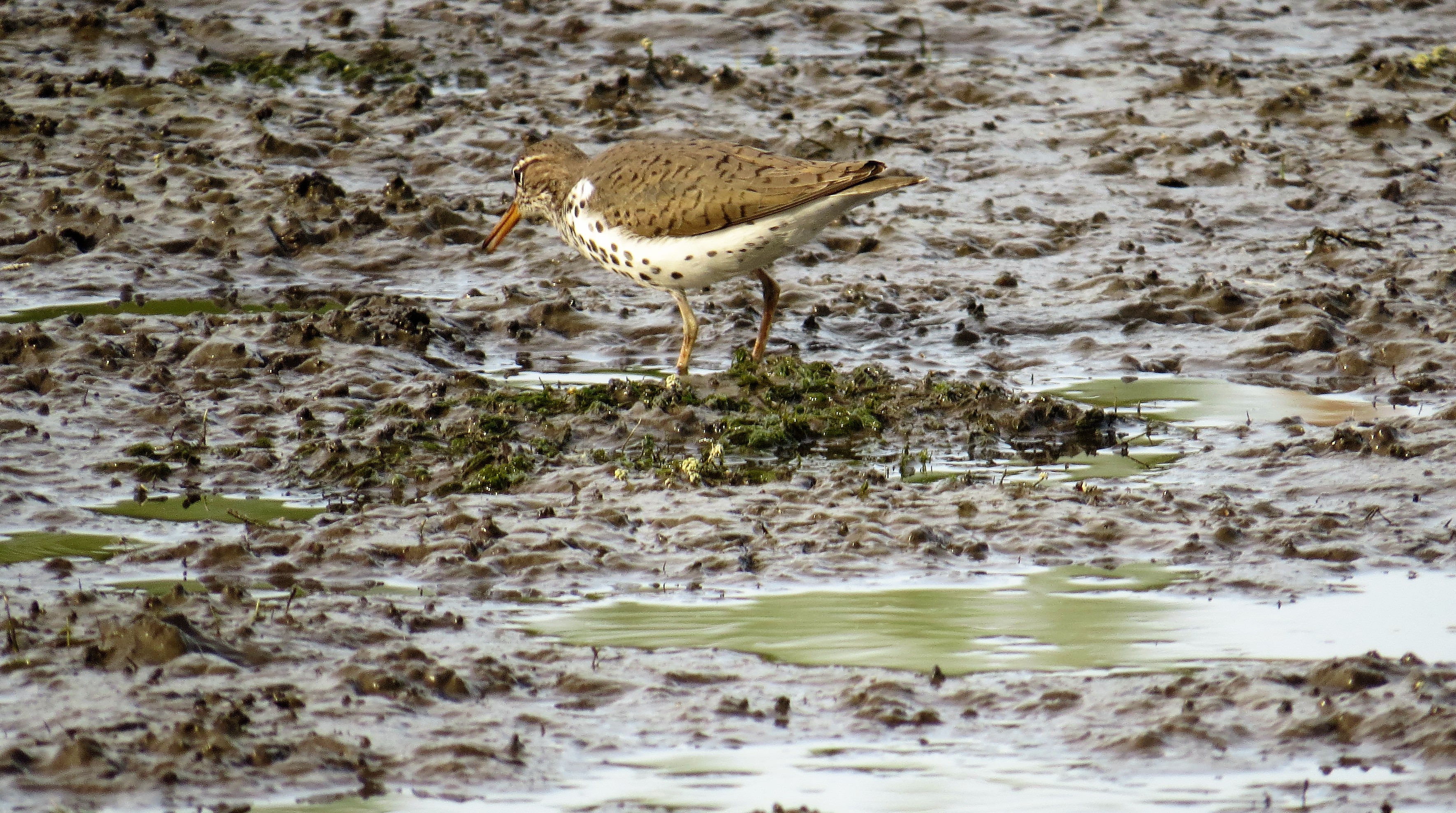
Killdeer (Chadrius vociferus) is the common breeding plover of the area. It is an uncommonly handsome bird.

The much smaller Semipalmated Sandpiper (Charadrius semipalmatus) is the epitome of cuteness.


In the picture below the plover looks quite quizzical, as though asking the Least Sandpipers (Calidris minutilla) what they are doing there.

Were I into making fuzzy toys I think Semipalmated Plover might be my inspiration!


Least Sandpiper is the world's smallest sandpiper, and it was a pleasure to see them in breeding plumage.

This tiny bird weighing as little as a dozen grams will wing its way to its Arctic breeding grounds before returning south again.

The journeys made by shorebirds are prodigious!
Usually we see Dunlin (Calidris alpina) in the fall when they have moulted out of their breeding finery, so it was an exceptional treat to see this species with its distinctive black belly patch.

There is so much enjoyment to be derived from studying shorebirds that we were mesmerized for an hour or so.
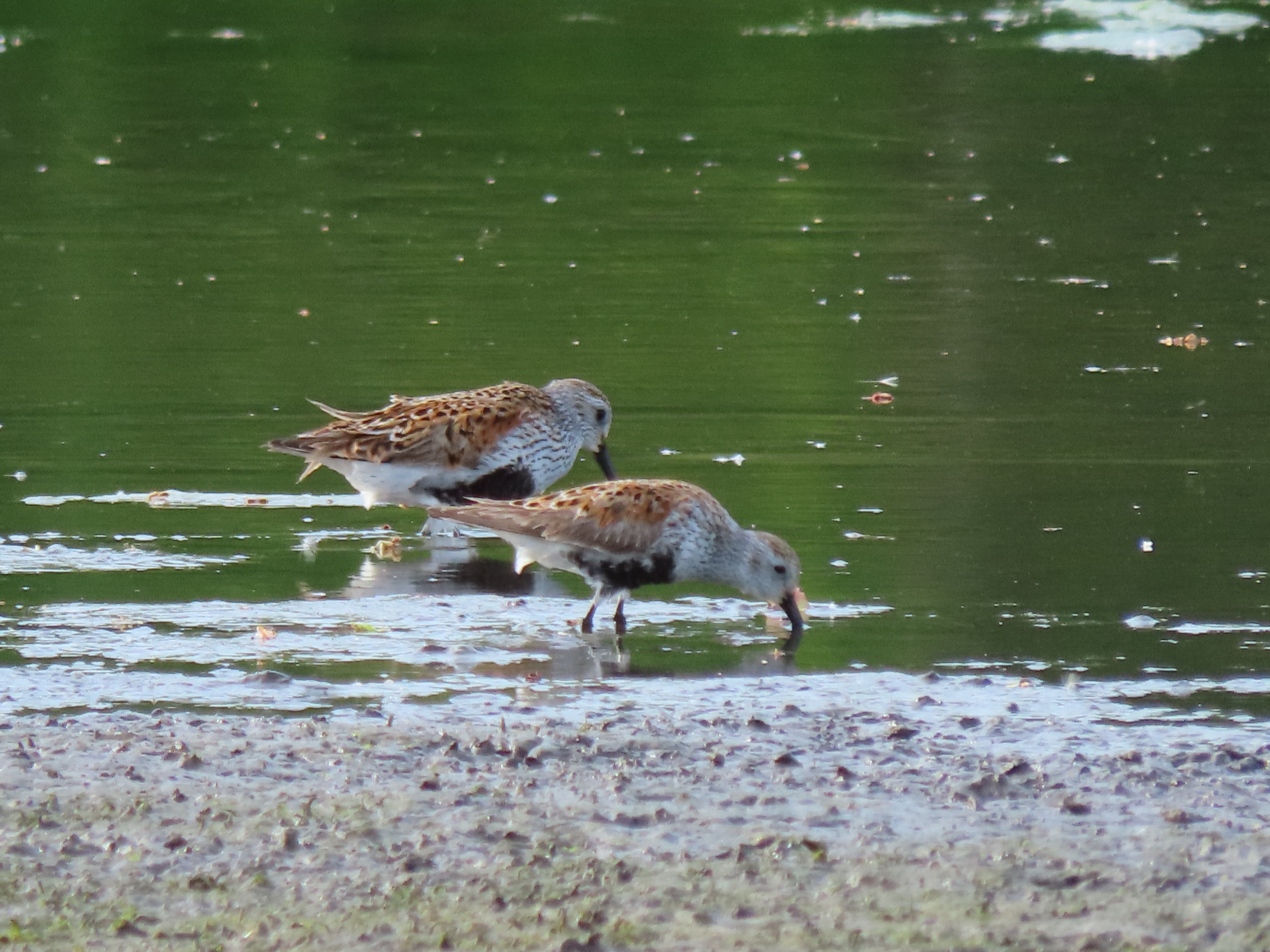
A group of breeding-plumaged Dunlin was the proverbial icing on the cake!

I mentioned above that the number of butterflies will increase throughout the summer. As if to reinforce the point, just as we were leaving an Eastern Tailed Blue (Cupido comyntas) flitted in front of us, and alighted for a picture.

Life is good!