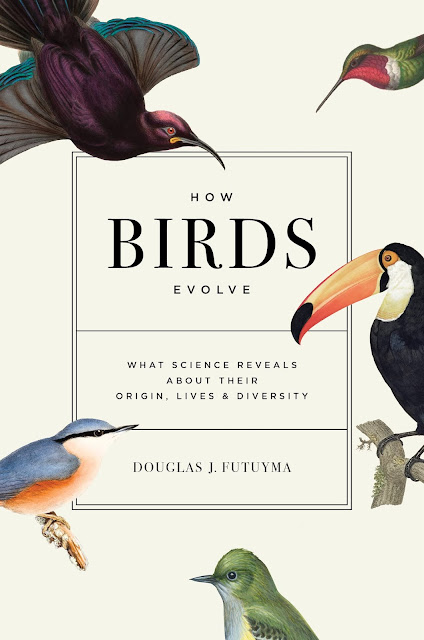
Douglas J. Futuyma has done a fabulous job reducing complex science to readily understandable prose, making precise mathematical concepts accessible to those less statistically inclined, or ill-equipped by training to engage in analysis. In so doing he delivers exactly what the subtitle to the book promises, "What Science Reveals About Their Origin, Lives and Diversity."
I can attest, based on many years of leading bird walks, that so many birders, perhaps even the majority, shy away from anything other than the pleasure and thrill of the birds themselves. It is good to bask in their beauty, marvel at their ability to fly, stand in awe of their migrations - but there is much more!
Who has not wondered why some species lay but one egg every two years and others eight or nine eggs in a single brood? Intuitively one would surmise that there is a practical advantage to one system over another for a given species, but what might that be? Is it possible to quantify the benefits based on lifestyle, food availability, longevity and other factors, so that precise models may be formulated based on firm data, removed from the realm of speculation? What is an "ideal" clutch size for a given species? How can that be proven? Why do some pairs attempt second broods and others not? How has the accumulated science of decades, centuries even, enabled us to arrive at the point where we can reliably explain the incredible diversity of plumages, lifestyles, feeding and breeding strategies, form, longevity and other aspects of the lives of birds.
What about gene flow and inheritance? How does this affect existing populations? How will it affect various species in the face of climate change, habitat loss, polluted land and water? What trends are already manifesting themselves, and how will avian plasticity respond? We know, based on landmark studies such as those conducted by Peter and Rosemary Grant with Galapagos finches that evolution can happen over the course of a few generations, based primarily on food availability and the morphological response of birds to it. Are such trends present now, or likely to manifest themselves in the near future, in other species? Computer modelling can tell us much about such possibilities.
It is common knowledge that ornamentation in birds, especially males in most species, is critical to mating success. Any birder worth his binoculars will tell you that. But don't dare ask why! Is there a point to which excessive grandeur in plumage becomes a disadvantage and how is that measured? Why is sexual fidelity a hallmark of the behaviour of some species and rampant promiscuity the norm in others?
All of these topics and so much more are covered in this wonderful book. You will even acquire a rudimentary understanding of DNA!
The text is based on birds, a much-studied organism, but many of its principles apply equally to all of the myriad life forms on our planet. Is it really too late for us to pull back from the brink?
It is perhaps a tad hyperbolic to say that any book should be considered essential reading, but this one comes close to it. For layman and biologist alike there is so much to reflect on.
Give up your Starbucks coffee for a month, I say, and use the money to buy a copy of this work. It is a decision you will not regret.
How Birds Evolve - What Science Reveals About Their Origin, Lives & Diversity
Author: Douglas J. Futuyma
US$29.95, £25.00
ISBN: 9780691182629
320 pages - 6.12 x 9.25 inches (15.3 x 23.125 cm)
48 colours plates and 67 black-and-white illustrations, 4 tables
Publishing dates: USA - 19 October 2021
UK - 14 December 2021