
25 October, 2025
Leader: David Gascoigne
Participants: Miriam Bauman, Jim Bowman, Mary Ann Cassidy, Dave Collins, Mary Collins, Heather DeYoe, Art Klassen, Fraser Gibson, Trevor Lewis, Melinda Metzger, Shannon Pennington, Shelley Watters

Dave, Heather, Melinda, Shelley, Mary Ann, Shannon, David, Fraser, Mary, Art, Jim, Trevor
Port Rowan Harbour
We were in a state of consternation as we looked out over the water at Port Rowan Harbour. There was hardly a bird to be seen!
Undiscouraged, however, we made our way to the edge of the bay.

We looked this way and that and began to see a few distant birds, but certainly nothing like we have become accustomed to over the years.

We all heard the most delightful tinkling sounds, very musical and pleasing, and located the minstrel, a Common Starling (Sturnus vulgaris). Often maligned, this individual, joined by a few of his congeners, rivalled the Vienna Boys' Choir for sonority, execution and variation.

With all eyes and ears mobilized to the task, we began to see more birds. A singular highlight was an Osprey (Pandion haliaetus) putting on a display of fishing inefficiency! It was probably a young bird still learning this essential skill before embarking on migration, but time is running out to acquire proficiency. Art was especially enervated on seeing this performance, and so were we all.
Dave Collins, that stalwart and photographic maestro, was on point to capture the moment and was his usual generous self in sharing his images to enhance my blog.


Several unsuccessful plunges yielded nothing at all for breakfast.
Perhaps it's time to sit a while and go through the strategy one more time!

An American Herring Gull (Larus smithsonianus) perched stoically on a post.

Perhaps he too had not breakfasted and this gaggle of humans brought nothing to assuage his hunger.
Port Rowan Harbour is a pretty spot.


A large number of Mute Swans (Cygnus olor) were present, but quite far off unfortunately. Dave's long lens narrowed the distance, however, and he obtained this picture.

This bizarre little duck is obviously a hybrid of some kind; we had as many guesses at its origins as there were people present!

Photo: Dave Collins
Many Common Terns (Sterna hirundo) were still present; I think that some of them were flaunting their fishing prowess, with sidelong glances at the Osprey, chortling, "This is how it's done!"
Dave achieved the following excellent shots.


Bonaparte's Gulls (Croicocephalus philadelphia) were also having great success.

Photo: Dave Collins

Photo: Dave Collins

Photo: Dave Collins
That poor Osprey may have to seek counselling!
Just before we left this fellow wheeled in with what is doubtless his pride and joy, his refurbished automobile of excellence.

It didn't have wings, however, so we left with barely a second glance!
Birds Canada Headquarters
The general paucity of birds continued at Birds Canada.
The pond, usually home to several species of duck, was almost completely dry, with no sign of avian abundance, merely a few half-hearted cries of Red-winged Blackbird (Agelaius phoeniceus) escaping from the rushes.

Jim scanned in vain.

I had no idea at the time of the identity of this plant, but having done a little research back at home, I think it is Hoary Alyssum (Berteroa incana).

Birds Canada has done a great job in window-proofing against bird strikes.


Vetches (genus Vicia) were still blooming prolifically.

An Autumn Meadowhawk (Sympetrum vicinum) came to rest on a bird house.

In the following picture, taken by Dave, you will note the wooden cup at the base of the nests. These devices were originally deployed to assist Barn Swallows (Hirundo rustica), but here they have been usurped by American Cliff Swallows (Petrochelidon pyrrhonota).

Their unique nests always remind me of my high school chemistry lab.
Lee Brown Waterfowl Management Area
The dearth of birds continued at Lee Brown, often highly productive with a wide range of species, always being sure of Mallards (Anas platyrynchos) and Canada Geese (Branta canadensis) if nothing else.

There was NOTHING at all - nada, nicht, rien, zippo! Not a bird in sight, not a flap of wings, not a honk or a quack.
We scanned hopefully, but more with bravado than conviction.

You will note that people didn't even raise their binoculars.
What have we done to deserve such avian ostracism? We have been their friends through all the years, through thick and thin. We have fought developers, resisted hunters, chivvied politicians, advocated, fulminated, orated and pontificated, admired and appreciated their beauty, welcomed them to our world. And this is the thanks we get?
We departed shaking our heads!
Long Point Causeway
Finally, our fortunes started to change.
A distant Bald Eagle (Haliaeetus leucocephalus) caused us to pull over to the side of the road.

Most local citizens are tolerant of birders occupying the shoulders and a metre of the road, but some honk their horns in derisive greeting, even leaning on it for extended effect.

We all have excellent skills in honk indifference and ignore them blissfully.
A lovely Shore Spider (Pardosa milvina) came to visit, posed for a picture and it seems to me I heard words of encouragement.

We were once again struck by the low water level - and this location is on the shoreline of Lake Erie, not an area subject to control.

A Great Blue Heron found the conditions suitable, no doubt making fish and frogs easy prey, and turning up creatures like crayfish generally hidden from view.

The prize here, however, was a group of Sandhill Cranes (Antigone canadensis), not especially close, and not at a good angle, but Dave managed a decent shot of them feeding in the mud.

This duck was picking up speed as it pattered across the water, but I am not quite sure what it is. It has some features I would associate with Hooded Merganser (Lophodytes cucullatus) but the belly seems far too pale and the feet look odd, resembling a rail more than a duck.

Photo: Dave Collins
A female Red-winged Blackbird perched nicely.

Photo: Dave Collins
Several Greater Yellowlegs (Tringa melanoleuca) were working the marsh.

There were many Mute Swans and American Coots (Fulica americana), peacefully coexisting.

Photo: Dave Collins
The swans' young of the year remain under the care of their parents until next spring when the adults lay eggs again. Then, the kids are kicked out!

Photo: Dave Collins
This individual seems a little agitated about something.

Photo: Dave Collins
A stop at Big Creek is akin to an obligation.

The sign itself is well worth a visit.
The viewing platform was not widely used because the water was (dare I say it?) devoid of birds.

Several species of sparrow were present, some vocalizing, and Miriam was able to zero in on a Swamp Sparrow (Melospiza georgiana).


Red-winged Blackbirds were not uncommon.

As might be expected along the windy shores on the Great Lakes, tree damage is not unusual, sometimes producing highly photogenic opportunities.

Looks like a challenge for Dave to clamber upon for a better view of the birds on the water. I'll be sure to point it out next time we visit, and I know Mary will add words of encouragement.
In the meantime, he photographed a young White-crowned Sparrow (Zonotrichia leucophrys), which perhaps he alone saw, with both feet firmly planted on the ground.

We found a marshy spot to have lunch and were delighted to spot White Campion (Silene latifolia).

A tiny Orbweaver spider (superfamily Araneoidea) came to join us.

The whole area was awash with non-biting midges (genus Chironomus).

Had they been of the biting type we would have been driven from there very quickly.
Bird Observatory at Old Cut
Bird banding was still in full swing; here a bander is checking the fat level on a Myrtle Warbler (Setophaga coronata).

Melinda was exceptionally keen to release a bird.

Photo: Heather DeYoe

If the bird is placed on its back it will lie there for a few seconds, unfamiliar with this position, before righting itself and flying off.

Photo: Dave Collins
Suffice it to say that Melinda was a very happy birder to have had this experience.
There are bird feeders near the banding station; not surprisingly they are routinely invaded by Eastern Grey Squirrels (Sciurus carolinensis).

Photo: Dave Collins


Having fully checked out the activity at the banding station we set off for the observation platform overlooking the marsh.

While standing there, huge flocks of Common Grackles (Quiscalus quiscula) were streaming overhead.


In mere minutes thousands of birds passed by; truly a spectacle of nature.
A Northern Cardinal (Cardinalis cardinalis) was vivid and beautiful against the dark green of the conifers.

Ruby-crowned Kinglets (Corthylio calendula), those frenetically active little sprites teased us with quick glimpses here and there.

Photo: Dave Collins
In the following picture you can even see a hint of the eponymous ruby crown from which this species derives its name.

Photo: Dave Collins
A Guelder-Rose (Viburnum opulus) garnered many admiring glances.

The mist nets were busy with many birds being ensnared in the service of science.

Here is a Brown Creeper (Certhia americana)

This appears to be a different species of Chironomus from the one shown above; very attractive, I thought.

A Black-capped Chickadee (Poecile atricapillus) paid us a visit.

Dave was able to take a couple of fine pictures of a male and female Purple Finch (Haemorhous purpureus).


White-throated Sparrows (Zonotrichia albicollis) were numerous; here are a couple caught in the mist nets.


An Autumn Meadowhawk had an obliging turn of mind and came to rest on Miriam's hat.

Virginia Creepers (genus Parthenocissus) sometimes produce prodigious crops of berries.

I wondered whether this sign was to alert motorists to watch out for distracted birders or to guide us back to the parking area.

I hope those same motorists paid close heed to turtles crossing the road, too.

It had been a very slow start, but by the end of the day we had seen a variety of species and enjoyed each other's company immensely.

Mary Ann Cassidy is not a birder, doesn't even have binoculars in fact, but she says she always enjoys coming out with us to share in our passion and enthusiasm.
I think that just about says it all!

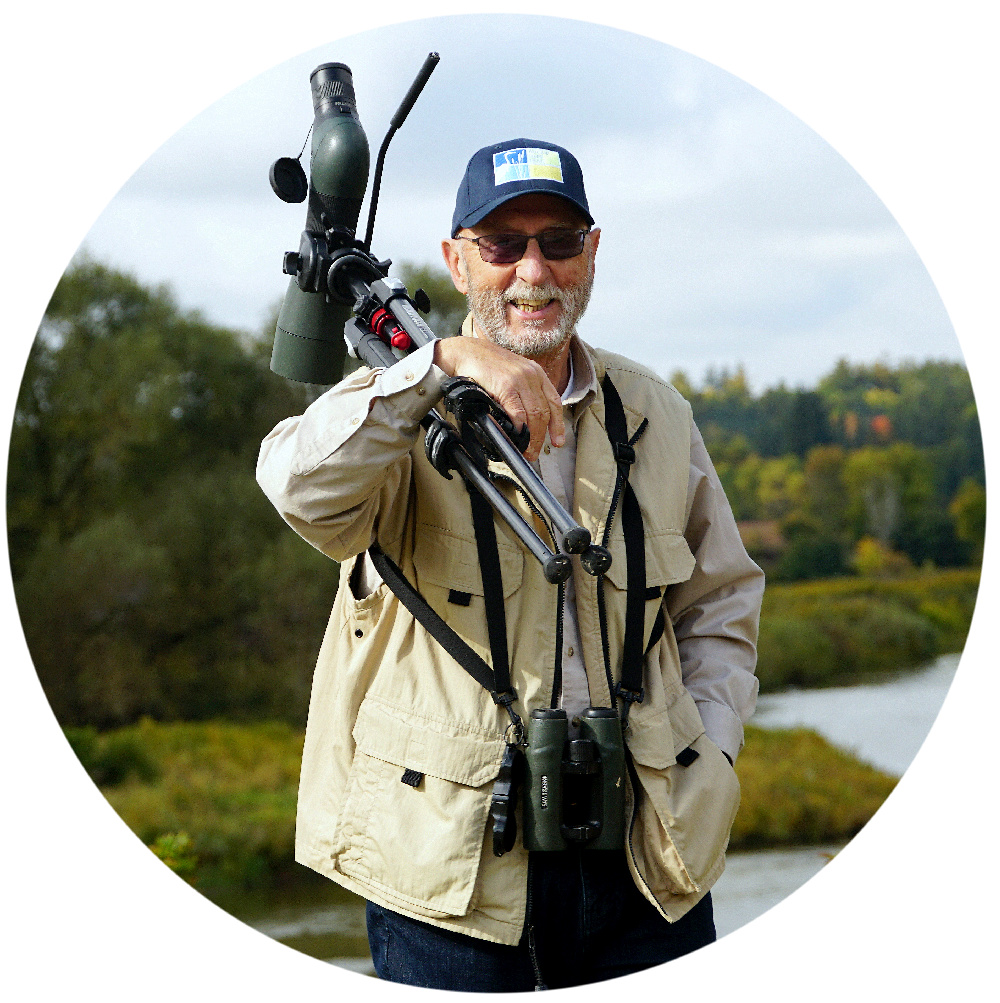


An excellent weather for a walk with diverse fauna.
ReplyDeleteWhat an amazing adventure, David. Nature is never boring, always fascinating and so much to enjoy and learn from.
ReplyDeleteI also love ❤️ that vintage car.
Wow! There are really a lot of pictures you are showing today, David! They are all so beautiful. The osprey is so beautifully captured. It must be amazing to see the large birds of prey that you have in Canada.
ReplyDeleteHugs and kisses, Marit
The sky view on the 2nd photo is breathtakingly beautiful, David. So many fascinating birds!
ReplyDeleteI will pass on your compliment to Miriam.
Delete...David, as always your nature images are gorgeous, but the '55/'56 Ford Crown Victoria take my breath away!!!
ReplyDeleteHard to believe that we all used to drive these dryland barges!
DeleteHari Om
ReplyDeleteI can recall many a birding day in which everything but was spotted... but that is part of the joy as every detail in nature becomes important! YAM xx
I bet a lot of birds might have migrated early because of the dryer conditions. Perhaps... I one went to listen to some talk about ospreys, and in our local area he said they migrate by late August. Hmm. You were lucky to see that one and your friend gets amazing photos. I haven't seen any grackle flocks (yet) this year, but boy, those are something to see. When I was in Greece my husband texted me a video because they landed in the trees around our house and they were freaking him out. I bet there were thousands of them. I have seen them fly over the and near the house before in the past too. It is something special. Have a super rest of your weekend. hugs-Erika
ReplyDeleteDavid, even though your group had a scarcity of birds at some locations, the variety that were captured made for an enjoyable viewing. The osprey is always amazing to see in action when capturing a meal. I have seen bird banding when we lived in VA, but never had the privilege of releasing one myself.
ReplyDeleteWhen I began reading, I thought it might be a short post, but you had some luck! Our Osprey are gone.
ReplyDeleteI truly enjoyed the post 💜 The pictures and also your humour. This was a good one: "Not a bird in sight, not a flap of wings, not a honk or a quack."
ReplyDeleteSome of your fauna looks different from ours in Finland, for instance I've never seen a squirrel like that, not that kind of passer domesticus.
Do you have tortoises or turtles in Canada?
We have several species of turtle in Canada, but no tortoises.
DeleteWhat a great program you had! You were able to be together and you ended up seeing a lot of birds. You were lucky and you had patience.
ReplyDeleteUnfortunately, I am not a bird expert. I like to watch and listen to them, but I only know the names of a few. I have many shortcomings but I like to learn. Your blog is one such place where I can do this.
There was a time when I sat on my balcony early in the morning on a summer day and listened to the birds. I didn’t want to miss this experience.
It was nice to follow your report and look at the pictures. Well-captured moments.
Éva
I'm sure it was quite disappointing not to find the birds throughout the regular areas. But you definitely hit a jackpot with the later spots. In general, the photos were terrific and there are some amazing ones...too many to list! Thanks for sharing!
ReplyDeletethank you David, and thanks to the others for continuing to this photo magical post. all the birds in flight are magical to me, the dive was amazing. my favorite today is the tiny bird on its back in the palm of her hand. I want to do that. the swallow nest is something I have never seen. wow. loved every single photo, even the midge, ha ha
ReplyDeleteWas für ein umfangreicher, großartiger Bericht eurer Vogel-Exkursion. Hoffentlich steckt kein ernsthafter Grund hinter der Abwesenheit der Vögel zu Beginn eurer Wanderung. Ich habe den ausführlichen Bericht sehr genossen und auch einiges gelernt. Besonders gut gefallen mir die Bilder mit der Möwe. Die Grackeln (Quiscalus quiscula) waren mir bisher völlig unbekannt. Inzwischen weiß ich, dass sie zu den Sperlingen gehören.
ReplyDeleteIm Dezember reise ich in die USA. Es ist das erste Mal. Vielleicht werde ich einen Fischadler sehen. Ich wünsche es mir sehr.
Anette
It will depend on which part of the USA you visit whether you see an Osprey. If you go to Florida, for example, it should be quite easy.
DeleteDave is a wizard with the camera, David. Why were there so few birds in the beginning? Any explanation for that?
ReplyDeleteOspreys are wonderful birds to watch. There is one at the lake and I have seen him catch his lunch several times now. It is such a gift to be witness of it.
Here it seems that Mute Swans have become a problem. It is allowed now to hunt and kill them without a permit because they threaten our native birds population. I'm not quite sure what to think of this. I haven't noticed very many Mute Swans here - there is just one at "my" lake and another one at a lake nearby. Apart from that I haven't seen any and can't quite understand the problem.
The birds in the mist nets - are they taken out of those nets quickly? Is it possible that they get hurt by getting caught in the nets? It looks a bit unpleasant. But holding a small bird in your hand and then letting it go must be a very special thing. Big hugs - Carola
I don't have a ready explanation for the paucity of birds, Carola, except to say that it is well documented that avian populations are in free fall everywhere. Every so often there seems to be an assault on Mute Swans (deliberately introduced by humans, by the way) and it seems to do little good to reduce their numbers. Birds from other areas move in to replace the birds that have been culled. It chills me to think that people are allowed to indiscriminately kill birds without a permit, and I would be willing to bet money that other birds are killed too. It is quite clear that many people are unable to correctly identify a large white bird as a Mute Swan, as distinct from a Trumpeter Swans, for example, or even egrets. The birds in the net are removed quickly and processed quickly. Very rarely a bird is injured, but most go on their way unscathed within minutes. Bird banding has produced volumes of information on bird movements over the years. The technology is a little antiquated now, but excellent training is provided for budding ornithologists. Abrazos y besos - David
DeleteWow! Good spots, and if there weren't birds at the beginning, I'm sure the ones that you saw later brought joy. Look at the beauty of that osprey! What a perfect feathered dinosaur. I also love the second and the third shot of the common tern.
ReplyDeleteYou had a great day no matter what!....Dave took great pictures!!.......Abrazotes, Marcela
ReplyDeleteHello David! what an intense experience; disappointment at first, then joy as everything began to unfold. Nature always fills our hearts. I loved your friendship, the small gestures, and even the osprey's clumsiness. Stories so vivid, amigo! i could almost feel the mosquitoes trying to bite me jeje!
ReplyDeleteGros bisous, have a great week ahead.
Lake Erie. What a coincidence. I'm on the other side, in Cleveland (actually the suburbs.) When I go to the shore I see mostly seagulls, but I'm sure you would see more.
ReplyDeleteMany years ago, my daughter and son-in-law, baseball fanatics, used to go to Cleveland to see The Cleveland Indians play.
DeleteA lot of lovely photos. The reflections in the water are beautiful. Don't care for the spider.
ReplyDeleteI love the Osprey Never seen that bird and love the duck landing on the water. How special that some were able to hold a bird We had that twice One time we had a silvereye who was stuck in the garage My husband took him out and we had a dove fly against the house. My husband made a cage for him (so the cat couldn't get to him) with food and the next day he had recovered and he held him in his hand, and he flew off.
ReplyDeleteThanks for taking care of the dove.
DeleteBeautiful series of photos, David.
ReplyDeleteIt was so much fun to go out with a group of people and take photos.
I enjoyed the photos.
I wish you a wonderful week.
Greetings Irma
Yes, birding can be a solitary activity, but it can also be a highly social one, and I always enjoy the company of my fellow naturalists.
DeleteMaravilloso el reportaje de esa salida con amigos ¡lo bien que lo pasáis en esos lugares viendo tantas aves! El águila pescadora en plena faena es increíble y muy buenas las bayas del Viburnum.
ReplyDeleteMuchos besos.
You had an incredibly wonderful trip with so much to see and photograph! Really stunning photos as well! There were a few interesting new birds for me, such as that beautiful red cardinalis cardinalis, the takeoff acceleration of the Lophodytes cucullatus was a magnificent photo, and I have always been interested in plants.
ReplyDeleteAll the best to You and greetings from Finland!
Wonderful photos David. That first one of you all with the reflection behind you is perfect :-D I like your new friend, the little spider :-D May it bring you luck :-D And I like the old car, I love when people take care and restore these old vehicles. :-D
ReplyDeleteAmong many lovely pictures my favorite is the one of the young White-crowned Sparrow. He looks as though he's posing for you.
ReplyDeleteHi David. In spite of the slow start you had a very successful day birding. I enjoyed how you describe the day. Your writing is brilliant. I have been apart of banding birds when I live in N. Idaho and was a Vet Tech. I was surprised at all of the cranes. Here, they seem to be loners. This was a wonderful post. Oh, yesterday I was looking out my upstairs window and there a hawk flew into my view, and then another. The vanished into the trees. A thrilling sight for me. Have a great day today.
ReplyDeleteSuch a beautiful place! it seems the gull is in good shape, well-feed.
ReplyDeleteLovely photos of the grey squirrel and the duck "walking" on the water.
Thank you so much for the wonderful photos, David, from your trip to Long Point on Lake Erie.
ReplyDeleteI'm especially delighted by the pictures of the white-tailed eagle hunting and the terns and gulls.
And Dave's photo of the duck walking on the water is particularly beautiful.
And of course, I'm absolutely thrilled by that huge flock of birds… I can hear their calls all the way here… My goodness, it must have been a magnificent sight!
Best regards and hug Viola
¡Qué suerte tienes, David!
ReplyDeleteMe ha hecho mucha gracia este comentario, ja ja ja:
Sin embargo, no tenía alas, ¡así que nos fuimos con apenas una segunda mirada!
También hay una nueva entrada de mariposas en mi blog.
¡Feliz día!
Really great photos. And many that unfortunately you don't see in Finland. Those warning signs are great.
ReplyDeleteNice report from your excursion and bird watching. I think you are a great leader there. Many great photos as well, and Mr Collins has taken some excellent photos. And that car.... wow !
ReplyDeleteEin schöner Ausflug in die Natur auch wenn nicht so viele Vögel zu sehen Waren ist es doch schön mir anderen Naturbegeisterten einen Tag zu verbringen.
ReplyDeleteGruß
Noke
Fabulous post and photographs ... what joy :)
ReplyDeleteAll the best Jan
David, you did end up with a good variety of birds.
ReplyDeleteWe saw upwards of 40-something species on our birding field trip for the naturalist group interns last Saturday in less than two and a half hours. Maybe all the birds have flown down here to the Texas Gulf Coast. lol
ReplyDeleteHi David,
ReplyDeleteIn the end, you did see some birds after all. Dave's white-tailed eagle is of course the favorite. Here in Germany, we're currently experiencing bird flu. Friends who wanted to photograph cranes at a lake told me that the cranes are falling dead from the sky. It's terrible.
Regards, Frank
Beautiful collective pictures ! Norfolk county is full of diversity ! Birds and others lovely critters !
ReplyDeleteIn Europe the number of birds is dropping...
Bonne journée et merci pour le partage !
Anna
Siempre te doy las gracias por tus publicaciones David. Entrar aquí es aprendes algo más de ornitología y saber de aves a que no vemos en nuestro entorno. Preciosa la foto del cardenal entre el verde y la del carbonero de cabeza negra.
ReplyDeleteBuen otoño y noviembre.
Un abrazo.
Hi David,
ReplyDeleteYou certainly experienced different sides of nature. It must have felt strange to notice that there really was nothing to be seen in some areas where you we used to enjoy an abundant amount of birds. Luckily there was enough left. Banding birds may look unpleasant, but as long as this is merely a contribution to science it is easy to accept. Anyway, you had your part of pleasant and successful trips in nature.
Greetings, Kees
That sign is a hoot, we had one with 'old hunter crossing' that was similar.
ReplyDeleteIt looks like you had success aside from the absence of birds that you should have seen.
Yes, it started out slow, but just being with these people was reward enough.
DeleteHello David :)
ReplyDeleteOnly my secong day back blogging and I am visiting my friends whom I have missed whilst I have been away. Your valued friendship means a great deal to me and I am very pleased to join other bloggers in admiration of your ever informative and the superb contents of your post. I'm so pleased your day's bird sightings increased as you moved from one location to another, but Dave's captures of the young Osprey in action and the Osprey close up are ace, in fact all his close up bird shots are lovely. Lots of spectacular images in your post David but none more so than the nest of the American Cliff Swallows. It must have taken them hours to built a nest like that. Thank you for the pleasurable moments I have just enjoyed.
As always hugs and kisses
Sonjia.
Hi David, You have a healthy-sized group!
ReplyDeleteDo they use the mist nets to band the birds?
Poor little Osprey. He's a handsome fellow. And he will get it figured out. Plenty of coaches to let him know how it's done;)
Thanks for sharing. I enjoyed the outing immensely.
The birds are ensnared in the mist nets and then removed to the banding station to be processed, i.e weighed, measurements taken, fat level checked etc., band installed, and then they are released.
DeleteI loved all the photos -- thanks to Dave for sharing his with you. And that spot looks great. Loved the views, the huts on the harbor. You are a chickadee whisperer, bringing them to your participants' hands. I know you think anyone could do it but I think they just come because of you!
ReplyDeleteI’m glad I visited your site. It felt like taking a relaxed walk alongside you on that trail. I shared your disappointment at the lack of birds early on — though I’ve never been on a formal birdwatching trip myself, I do pause to notice them whenever they cross my path.
ReplyDeleteI’ve learned the hard way that photographing birds is no easy task! There are quite a few shots in this post that I truly admire — especially the Tern’s descent and Bonaparte’s Gull.
If I may add one small observation — I was expecting a few bursts of vibrant colour amidst the calm tones.
Exciting stories about searching, keeping an eye out for birds... and ultimately discovering them. The observations in the pictures accompany the stories. And I feel a little sorry that the eagle was unlucky when fishing.
ReplyDeleteBut I'm sure he or she will learn, at least I hope so.
I enjoyed reading very much.
I am with Mary Ann.. I think it would be most enjoyable and informative to walk along with your birder groups... Birder or not !
ReplyDeleteI loved this post. It was certainly worthy of a second read... I enjoyed Dave's picture of the Swan rapidly exiting the water..great catch!! The picture of the "sheds" along the water was very colorful and would be a good water color subject.
I have noticed a decline of birds at my feeders this year. Less Finches, especially the gold Finches..almost none of the "out of the ordinary" birds.
A lovely group of smiling faces. You can just tell how much they enjoy these outings and must be great company. Your photos are as always a great pleasure to see, thank you David!
ReplyDeleteHello David, I am ashamed for responding so late on this blog. You are so productive it is amazing. And in this blog you show some great birds. Wow the Sandhill cranes, Osprey fishing super, the Ruby-crowned Kinglet so cute! There is so much to see where you are having your outings. It is just wonderful.
ReplyDeleteWarm regards from me and take care,
Roos
Querido amigo David, espero y deseo que no llegue por ahí la gripe aviar, por España parece que sí, llegaron hace poco las grullas y siento mucha tristeza de que puedan morir. Abrazos.
ReplyDeleteIt is a worry to be sure, Teresa. So far it is not widespread here in southern Ontario, and we hope it stays that way. Besos - David
Delete