16 February, 2023
Playa Larga - Trinidad
We were all sad to say goodbye to our kind, considerate, gentle hosts, of whom we had become very fond.
Jose, Sr., Damita, Jose, Jr.
But, it was time to move on and we had the renowned old colonial city of Trinidad, a UNESCO World Heritage Site, in our sights.
It is a remarkable place, with its ancient cobbled streets, and venerable old buildings; history oozing from its pores and Cuban life in all its varied manifestations thrumming all around.
Street musicians there would be worthy of a stage in Canada, such was their musical proficiency and sheer exuberance in what they did.
I think that Selwyn and I were singing Guantanamera for the rest of the day! You have never really heard it until you hear the full-throated joyful rendition of a couple of Cubans on warm, sunny day in Trinidad. We had our own personal tour guide in Mariana who is very knowledgeable about the city and its historic context.
Every minute of every day Mariana charmed us with her big smile, affectionate ways and her sheer exuberance for life. Her presence added so much to our experience of Cuba. I do not remember all that she told us about the various buildings, and the Cuban heroes who were so important in the development of the country, but the pictures below will give you the flavour of the place.
The Teatro Tomás Terry has been carefully and lovingly restored and is a cultural gem.
Old cars are part of the streetscape everywhere in Cuba, some so well preserved and restored as to defy belief.
But let it be remembered that we are a team of impassioned birders and nothing with wings escaped our attention. A Rock Dove (Columba livia), common the world over, nevertheless looked exceptionally splendid when bathed in sunlight atop an ancient tree.
Everyone got a good look at Cuban Martin (Progne cryptoleuca), initially as they wheeled above the streets and then when they came to rest.
Eurasian Collared Dove (Streptopelia decaocto) is conquering the world, and is quite at home in Cuba.
No doubt they are all happy to make Trinidad their home.
We were very happy to visit.
There were attractive murals to admire.
Ernesto (Che) Guevara remains an enduring hero of the Revolution and his memory is cherished and his legacy celebrated by Cubans.
We left downtown to visit a local arboretum. A classic Cuban scene presented itself as these hard-working people went about their business.
A grand sweep of palm trees heralded the entrance to the arboretum.
We were greeted by our friendly and very competent guide, a plant biologist working at the arboretum, whose name, sadly, I forget.
White Peacock (Anartia jatrophae) was quite common and this individual seems to have suffered from the rigours of flight or the perils of attempted predation.
The whimsical name of Shaving Brush Tree (Pseudobombax ellipticum), sometimes called the Dr. Seuss tree, is very descriptive of the flowers, in both pink and white versions.
Our arboretum guide was quite superb and provided lots of information on the trees we examined, but I cannot remember it all, not even the names in some instances. In this case a search has not helped me so all I can tell you is that this is a tree!
Bear in mind that this is an arboretum and trees from around the world are cultivated there. Buttercup Tree follows. There seems to be two scientific names in use for this plant, Cochlospernum religiosum or C. vitifolium. I am not sure which is in current usage so I am providing both.
As we all marched ahead, Lisa was glancing back to capture something that had caught her eye.
Fig Trees (Moraceae) were very interesting.
Our guide was anxious to show us the strength of their trailing branches and swung to and fro in an impressive display of physical fitness.
Lisa and Tina, the unsinkable Den Besten sisters, posed in the woods like sprites from a Hans Christian Andersen fairy tale.
Palms are magificent, numerous, exotic and appealing - and difficult for the uninitiated to identify as to species! You will have to be content knowing only that these fan-like beauties are in the family Arecaceae.
I do not recall specifically the function of these plastic covers on the branches, but I am assuming that it is a protective device against undesireable insects. It could also be a means of facilitating a graft and shielding the wound from pathogens.
Our guide was lamenting the fact that cattle frequently stray into the arboretum and eat just about anything they can reach, and it is becoming a serious problem. We saw evidence of this in several locations.
I am afraid that once again the following plant, beautiful though it is, has to remain unkown.
Victoria had been hoping for a good, solid look at Smooth-billed Ani (Crotophaga ani) and several were quite obliging and she was able to study them in detail.
More plants that I am unable to identify, I'm afraid.
This interesting structure is colloquially know as a monkey pot, apparently in reference to the tendency of monkeys in its South American home to attempt to breach its defences.
It is the empty seed pod of the Brazil Nut Tree (family Lecythidoideae), the familiar nuts having originally been nestled inside. They would make great nest boxes suitably mounted on a tree.
There is not a birder alive who does not love an owl, and even people generally not intimately concerned with nature, enjoy seeing them. On this visit to Cuba, Cuban Pygmy Owl (Glaucidium siju) was seen on no less than four occasions.
Another Smooth-billed Ani presented itself for study by Dr. Ho.
We saw this kind of waste receptacle quite often, and thought it a great use of natural material, and quite attractive in addition to being utilitarian.
People seemed to use it too and not toss their trash on the ground. Try not to be too shocked - here is another plant I am unable to identify.
Cuban Butterup (Turnera subulata) gave me no trouble at all!
Yellow Trumpet Flower (Tecoma stans) is equally captivating.
Spiderwort (Subfamily: Commelinoideae) of one variety or another was widespread.
We returned to Trinidad where we took lunch in a restarant that would not have been out of place on the Champs Elysée. Elegance, good taste and excellent service was personifed from start to finish. Miriam and I decided that a gin and tonic on a hot day was just the ticket, and that is what we had. Miriam shared a pizza with Mariana and I had a ham and cheese sandwich, with french fries cooked to perfection. Much as I made a very valiant effort to resist, and despite my protestations to the contrary, a slice of lava cake with ice cream appeared in front of me. What could I do but eat it, followed of course by delicious coffee. How do you spell satisfaction? - C U B A. After lunch we ventured into the countryside; my notes are scant as to what we saw, but here we are searching.
This lizard charmed us but I have been unable to identify it.
When we returned to Trinidad in late afternoon to claim our B&B Jiovani was unable to drive along the narrow cobbled street where it was located, so a horse and cart was pressed into service to deliver our luggage to the front door, and we walked alongside and behind, all the while finding interesting sights to occupy our attention.
One could easily imagine being transported back in time.
Our casa from the outside resembled all the other doors on the street, but once across the threshold it was a different story.
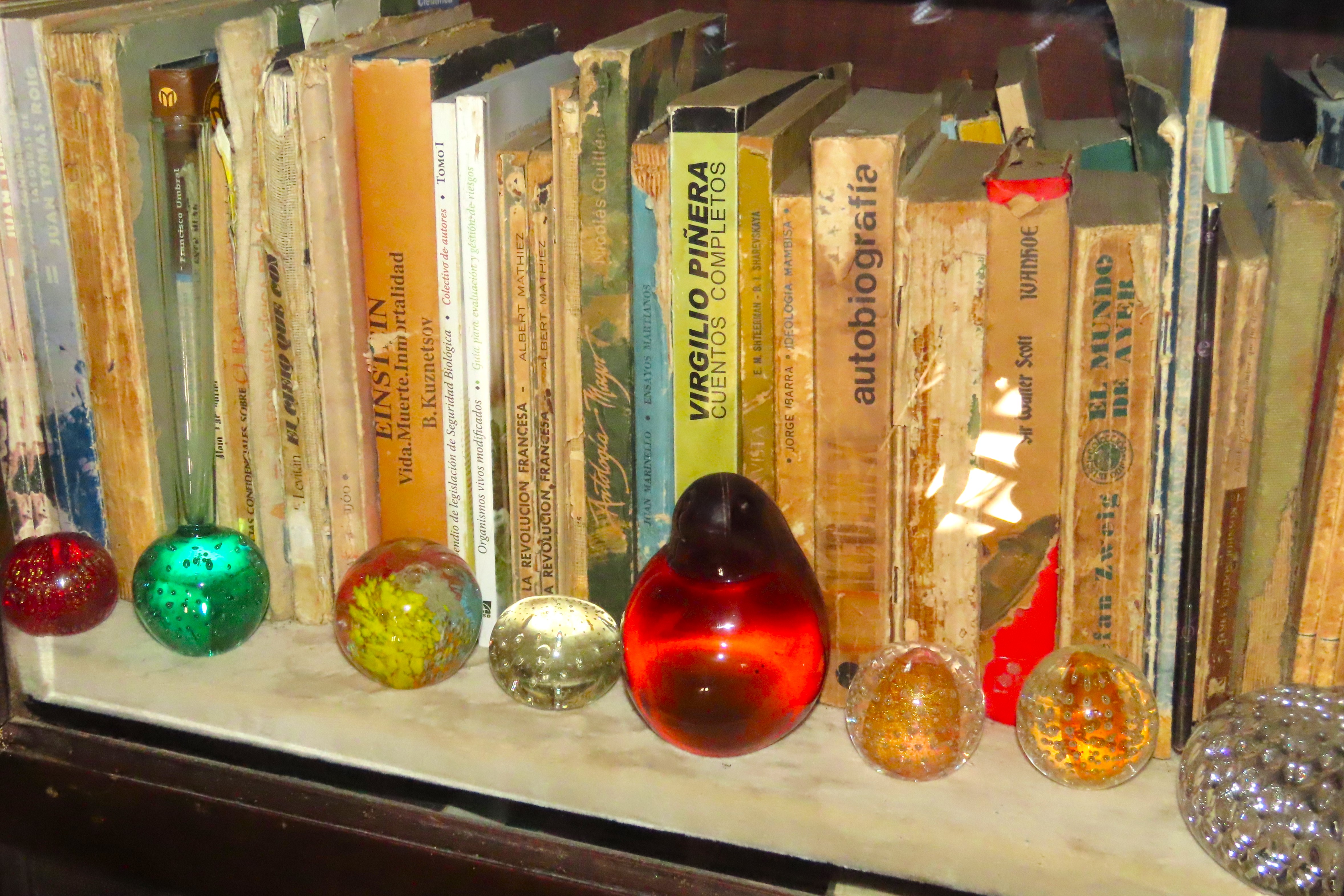
There was a fascinating collection of historical artifacts to rival a museum and a pleasant little courtyard. It was truly charming.
At one point this was no doubt a grand mansion with many rooms, now converted to serve the tourist trade. The level of dignified grandeur has been maintained, however, and our room was very comfortable.
As we had encountered elsewhere the ceilings were very high - around four metres would be my guess - to permit hot air to rise during the intense heat of the summer, I presume. We were able to climb up onto the roof and this was one of the views from that vantage point.
Tania had granted us an extended siesta until 17h:30 when we left to go for dinner, after enjoying a pleasant stroll through the city.
It staggers the imagination to contemplate the passage of history that these cobbled streets have witnessed.
At all times we had our beautiful Mariana to provide a narrative for us.
Here we are glancing skyward, at White-collared Swifts (Streptoprocne zonaris) I presume, many of which were feeding on insects high above our heads.
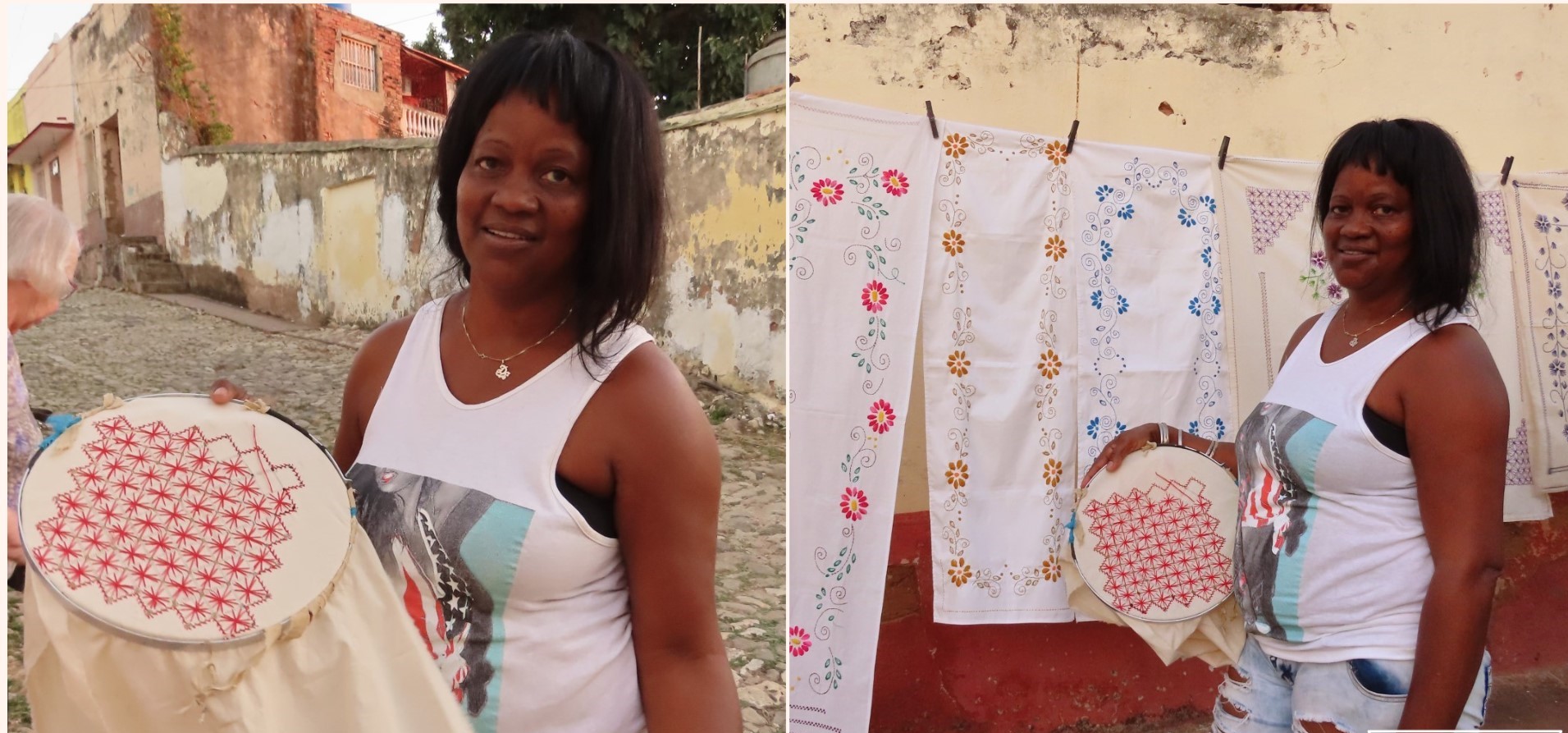
As we made our way through the streets, eyes darting hither and yon at every step along the way, this display of traditional Cuban craft caught Miriam's eye.
It is called pulled-thread embroidery, we believe and it is interesting, intricate and beautiful.
I would never claim for a moment that my knowledge of this kind of work approaches Miriam's, but when you are married to a quilter you learn to appreciate the creative process and the finesse of the end result. A lot of work is required to accomplish the perfection you see here, starting with considerable creative talent.
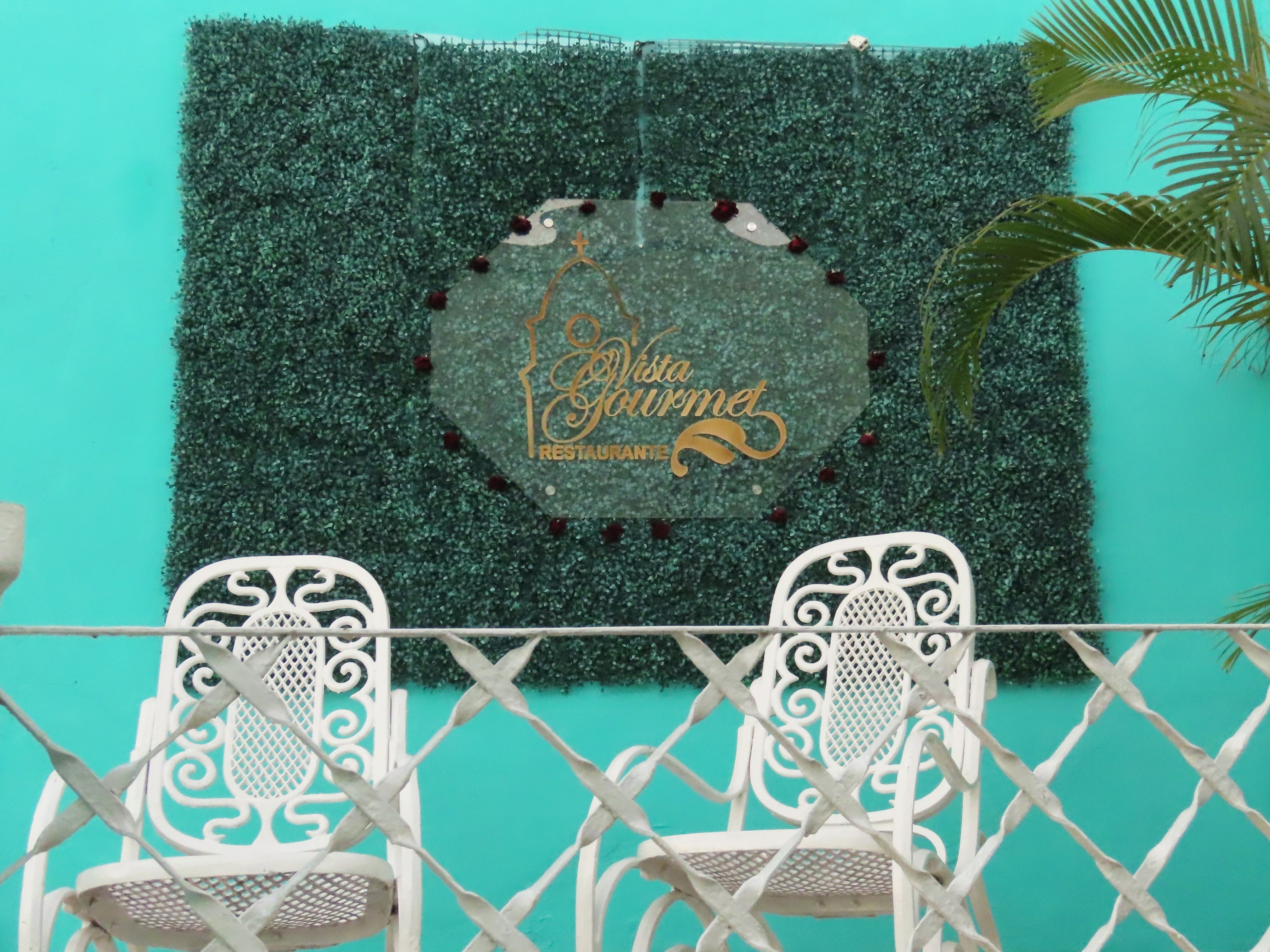
I kick myself for not having bought one. We went for dinner to the Vista Gourmet restaurant.
It had pretentions that were not quite realized, but was very pleasant nonetheless, and everyone enjoyed a fine meal. Another view of the city was an agreeable corollary to a splendid day in fine company.
We made our way back to our rooms as the city lights illuminated the streets, well content in every respect, with Victoria and Selwyn waltzing down the cobbled streets. Mary Oliver asked, "Tell me, what is it you plan to do with your one wild and precious life?" Maybe including a day or two in Cuba is not a bad start.